
Statistics surround us every day.
We encounter percentages, probabilities, survey results, economic indicators, and medical studies in news reports, social media posts, advertisements, and political debates. Because numbers appear objective and scientific, many people accept them without questioning what they actually mean.
However, statistics can be surprisingly misleading when presented without context.
A single percentage may sound convincing, yet it can lead to completely incorrect conclusions if we fail to consider the underlying probabilities. One of the most powerful mathematical tools for understanding this phenomenon is Bayes’ Theorem.
In this article, we will examine a simple example that demonstrates why an apparently reliable statistic may not mean what most people think it means.
A Medical Test That Seems Almost Perfect
Imagine a disease that affects only 1% of the population.
Now suppose that scientists have developed a medical test with the following characteristics:
- The test correctly identifies an infected person 99% of the time.
- The test correctly identifies a healthy person 99% of the time.
At first glance, this sounds extremely reliable.
If your test result comes back positive, you might naturally assume that there is about a 99% chance that you actually have the disease.
Surprisingly, that conclusion is wrong.
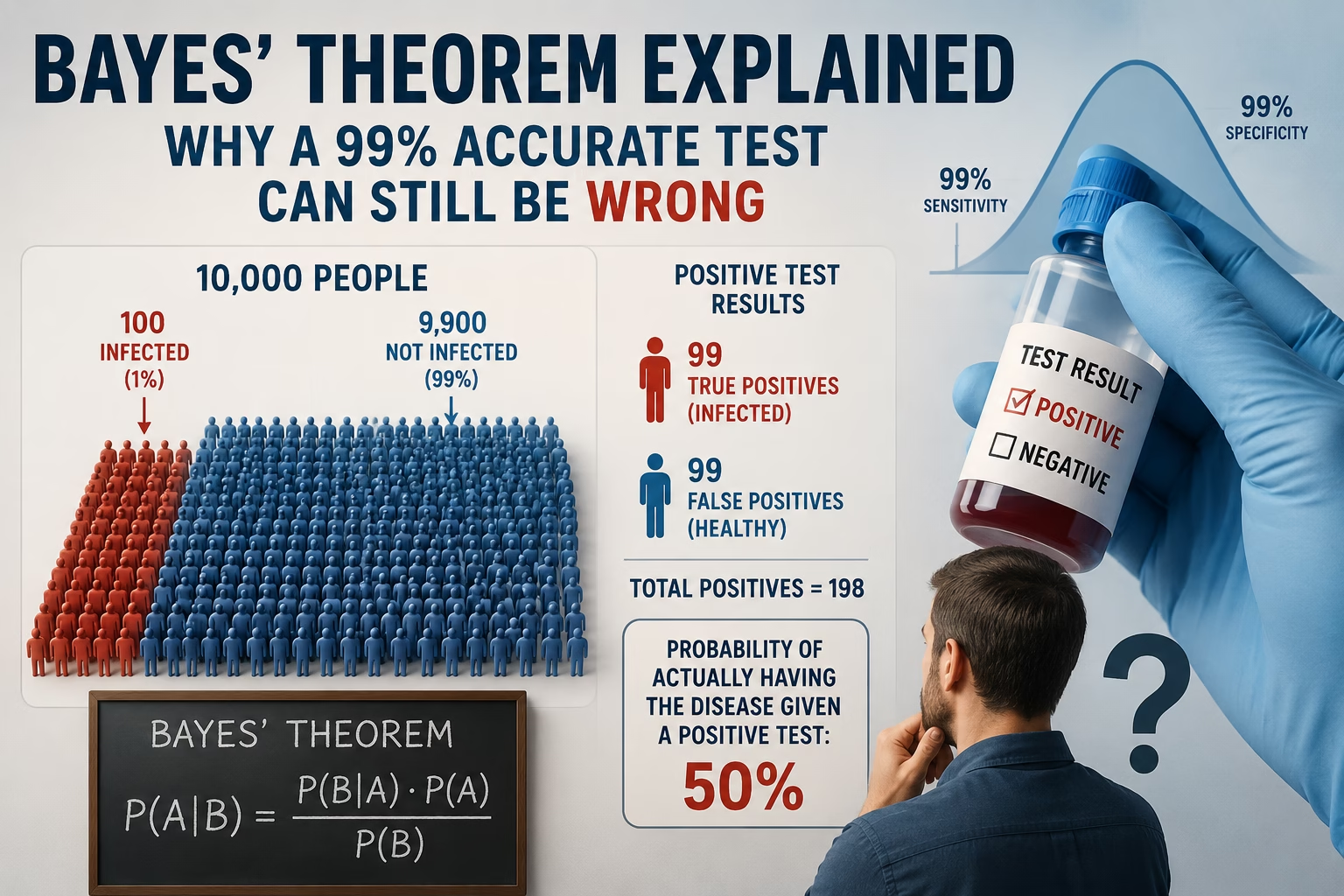
Looking at 10,000 People
To understand why, let us imagine testing 10,000 individuals.
Since the disease affects 1% of the population:
- 100 people actually have the disease.
- 9,900 people do not have the disease.
What Happens to the Infected Group
The test correctly identifies 99% of infected individuals.
Therefore:
- 99 infected people receive a positive result.
- 1 infected person receives a false negative result.
What Happens to the Healthy Group
The test incorrectly produces a positive result for 1% of healthy individuals.
Therefore:
- 99 healthy people receive a false positive result.
- 9,801 healthy people receive a correct negative result.
The Surprising Result
Now let us focus only on people who received a positive test result.
Among all positive results:
- 99 people are truly infected.
- 99 people are actually healthy.
Therefore:
- Total positive results = 198
The probability that a person is genuinely infected given a positive test result is:
99 / 198 = 0.5
or
50%
This means that even though the test is 99% accurate, a positive result indicates only a 50% chance of actually having the disease.
For many people, this conclusion feels counterintuitive.
Yet it is mathematically correct.
Bayes’ Theorem
The explanation comes from Bayes’ Theorem, developed by the English statistician and philosopher Thomas Bayes in the 18th century.
The theorem is given by:
P(A|B) = [P(B|A) ⋅ P(A)] / P(B)
where:
- P(A|B) is the probability that event A is true given that B has occurred.
- P(B|A) is the probability that B occurs when A is true.
- P(A) is the prior probability of A.
- P(B) is the overall probability of B.
In our example:
- A = the person has the disease
- B = the test result is positive
The crucial factor is the disease prevalence.
Even an excellent test can generate a surprisingly large number of false positives when the disease itself is rare.
Applying Bayes’ Theorem to the Example
Using the values from our scenario:
- P(A) = 0.01
- P(B|A) = 0.99
- P(B|¬A) = 0.01
Bayes’ Theorem becomes:
P(A∣B) = (0.99 ⋅ 0.01) / (0.99 ⋅ 0.01 + 0.01 ⋅ 0.99) = 0.5
which confirms the result obtained through direct counting.
Why This Matters Beyond Medicine
The importance of Bayes’ Theorem extends far beyond medical testing.
The same principle appears in:
- Scientific research
- Economic forecasts
- Election polling
- Risk assessment
- Machine learning and artificial intelligence
- Criminal investigations
- Media reporting
In many situations, people focus on a single statistic while ignoring the underlying base rate.
This mistake is known as the base rate fallacy.
When background probabilities are neglected, even accurate statistics can produce misleading interpretations.
Statistics Without Context Can Be Dangerous
Numbers do not automatically tell the whole story.
A statement such as:
- “Success rate increased by 200%”
- “The risk doubled”
- “The test is 99% accurate”
- “Support increased by 10%”
may sound impressive or alarming.
However, without knowing the underlying context, sample size, methodology, and prior probabilities, such statements can be highly misleading.
This is why critical thinking is essential whenever statistics are presented in news reports, advertisements, political discussions, or social media posts.
Conclusion
Bayes’ Theorem teaches an important lesson:
Statistics are meaningful only when interpreted within their proper context.
A medical test can be 99% accurate and still provide only a 50% probability that a person actually has a disease. The apparent paradox disappears once we consider the prevalence of the disease and apply Bayesian reasoning correctly.
The next time you encounter a striking statistic, do not focus solely on the number itself.
Ask an additional question:
What is the underlying probability behind it?
Very often, the answer completely changes the conclusion.