
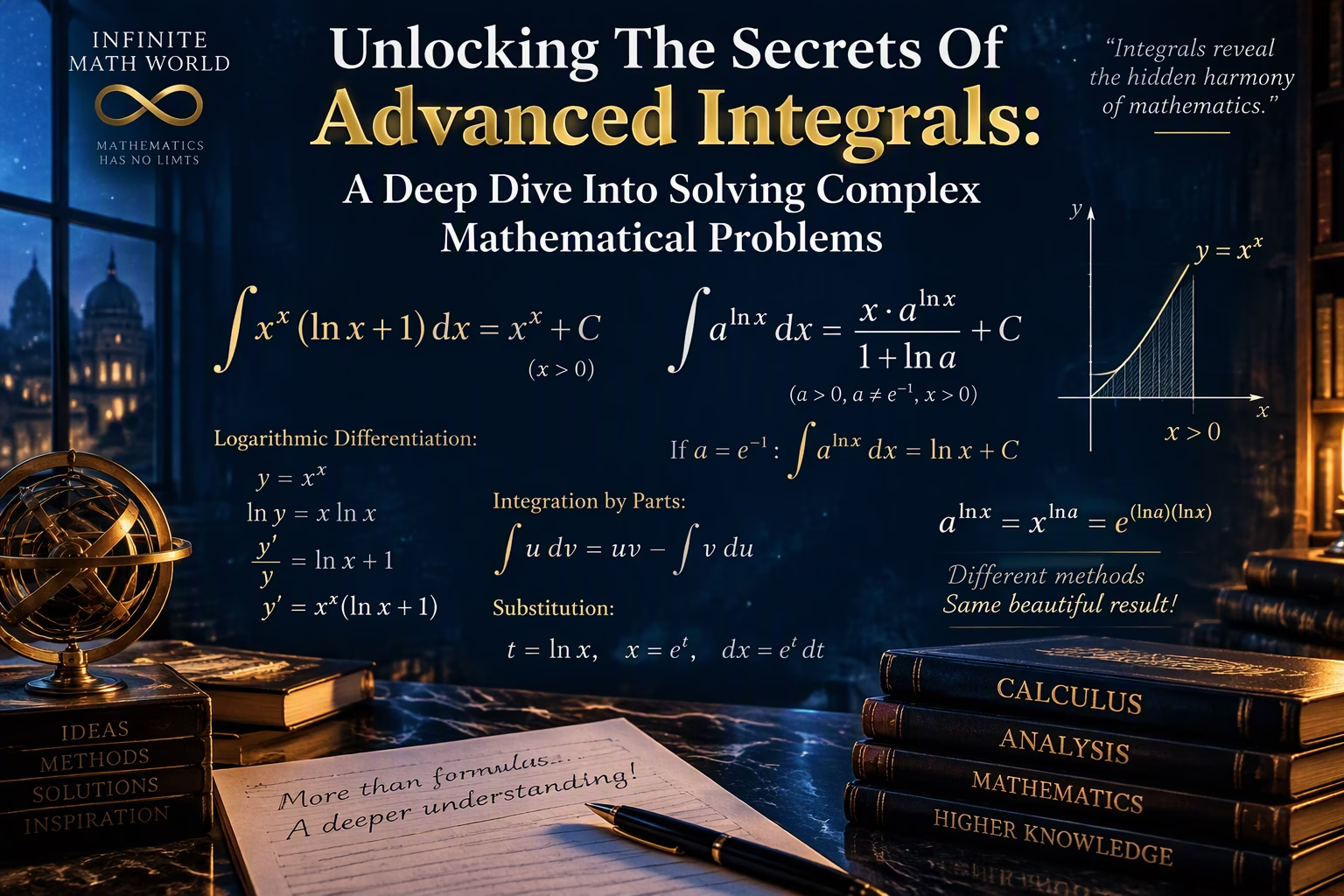
Introduction
Advanced integrals often appear intimidating because their solutions are not immediately visible through standard formulas. However, many seemingly difficult integrals become surprisingly elegant once their hidden structure is recognized.
In calculus, successful integration frequently depends not on memorizing formulas but on identifying relationships between functions and their derivatives. This article explores two particularly instructive examples:
∫xˣ(lnx + 1)dx
and
∫aˡⁿˣdx
Through logarithmic differentiation, substitution, integration by parts, and direct verification, we will uncover the mathematical principles that make these integrals solvable.
For readers who would like to review the fundamentals before continuing, the concepts discussed here build naturally upon Understanding the Basics: An Introduction to First Derivatives and Integrals and Understanding the Basics of Logarithms: A Beginner’s Guide.
Why Advanced Integrals Are Challenging
Recognizing Hidden Structures
Many advanced integrals cannot be evaluated by directly applying a memorized rule.
Instead, one must determine whether:
- the integrand is itself a derivative of a familiar function
- a logarithmic transformation can simplify the expression
- substitution converts the problem into a standard form
- integration by parts produces a solvable equation
The examples below illustrate all of these techniques.
Solving ∫xˣ(lnx + 1)dx
Step 1: Examine the Function xˣ
Let
y = xˣ
Since x appears in both the base and exponent, ordinary differentiation rules do not apply directly.
Taking natural logarithms of both sides yields
ln y = x ln x
For real-valued analysis, we assume
x > 0
because ln(x) is defined only for positive x.
Step 2: Apply Logarithmic Differentiation
Differentiating both sides with respect to x gives
d/dx(ln y) = d/dx(x ln x)
Using the chain rule and the product rule,
y′/y = ln x + x·(1/x)
which simplifies to
y′/y = ln x + 1
Multiplying both sides by y:
y′ = y(ln x + 1)
Since y = xˣ,
d/dx(xˣ) = xˣ(ln x + 1)
Step 3: Recognize the Integrand
Notice that the integrand is precisely the derivative we have just computed:
xˣ(ln x + 1) = d/dx(xˣ)
Therefore,
∫xˣ(ln x + 1)dx = xˣ + C
where C is the constant of integration.
Step 4: Verification
Differentiating the proposed antiderivative:
d/dx(xˣ + C) = xˣ(ln x + 1)
which exactly reproduces the original integrand.
Therefore,
∫xˣ(ln x + 1)dx = xˣ + C
is confirmed.
Connection with Exponential Functions
Another way to understand this result is to observe that
xˣ = eˣˡⁿˣ
The derivative then follows directly from the chain rule:
d/dx(eˣˡⁿˣ) = eˣˡⁿˣ(ln x + 1) = xˣ(ln x + 1)
Readers interested in the remarkable properties of e may also enjoy The Number e: Exploring Its Definitions, Properties and Significance.
Solving ∫aˡⁿˣdx
Now consider
∫aˡⁿˣdx
where a is a positive constant.
We assume
a > 0
and
x > 0
to ensure that ln(a) and ln(x) are defined in the real number system.
Method 1: Converting the Integrand into a Power Function
A Useful Identity
Using
aᵘ = eᵘˡⁿᵃ
we obtain
aˡⁿˣ = e^(lnx·lna)
Since multiplication is commutative,
aˡⁿˣ = e^(lna·lnx)
which implies
aˡⁿˣ = xˡⁿᵃ
Thus,
∫aˡⁿˣdx = ∫xˡⁿᵃdx
Applying the power rule gives
∫xⁿdx = xⁿ⁺¹/(n + 1) + C
with
n = ln a
Therefore,
∫aˡⁿˣdx = x¹⁺ˡⁿᵃ/(1 + ln a) + C
or equivalently,
∫aˡⁿˣdx = x·aˡⁿˣ/(1 + ln a) + C
provided that
1 + ln a ≠ 0
Exceptional Case: a = e⁻¹
The formula above breaks down when
1 + ln a = 0
which occurs when
a = e⁻¹
In this case,
aˡⁿˣ = (e⁻¹)ˡⁿˣ = e⁻ˡⁿˣ = 1/x
Hence
∫aˡⁿˣdx = ∫1/x dx = ln x + C
This special case deserves explicit mention because many textbook solutions overlook it.
Method 2: Integration by Parts
Let
u = aˡⁿˣ
dv = dx
Then
v = x
and
du = aˡⁿˣ·(ln a)/x · dx
Applying
gives
∫aˡⁿˣdx = x·aˡⁿˣ − ln(a)∫aˡⁿˣdx
Moving the integral terms to one side:
(1 + ln a)∫aˡⁿˣdx = x·aˡⁿˣ
Therefore,
∫aˡⁿˣdx = x·aˡⁿˣ/(1 + ln a) + C
for
a ≠ e⁻¹
Method 3: Substitution
Let
t = ln x
Then
x = eᵗ
dx = eᵗdt
The integral becomes
∫(aᵗ)(eᵗ)dt
Using
aᵗ = eᵗˡⁿᵃ
we obtain
∫eᵗ(¹⁺ˡⁿᵃ)dt
Integrating,
eᵗ(¹⁺ˡⁿᵃ)/(1 + ln a) + C
Substituting back t = ln x yields
x·aˡⁿˣ/(1 + ln a) + C
which agrees with the previous methods.
Verification of the Result
To verify,
F(x) = x·aˡⁿˣ/(1 + ln a)
Differentiate:
F′(x) = [aˡⁿˣ + x·aˡⁿˣ·ln(a)/x]/(1 + ln a) = aˡⁿˣ[1 + ln(a)]/(1 + ln a) = aˡⁿˣ
Thus the solution is correct.
Common Mistakes
Forgetting the Domain
Because logarithms are involved,
x > 0
must always be specified.
Ignoring the Special Case a = e⁻¹
The formula
x·aˡⁿˣ/(1 + ln a)
fails when
a = e⁻¹
because the denominator becomes zero.
Omitting Verification
One of the most powerful habits in calculus is verifying an antiderivative by differentiation.
A correctly differentiated result should reproduce the original integrand exactly.
Conclusion
Advanced integrals often appear difficult only because their underlying structure is hidden. The integral
∫xˣ(ln x + 1)dx
becomes trivial once the derivative of xˣ is recognized, while
∫aˡⁿˣdx
can be evaluated through algebraic transformation, substitution, or integration by parts.
These examples demonstrate a fundamental principle of calculus: the most powerful integration technique is often a deep understanding of differentiation itself.
Hi Slavisa. I remember when I first encountered integrals — they were a serious challenge for me! This page does an awesome job breaking things down and explaining the logic behind solving complex integrals. It really helps demystify a topic that can feel intimidating at first.
In my younger days, as a graduate engineer, integrals were everywhere. Integral calculus plays such a crucial role in areas like physics (calculating motion, work, and energy), economics (finding cost and revenue over time), engineering (modeling stress or fluid flow), and even in probability and statistics.
Thanks for putting together a clear and informative guide — it definitely would’ve saved me some headaches back in the day!
This was such a helpful breakdown—advanced integrals usually feel way out of reach, but the way you explained each step made it feel manageable. I especially liked how you connected it back to differentiation; that really helped the concept stick. It’s reassuring to see that even complex-looking problems can have elegant solutions once you know what to look for. Do you have a list of similar integrals that follow this kind of “reverse engineering” approach? Would love to try a few more like these.
Thank you so much for your thoughtful feedback. I’m really glad to hear the breakdown helped make advanced integrals feel more approachable! You’re absolutely right: many seemingly intimidating integrals become much more manageable when we reverse-engineer them using differentiation as a guide.
As for similar integrals that lend themselves to this kind of approach, here are a few you might enjoy exploring:
∫x^x dx – A classic that’s closely related to the one we solved. It’s not elementary in a strict sense but examining it through derivatives or approximations can reveal a lot
∫(ln(x))^x dx – Involves combining logarithmic and exponential rules, often best handled through substitution and understanding the inverse relationship with differentiation
∫x^a * ln(x) dx – A great candidate for integration by parts and connecting it back to the power rule and properties of logarithms
∫e^(x ln(x)) dx – This one looks tricky at first glance, but if you rewrite the integrand and apply substitution, it ties back to known derivatives quite elegantly
∫ln(x)/x dx – A more elementary one, but it’s a classic example of reverse engineering since you’re really looking for the antiderivative of a known derivative
Hi Slavisa,
This time you had me on a loop it took me sometime understand thanks to the step-by-step breakdowns not only explain the “how” but also the “why” behind each method, which is incredibly helpful. I particularly appreciated the clear use of differentiation and integration by parts it’s a great reminder of how foundational techniques can tackle even advanced problems. You did a great job verifying each result, which reinforces both accuracy and understanding. How can we encourage students to view these integrals not as barriers but as puzzles to explore?
Thank you so much for the kind words! I’m really glad the step-by-step approach helped clarify the methods. You raise a fantastic question – changing how students perceive complex integrals is so important. I think one key is framing these problems as intellectual challenges rather than hurdles. By emphasizing pattern recognition, logical structure, and the elegance behind each method, we can show that integrals are more like intricate puzzles than roadblocks. Visual aids and interactive tools can also help bring abstract concepts to life.
The topic “Unlocking The Secrets Of Advanced Integrals” is both intellectually rich and practically valuable, especially for students and enthusiasts aiming to deepen their calculus skills. It smartly tackles two challenging integrals—∫x^x[ln(x) + 1]dx and ∫a^ln(x)dx—using elegant strategies such as logarithmic differentiation, substitution, and integration by parts. What makes the piece particularly compelling is its clear step-by-step exposition and thoughtful emphasis on verification, which reinforces conceptual understanding. Additionally, it bridges theoretical math with applicable problem-solving skills, making it an excellent resource for learners seeking both clarity and rigour in tackling advanced integral calculus.
Looking forward for more informative posts.
Dear Slavisa,
Thank you for sharing your thoughts on the article “Unlocking the Secrets of Advanced Integrals: A Deep Dive Into Solving Complex Mathematical Problems”
The author’s approach to demystifying complex integrals, particularly the example of ∫x^x[ln(x)+1]dx, is commendable. By breaking down the problem using logarithmic differentiation and the chain rule, the article provides a clear pathway through a challenging topic. This method not only enhances understanding but also showcases the elegance of calculus when approached systematically.
The inclusion of visual aids, such as the digital blackboard annotations, further aids in comprehension, making abstract concepts more tangible.
I’m curious, have you explored other unconventional integrals or functions that defy standard techniques? It would be fascinating to see how similar methodologies could be applied to those problems.
Looking forward to your insights!
Sincerely,
Steve
Dear Steve,
Thank you for your thoughtful comment and encouraging words! I’m glad you appreciated the breakdown of ∫x^x[ln(x)+1]dx. It’s a great example of how differentiation can reveal elegant solutions when integration gets tricky.
Yes, I’ve been exploring other unconventional integrals that require creative approaches, especially those involving expressions like x^x, inverse trigonometric compositions, and even integrals involving special functions. I plan to cover more of these in future posts, continuing with the same balance of rigor and clarity.
Stay tuned, and thanks again for the engaging feedback!
Best regards,
Slavisa
I’ve found advanced integral techniques—like substitution, integration by parts, partial fractions, and handling improper integrals—transform seemingly impossible problems into manageable ones. Personally, visualizing the perpendicular drop from a point to a curve or the step-by-step deconstruction using substitution really helped me grasp the process. In my opinion, the elegance of these methods lies in their ability to break complex math into clear stages, though many students struggle with recognizing which technique to apply first. Have you found any tricks—like flowcharts or color-coded notes—that helped identify the right integration method more quickly?
Thank you for your thoughtful comment! I completely agree, advanced techniques like substitution, integration by parts, and partial fractions truly reveal the elegance of calculus when applied correctly. Your point about breaking down problems step by step resonates deeply, especially for students who find the sheer variety of techniques overwhelming at first.
As for your question about tricks – yes, I’ve found that using a flowchart-style decision tree can be incredibly helpful when determining which integration method to apply. For example:
Is the integrand a product of functions? → Try integration by parts.
Is it a rational function? → Consider partial fractions.
Is there a composite function or inner function? → Look into substitution.
Does it involve square roots of quadratic expressions? → Think about trigonometric substitution.
Improper bounds or discontinuities? → Be ready for improper integrals.
Color-coding notes is also a great idea, especially when you’re dealing with long chains of substitutions or integration by parts. For instance, using one color for u, another for dv, and a third for the resulting integrals helps keep the structure visible and avoids mix-ups.
Ultimately, recognizing patterns in integrals comes with exposure and practice, but tools like these definitely speed up the learning curve. Thanks again for adding such valuable insight to the discussion!
What a clear and insightful walkthrough of two really tricky integrals! I especially appreciated how you showed the link between differentiation and integration for the ∫ xˣ[ln x + 1] dx case—it makes perfect sense why it collapses back to xˣ + C once you see the derivative. And your alternative substitution and integration‑by‑parts derivation for ∫ aˡⁿ⁽ˣ⁾ dx is super helpful, too—it’s great to see both the direct and the t = ln x approaches side by side. Thanks for demystifying these advanced techniques with such clear, step‑by‑step explanations!
This article offers valuable insights into mastering complex integrals through detailed, step-by-step explanations, essential for advancing calculus skills. I recommend your website to anyone wanting to learn calculus, as your website is easy to follow along and learn with just as if in a real classroom setting. I will be sharing your website with my social media followers as have lots of friends still attending college.
Hello Slavisa!
This is a fantastic exploration of advanced integrals—thank you for diving so deeply into what can often feel like an untamed and intimidating topic.
I especially appreciated how you broke down techniques like integration by parts, substitution, and contour integration into clear, step-by-step explanations. My own experience with tricky integrals was forever changed the first time I saw a complex substitution simplify an impossible-looking problem. Your examples felt like that “aha” moment all over again.
I also loved the sections on special integrals involving trigonometric and exponential functions—seeing those patterns emerge reminded me why I loved higher math in the first place in high school. It’s encouraging to see such detailed guidance—it gives me confidence to go back and tackle those integral challenges I once avoided.
Thanks for making deep math feel accessible and even a bit fun. I can’t wait to apply some of these strategies to my own problem sets!
Angela M 🙂
As someone who’s worked through advanced calculus and occasionally assists tutoring sessions, I’ve seen many students struggle when standard formulas no longer apply. Problems like ∫x^x[ln(x)+1]dx force you to think beyond rote memorization. I remember the first time I encountered x^x in a derivation problem—realizing the power of using logarithmic differentiation was a lightbulb moment.
Also, I’ve personally found that visualizing the integral’s behavior (graphically or numerically) before diving into algebra helps guide which method to try—especially when integrals involve exponentials or logs in unusual positions.
This article is a fantastic deep dive into the kind of calculus that usually gets brushed aside in favor of simpler problems. It bridges the gap between procedural math and creative problem-solving, which is often where advanced calculus shines. The author strikes a good balance between rigor and accessibility, especially by showing full derivations rather than shortcuts.
I’d love to see future articles expand on related complex integrals, perhaps involving limits, improper integrals, or multivariable applications. Overall, this was a well-written and very helpful read for anyone looking to level up their calculus understanding!
However, i have a few questions for the topic.
Could the article also touch on when or how often these types of integrals appear in real-world applications like physics or engineering?
For the substitution method used in solving ∫a^ln(x)dx, are there scenarios where substitution might be more effective than integration by parts—or vice versa?
In the solution of ∫x^x[ln(x)+1]dx, are there related forms of x^x integrals (like involving limits or definite bounds) that are worth exploring in advanced coursework?
Thanks for the thoughtful comment!
Real-world applications: Integrals like these appear in theoretical physics, information theory, and complex modeling, especially in systems with exponential/logarithmic growth, entropy, or custom probability distributions.
Substitution vs. integration by parts: Substitution is often simpler when the structure matches a derivative; integration by parts is more versatile when dealing with products. In this case, both work, but substitution gives a cleaner path.
Related forms of x^x: Definitely worth exploring! For example, the definite integral ∫ [0 to 1] x^x dx is famous and evaluated numerically. Extensions with limits or multivariable setups can reveal even deeper insights.