
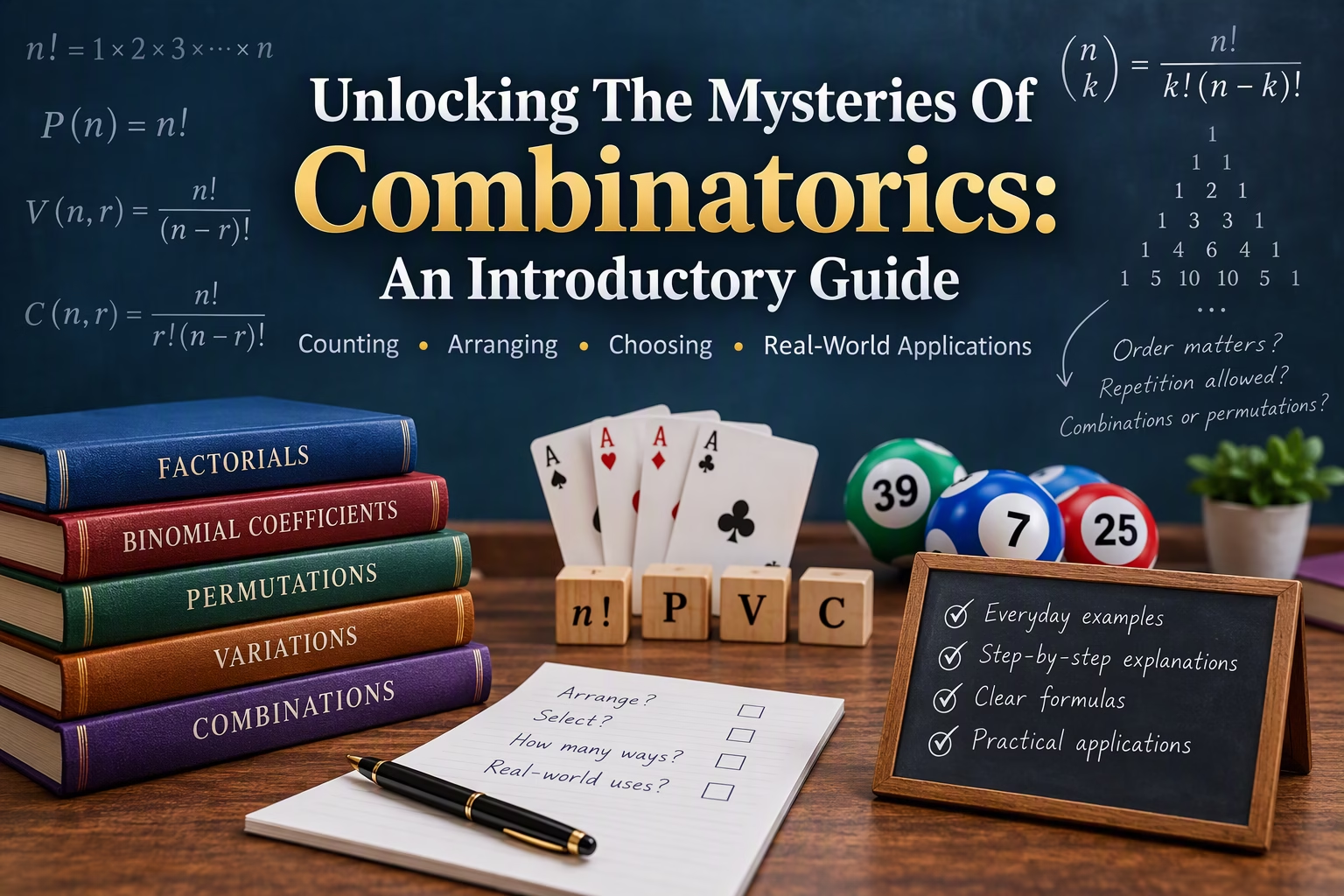
Combinatorics is the branch of mathematics concerned with counting, arranging, and selecting objects according to clearly defined rules. It provides systematic methods for answering questions such as:
- How many different passwords can be created from a given set of characters
- In how many ways can books be arranged on a shelf
- How many committees can be selected from a group of people
- What are the odds of choosing a winning combination in a lottery
Although such problems may initially appear unrelated, they are governed by a small number of powerful principles. By understanding factorials, binomial coefficients, permutations, variations, and combinations, we can solve a remarkably wide range of counting problems without listing every possibility individually.
What Is Combinatorics
Combinatorics studies finite or countable structures and the different ways in which their elements can be selected, grouped, or arranged.
At the introductory level, most combinatorial problems can be classified by answering three questions:
- Are all available elements used, or only some of them
- Does the order of the selected elements matter
- Is repetition allowed
These questions determine whether the appropriate method involves a permutation, variation, or combination.
The Fundamental Principle of Counting
Before introducing the standard formulas, we need two basic counting principles.
The Addition Principle
If one task can be completed in m ways and another mutually exclusive task can be completed in n ways, then choosing one of the two tasks can be done in:
m + n
ways.
For example, if a student may choose one of 5 mathematics books or one of 3 physics books, then the student has:
5 + 3 = 8
possible choices.
The Multiplication Principle
If a process consists of several successive stages, and each stage can be completed independently in a certain number of ways, then the total number of outcomes is the product of those numbers.
If the first stage can be completed in m ways and the second in n ways, then the complete process can be performed in:
m × n
ways.
For example, if a restaurant offers 4 main courses and 3 desserts, the number of possible main-course-and-dessert selections is:
4 × 3 = 12
The multiplication principle forms the foundation of most formulas in elementary combinatorics.
Factorials
Definition of a Factorial
For a positive integer n, the factorial of n, written n!, is the product of all positive integers from 1 to n:
n! = 1 × 2 × 3 × ⋯ × (n − 1) × n
Equivalently:
n! = n × (n − 1) × (n − 2) × ⋯ × 2 × 1
For example:
5! = 5 × 4 × 3 × 2 × 1 = 120
Factorials grow extremely rapidly. Even relatively small values of n produce very large numbers:
6! = 720
10! = 3,628,800
20! = 2,432,902,008,176,640,000
Why Is 0! Equal to 1
By definition:
This convention is not arbitrary. It ensures that many combinatorial formulas remain valid when zero elements are selected.
For example, there is exactly one way to arrange no objects: the empty arrangement. Similarly, there is exactly one way to choose zero objects from a collection.
The recursive factorial identity gives the same result:
1! = 1 × 0!
Since 1! = 1, it follows that:
0! = 1
The Recursive Property of Factorials
Factorials satisfy the recurrence relation:
n! = n × (n − 1)!
For example:
5! = 5 × 4! = 5 × 24 = 120
This identity is frequently used to simplify expressions involving factorials.
For a more detailed examination of factorials, including their properties, growth, and mathematical significance, read Exploring the Fascinating World of Factorials.
Binomial Coefficients
Definition of the Binomial Coefficient
The binomial coefficient, read as “n choose k”, counts the number of ways to select k elements from a set of n distinct elements when order does not matter and repetition is not allowed.
It is written as C(n, k) and defined by:
C(n, k) = n! ÷ [k! × (n − k)!]
where:
0 ≤ k ≤ n
Another widely used notation is:
(n choose k)
Example: Choosing Four Objects from Seven
The number of ways to choose 4 objects from a set of 7 distinct objects is:
C(7, 4) = 7! ÷ [4! × 3!]
Canceling common factorial factors gives:
C(7, 4) = (7 × 6 × 5) ÷ (3 × 2 × 1)
Therefore:
C(7, 4) = 210 ÷ 6 = 35
There are 35 different four-element subsets of a seven-element set.
Symmetry of Binomial Coefficients
Binomial coefficients satisfy the important identity:
C(n, k) = C(n, n − k)
This identity has a simple combinatorial interpretation. Choosing k elements to include is equivalent to choosing the remaining n − k elements to exclude.
For example:
C(7, 4) = C(7, 3) = 35
Binomial Coefficients and Pascal’s Triangle
Binomial coefficients appear in Pascal’s triangle. Each interior number is the sum of the two numbers directly above it.
This gives Pascal’s identity:
C(n, k) = C(n − 1, k − 1) + C(n − 1, k)
The identity can be understood by considering a particular element. A selected group either contains that element or does not contain it.
Binomial Coefficients in the Binomial Theorem
Binomial coefficients are also the coefficients in the expansion of a binomial power:
(a + b)ⁿ = Σ C(n, k)aⁿ⁻ᵏbᵏ
where the sum extends from k = 0 to k = n.
For example:
(a + b)⁴ = a⁴ + 4a³b + 6a²b² + 4ab³ + b⁴
The coefficients 1, 4, 6, 4, 1 are precisely the numbers in the fourth row of Pascal’s triangle.
Permutations
What Is a Permutation
A permutation is an arrangement of objects in which order matters.
For example, the arrangements ABC and BAC contain the same three letters, but they represent different permutations because the order is different.
Permutations are used when every available object is included in the arrangement.
Permutations Without Repetition
If n distinct objects are arranged in a sequence, the number of possible permutations is:
P(n) = n!
Why?
- The first position can be filled in n ways
- The second position can then be filled in n − 1 ways
- The third position can be filled in n − 2 ways
- This process continues until only one object remains.
By the multiplication principle:
P(n) = n × (n − 1) × (n − 2) × ⋯ × 2 × 1 = n!
Example: Arranging Three Books
Suppose three distinct books are placed on a shelf. The number of possible arrangements is:
P(3) = 3! = 3 × 2 × 1 = 6
The six arrangements are:
ABC, ACB, BAC, BCA, CAB, CBA
Permutations with Identical Objects
If some objects are identical, exchanging identical objects does not produce a new distinguishable arrangement.
Suppose there are n objects divided into groups of identical objects, with group sizes:
m₁, m₂, …, mₖ
where:
m₁ + m₂ + ⋯ + mₖ = n
The number of distinct permutations is:
P(n; m₁, m₂, …, mₖ) = n! ÷ (m₁! × m₂! × ⋯ × mₖ!)
Example: Arranging Books by Type
Suppose six books consist of:
- 3 identical mathematics textbooks
- 2 identical workbooks
- 1 notebook
The number of distinct arrangements is:
P(6; 3, 2, 1) = 6! ÷ (3! × 2! × 1!)
Therefore:
P(6; 3, 2, 1) = 720 ÷ (6 × 2 × 1) = 720 ÷ 12 = 60
Thus, the six books can be arranged in 60 distinguishable ways.
Circular Permutations
When n distinct objects are arranged around a circle, rotations are usually considered equivalent. The number of circular permutations is therefore:
P꜀(n) = (n − 1)!
For example, the number of ways to seat 6 people around a circular table is:
P꜀(6) = 5! = 120
One person may be treated as occupying a fixed reference position, after which the remaining five people can be arranged freely.
Variations
What Is a Variation
A variation is an ordered selection of only some elements from a larger set.
In some English-language textbooks, variations are called partial permutations, ordered selections, or k-permutations.
Variations differ from permutations because not all available elements must be used. They differ from combinations because order matters.
For example, selecting Alice, Bob, and Carol for three identical committee positions would be a combination. Assigning them the distinct roles of president, secretary, and treasurer would be a variation.
Variations Without Repetition
When r distinct elements are selected and arranged from a set of n distinct elements, without repetition, the number of variations is:
V(n, r) = n! ÷ (n − r)!
where:
0 ≤ r ≤ n
This formula can also be written as:
V(n, r) = n × (n − 1) × (n − 2) × ⋯ × (n − r + 1)
Example: Assigning Three Different Offices
Suppose a class contains 25 students, and three different positions must be assigned:
- president
- secretary
- treasurer
Because the positions are different, order matters. A student chosen as president has a different role from a student chosen as secretary.
Assuming that no student may hold more than one position:
V(25, 3) = 25! ÷ 22!
After canceling 22!, we obtain:
V(25, 3) = 25 × 24 × 23 = 13,800
Therefore, the three offices can be assigned in 13,800 different ways.
Variations with Repetition
If there are n possible choices for each of r ordered positions and repetition is allowed, the number of variations is:
Vᵣₑₚ(n, r) = nʳ
Example: Repeated Assignment Is Allowed
Suppose each of three distinct positions can be assigned independently to any of 25 students, and the same student is allowed to hold more than one position.
For each position, there are 25 possible choices. Therefore:
Vᵣₑₚ(25, 3) = 25³ = 15,625
This scenario differs from the previous example because selecting a student for one position does not prevent that student from being selected again.
Example: Creating a Numerical Code
A four-digit code is formed using the digits 0 through 9. If digits may be repeated and leading zeroes are allowed, then each of the four positions has 10 possibilities:
10⁴ = 10,000
Thus, there are 10,000 possible codes, ranging from 0000 to 9999.
Combinations
What Is a Combination
A combination is a selection in which order does not matter.
For example, choosing Alice and Bob produces the same two-person group as choosing Bob and Alice. These two orders represent only one combination.
The essential distinction is:
- In a variation, order matters
- In a combination, order does not matter
Combinations Without Repetition
The number of ways to select r elements from n distinct elements, without repetition and without regard to order, is:
C(n, r) = n! ÷ [r! × (n − r)!]
where:
0 ≤ r ≤ n
The relationship between variations and combinations is:
V(n, r) = C(n, r) × r!
Therefore:
C(n, r) = V(n, r) ÷ r!
The division by r! removes the different orderings of the same selected group.
Example: Selecting Two Representatives
Suppose two representatives are selected from a group of 25 students. Since both representatives have the same status, order does not matter.
The number of possible selections is:
C(25, 2) = 25! ÷ [2! × 23!]
After canceling 23!:
C(25, 2) = (25 × 24) ÷ (2 × 1)
Therefore:
C(25, 2) = 600 ÷ 2 = 300
There are 300 possible pairs of representatives.
Combinations with Repetition
When r objects are selected from n different types and repetition is allowed, the number of combinations is:
Cᵣₑₚ(n, r) = C(n + r − 1, r)
Equivalently:
Cᵣₑₚ(n, r) = (n + r − 1)! ÷ [r! × (n − 1)!]
This formula is often explained through the stars-and-bars method.
Example: Choosing Ice-Cream Scoops
Suppose 4 scoops of ice cream are selected from 6 available flavors. The same flavor may be chosen more than once, and the order of the scoops does not matter.
The number of selections is:
Cᵣₑₚ(6, 4) = C(6 + 4 − 1, 4)
Thus:
Cᵣₑₚ(6, 4) = C(9, 4) = 126
There are 126 possible flavor combinations.
Permutations, Variations, and Combinations Compared
The correct formula depends on whether every element is used, whether order matters, and whether repetition is allowed.
When All Elements Are Used
If all n distinct elements are arranged and order matters:
P(n) = n!
If some elements are identical:
P(n; m₁, m₂, …, mₖ) = n! ÷ (m₁! × m₂! × ⋯ × mₖ!)
When Only Some Elements Are Used and Order Matters
Without repetition:
V(n, r) = n! ÷ (n − r)!
With repetition:
Vᵣₑₚ(n, r) = nʳ
When Only Some Elements Are Used and Order Does Not Matter
Without repetition:
C(n, r) = n! ÷ [r! × (n − r)!]
With repetition:
Cᵣₑₚ(n, r) = C(n + r − 1, r)
A Practical Decision Guide
When solving a combinatorial problem, use the following procedure.
Step 1: Identify the Available Objects
Determine the total number n of available objects or possible choices.
Step 2: Determine How Many Are Used
Ask whether all n objects are used or only r of them.
Step 3: Decide Whether Order Matters
A useful test is to reverse the order of two selected elements.
If the outcome changes, order matters.
For example:
- President–secretary is different from secretary–president
- The committee {Alice, Bob} is the same as {Bob, Alice}
Step 4: Determine Whether Repetition Is Allowed
Ask whether the same object may be selected more than once.
Step 5: Choose the Appropriate Formula
- All elements used, order matters: permutation
- Some elements used, order matters: variation
- Some elements used, order does not matter: combination
- Repetition allowed: use the corresponding repetition formula
Real-World Applications of Combinatorics
Combinatorics is far more than an abstract collection of formulas. It appears in probability, computer science, cryptography, genetics, scheduling, network design, statistical analysis, and many other fields.
Lottery Mathematics
Consider a lottery in which 7 numbers are selected from a set of 39 distinct numbers. Numbers cannot be repeated, and the order in which they are drawn does not affect the final ticket.
The total number of possible tickets is therefore:
C(39, 7) = 39! ÷ [7! × 32!]
Canceling the common factorial terms:
C(39, 7) = (39 × 38 × 37 × 36 × 35 × 34 × 33) ÷ (7 × 6 × 5 × 4 × 3 × 2 × 1)
Hence:
C(39, 7) = 15,380,937
A single ticket therefore represents one outcome among 15,380,937 possible seven-number combinations.
This enormous number of possibilities explains why winning the main lottery prize is extremely unlikely. For a more detailed analysis, read The Math Behind Lottery Odds: Understanding Your Chances.
Passwords and Security
Suppose a password contains 8 characters, and each character can be one of 26 lowercase letters. If repetition is allowed, the number of possible passwords is:
26⁸ = 208,827,064,576
If uppercase letters, digits, and special symbols are also permitted, the number of possibilities becomes much larger.
This illustrates why password length and character diversity can have a major effect on the size of the search space.
Computer Science and Algorithms
Combinatorics is essential in computer science because algorithms often examine possible arrangements, selections, paths, or states.
It is used in:
- algorithm analysis
- graph theory
- database queries
- coding theory
- artificial intelligence
- network optimization
- data structures
- cryptography
Understanding combinatorial growth is particularly important because the number of possible configurations may increase too rapidly for exhaustive computational search.
Probability
Many probability calculations have the form:
Probability = Number of favorable outcomes ÷ Total number of possible outcomes
Combinatorics provides the tools required to count both the favorable outcomes and the total outcomes accurately.
For example, when drawing cards from a deck, the probability of a particular hand often depends on combinations because the order of the cards in the hand is irrelevant.
Scheduling and Organization
Combinatorial methods can be used to determine:
- the number of possible work schedules
- the number of seating arrangements
- the number of ways to assign tasks
- the number of possible tournament pairings
- the number of routes through a network
These applications demonstrate that combinatorics is fundamentally concerned with structured decision-making under finite constraints.
Common Mistakes in Combinatorics
Confusing Variations with Combinations
The most frequent mistake is failing to determine whether order matters.
Selecting three students for three different offices is a variation because the roles are distinct. Selecting three students for an undifferentiated committee is a combination.
Forgetting Whether Repetition Is Allowed
A four-digit code may allow repeated digits, whereas selecting four students from a class ordinarily does not allow the same student to be selected multiple times.
The repetition condition must therefore be identified before choosing a formula.
Omitting Parentheses in Factorial Formulas
The formula:
C(n, r) = n! ÷ [r! × (n − r)!]
must include the entire denominator. Writing the expression without grouping symbols can make it mathematically ambiguous.
Treating Identical Objects as Distinct
If some objects are identical, ordinary permutation counting produces an overcount. The result must be divided by the factorial of the number of occurrences of each repeated type.
Applying Formulas Without Understanding the Structure
Memorizing formulas is not enough. The central task is to translate the verbal description of a problem into a precise mathematical model.
The most important questions remain:
- Does order matter
- Is repetition allowed
- Are all elements used
- Are any elements identical
Key Takeaways
- Combinatorics studies systematic methods for counting, selecting, and arranging objects
- The addition principle applies to mutually exclusive alternatives
- The multiplication principle applies to successive stages of a process
- A factorial is defined by n! = n × (n − 1) × ⋯ × 2 × 1, with 0! = 1
- A permutation arranges all available objects, so order matters
- A variation selects and arranges some available objects, so order also matters
- A combination selects objects without regard to order
- Repetition changes the counting model and usually requires a different formula
- Binomial coefficients connect combinations, Pascal’s triangle, and the binomial theorem
- Combinatorics has important applications in probability, computing, cryptography, scheduling, and lottery mathematics
Conclusion
Combinatorics transforms complicated counting problems into structured mathematical reasoning. Instead of attempting to list every possible outcome, we identify the logical structure of the problem and apply an appropriate counting principle.
The decisive questions are simple:
- Are all available elements used
- Does order matter
- Is repetition allowed
- Are any objects identical
Once these conditions are understood, the distinction between permutations, variations, and combinations becomes clear.
Factorials provide the algebraic foundation, binomial coefficients count unordered selections, permutations describe complete arrangements, variations represent ordered partial selections, and combinations count groups in which order is irrelevant.
Mastering these ideas does more than improve the ability to solve textbook exercises. It develops a powerful form of mathematical reasoning that can be applied to probability, computer science, network analysis, cryptography, scheduling, games of chance, and many everyday decision-making problems.
Thank you for providing such a detailed introduction to combinatorics! I found the explanations clear and engaging. One question that came to mind while reading is: How do you recommend approaching more complex problems in combinatorics for beginners who feel overwhelmed by the formulas? Additionally, I’ve often used combinatorics in real-life situations like planning events and optimizing schedules, and it’s fascinating to see how practical it is beyond mathematics. What’s your opinion on its application in fields like computer science or machine learning? Looking forward to more posts like this!
Hi, thank you for your kind words! I’m so glad you found the introduction to combinatorics engaging.
For beginners who feel overwhelmed by the formulas, my recommendation is to start with smaller, simpler problems and focus on understanding the reasoning behind the formulas rather than memorizing them. For example, break down problems into step-by-step processes—ask yourself questions like, “What choices do I have at each step?” Using visual aids, like tree diagrams, can also make abstract concepts more concrete and easier to grasp.
Your point about real-life applications is spot on! Combinatorics plays such a vital role in solving practical problems like event planning and scheduling, and it’s exciting to hear how you’ve used it. When it comes to fields like computer science and machine learning, combinatorics is absolutely essential. For instance, in computer science, it’s heavily used in algorithm design, optimization, and data structures. In machine learning, combinatorial techniques help with feature selection, clustering, and even neural network architecture optimization.
It’s truly a versatile branch of mathematics, and its relevance only seems to grow as technology advances.
Clear and Engaging Explanation: I love how you’ve broken down complex concepts like permutations, combinations, and variations into relatable examples—makes it much easier to grasp for beginners!
Practical Applications: Highlighting real-world uses, like cracking codes or arranging events, truly shows the relevance of combinatorics beyond the classroom.
This is a fascinating and well-structured introduction to combinatorics!
The way the article breaks down complex mathematical concepts into real-world applications makes it accessible to a broad audience, from students to professionals.
I particularly appreciate how it highlights practical scenarios, such as party planning, cryptography, and even sandwich-making, to illustrate the significance of permutations, variations, and combinations.
One of the most eye-opening sections was the discussion on lottery odds, showing just how astronomically small the chances of winning truly are. It’s a great way to introduce probability while also offering a reality check on games of chance.
A few discussion points and questions that come to mind:
What are some lesser-known but surprising real-world applications of combinatorics? (For example, how does it apply to AI, music composition, or even social media algorithms?)
How do you think combinatorics plays a role in everyday decision-making without us realizing it? (e.g., choosing the fastest route to work, meal planning, or organizing a travel itinerary)
Are there any intuitive tricks or mental shortcuts that can help people grasp combinatoric concepts more easily?
Overall, this article makes combinatorics feel less intimidating and more exciting, emphasizing its importance beyond the classroom.
Would love to hear more about how these concepts evolve when applied to cutting-edge fields like quantum computing or machine learning!
Thank you so much for your thoughtful and encouraging comment! I’m thrilled that you found the article engaging and accessible. Combinatorics is such a fascinating topic, and I love exploring its real-world applications.
Combinatorics plays a huge role in AI, especially in decision trees and neural networks, where algorithms evaluate countless possibilities efficiently. In music composition, it helps with algorithmic composition, where computers generate musical pieces based on combinatorial rules. Social media algorithms also leverage combinatorics when optimizing news feeds, suggesting friends, or ranking content based on engagement patterns.
We actually use combinatorics more than we realize! Choosing the fastest route to work is an example of path optimization, which involves permutations of possible routes. Meal planning can involve combinatorial choices, balancing ingredients and preferences. Even packing a suitcase efficiently can be thought of as a combinatorial problem!
One simple trick for grasping combinatorial concepts is breaking problems into smaller cases and using visual tools like tree diagrams. Another intuitive method is the “handshake problem” – a great way to understand combinations by imagining how many handshakes occur in a room of people!
Quantum computing uses combinatorial techniques for optimizing computations, such as Shor’s algorithm for factoring large numbers exponentially faster than classical computers. In machine learning, combinatorics helps with feature selection—choosing the best combination of variables to improve model accuracy.
A fantastic deep dive into one of mathematics’ most fascinating and practical branches. You do an excellent job breaking down complex concepts like factorials, permutations, and combinations in a clear, approachable way. The explanations are thorough, and the real-world examples like lottery odds and student leadership roles help bring abstract formulas to life. I especially appreciated the structured layout and progression, which makes it easy for readers of any background to follow along and build their understanding step by step.
I’ve been following your posts for a while now, and each one deepens my appreciation for mathematics. This latest piece on combinatorics was no exception! Your clear explanations of factorials, permutations, and combinations made a topic that once seemed daunting feel approachable and even fun.
It’s fascinating to see how these concepts apply to real-life situations, like calculating lottery odds or organizing events. Your examples really bring the subject to life.
I’m curious—are there any interactive tools or visual aids you recommend for practicing combinatorics problems? I think having a hands-on approach could further solidify these concepts.
Thank you for consistently delivering insightful and accessible content. I’m eagerly looking forward to your next post!
Thank you so much for your kind words and continued support. I’m really glad to hear that the post helped make combinatorics feel more accessible! I completely agree that hands-on practice is key to mastering these ideas. For interactive tools, I’d recommend trying out platforms like Desmos for visualizing combinations and permutations, and WolframAlpha for quick factorial or binomial coefficient calculations. There are also some great combinatorics-specific practice problems on Brilliant.org if you’re looking for more of a challenge.
It has been a long time since I did math in high school, or college for that matter. Yet it was my favorite subject along with science. I do, however, wonder when I would have a need to use this again such as mastering factorials, binomial coefficients, permutations, variations, and combinations. I can see lottery odds, however I don’t play the lottery. I know my statistics instructor made us all learn with formulas as opposed to a calculator. So my question is this, can a calculator do all this for you? I guess if it does that leads to my second question, would it be hard to figure out how to use it on a calculator?
Great questions and it’s awesome to hear that you’ve always loved math and science!
To answer your first question: yes, most modern scientific calculators and definitely graphing calculators, can handle many of these calculations, like factorials (n!), permutations (nPr), and combinations (nCr). Some even have built-in menus to walk you through the inputs.
For example:
On many calculators, you can enter 5, then hit the n! button to get 120.
For combinations like “10 choose 3,” you’d enter 10, then nCr, then 3, and the calculator gives you the result.
As for how hard it is to figure out, it depends a bit on the model, but the good news is:
Most calculator manuals (or even YouTube videos) walk you through the steps quickly.
Once you’ve done it once or twice, it becomes second nature.
Even though calculators can do the heavy lifting, understanding the formulas helps you know what you’re calculating and why the result makes sense. It’s like knowing how to cook from scratch even if you sometimes use shortcuts. It gives you more control and confidence.
And while not everyone uses combinatorics daily, it pops up in surprising places: organizing teams, planning routes, coding, probability games, and yes, even puzzles or strategy games. You might not use it often, but when you need it, it’s a superpower!
Thanks for your thoughtful comment!
Understanding combinatorics becomes even more powerful when applied to real-life experiences. For example, someone in event planning may instinctively use combinations and permutations to arrange seating or organize schedules. Similarly, experience with project management can help clarify the use of variations and combinations in decision-making. While the mathematical theory is crucial, it’s in the practical application of these concepts that their true value shines—offering clarity and efficiency in complex, real-world situations.
This post does a fantastic job breaking down combinatorics into clear, understandable parts, especially with practical examples like lottery odds and arranging books. I appreciate how it explains when to use permutations, variations, or combinations depending on order and repetition. It really helps demystify these concepts for beginners. I’m curious, how would you suggest applying these principles to real-life problems beyond lotteries and simple arrangements? Are there common everyday scenarios where combinatorics can make a big difference?
Thank you so much for your thoughtful comment! I’m really glad the examples helped clarify things. Making these abstract concepts more relatable is one of my main goals.
To your excellent question: yes, combinatorics shows up in many real-life situations beyond lotteries or simple arrangements. Here are a few interesting and practical examples:
Meal Planning or Outfit Choices: If you’re deciding what to wear or what meals to prep for the week, combinatorics helps you calculate how many possible combinations you can create from your options, especially useful if you’re aiming for variety without repetition.
Password and PIN Security: When designing secure passwords or PINs, understanding permutations and variations (especially with repetition) helps estimate how many combinations an attacker would need to guess – an important consideration in cybersecurity.
Scheduling and Task Assignments: In workplaces or schools, determining how many ways to assign roles or create schedules involves permutations or variations, depending on whether repetition or order matters.
Games and Board Strategies: Many games rely on counting possible moves, strategies, or outcomes. Chess, card games, and even Sudoku puzzles all have combinatorial backbones.
Data Sampling and Surveys: When statisticians sample from populations, they use combinations to calculate probabilities of selecting certain groups, essential in making accurate predictions.
Combinatorics really is all around us. It helps us make better decisions, optimize outcomes, and understand just how vast or limited our choices are in various contexts.
Thanks again for your question. It’s a great one that deepens the conversation. Feel free to share if you’ve encountered real-world scenarios where counting principles came in handy!
This was such a clear and well-structured breakdown of combinatorics! I like how you framed everything around two simple guiding questions—whether all elements are used and whether order matters. That makes the different formulas much easier to sort out.
The real-world examples also helped a lot, especially the lottery calculation. It really puts the odds into perspective and shows why combinatorics isn’t just abstract math but something we bump into in daily life. I also found the section on variations with repetition particularly useful—it’s one of those concepts that often gets glossed over but has so many practical applications.
Thanks for turning what can be an intimidating topic into something approachable and engaging. This guide is definitely one I’ll revisit when I need a refresher!
Really enjoyed this breakdown! You explained some pretty heavy concepts in a way that feels approachable. I’ve always found permutations and combinations tricky to keep straight, but your “order matters vs. order doesn’t matter” reminder really helps.
The lottery example was eye-opening too, crazy to think how astronomical the odds really are when you see the actual numbers. Makes me appreciate combinatorics a lot more in everyday life. Thanks for making it so clear!