Introduction
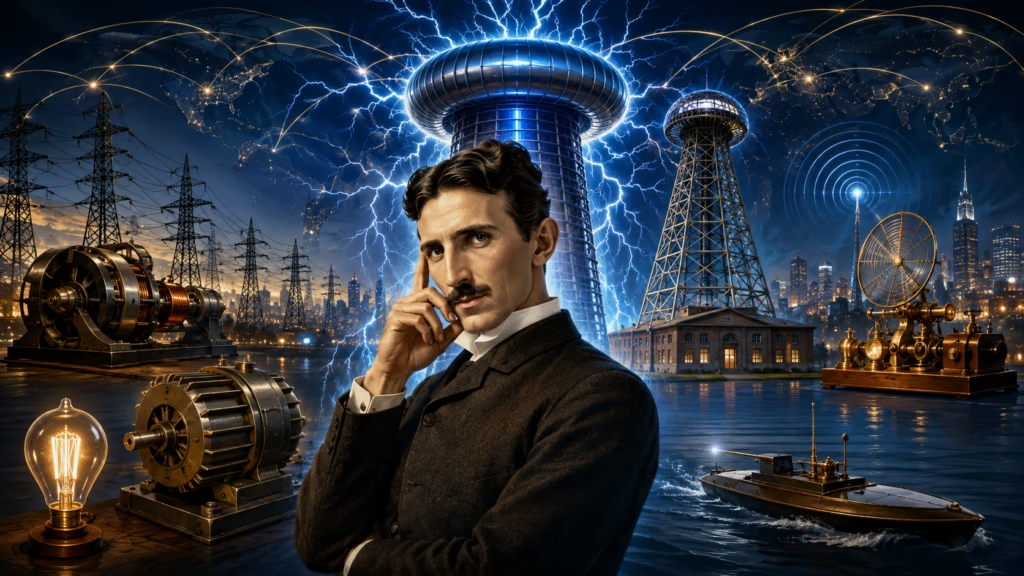
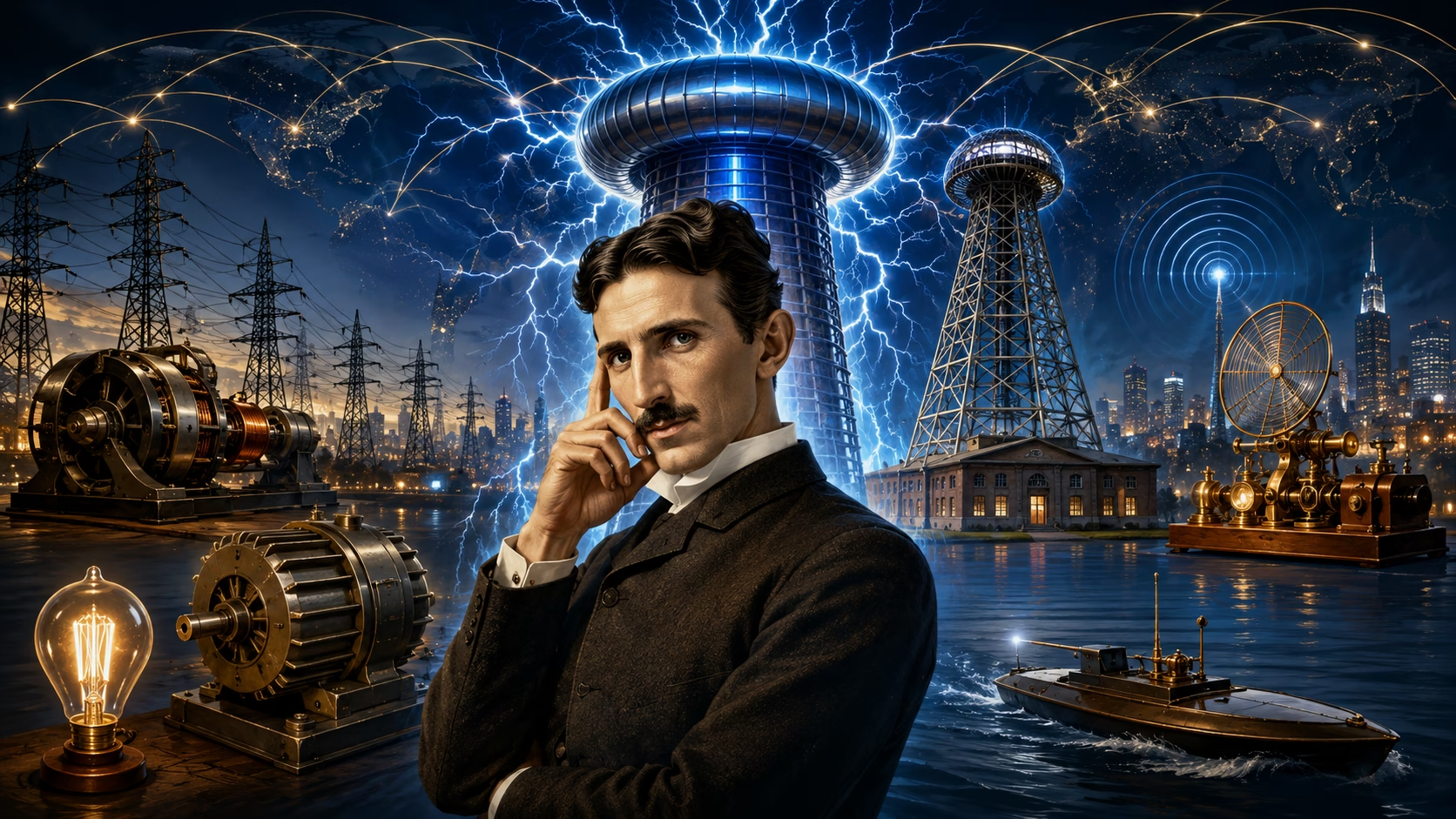
Few individuals in human history have transformed civilization as profoundly as Nikola Tesla. More than an inventor, more than an engineer, and more than a scientist, Tesla was a visionary whose ideas laid the technological foundations of the modern age. The electrical power systems that illuminate cities, drive industries, support digital infrastructure, and sustain contemporary life owe an immeasurable debt to his genius.
On July 10, 1856, in the village of Smiljan, a child was born who would eventually reshape the relationship between humanity and energy. That child was Nikola Tesla.
More than a century after his greatest achievements, Tesla remains a figure of fascination among scientists, engineers, historians, and the general public. His life story combines extraordinary intellectual brilliance, relentless dedication, visionary imagination, financial hardship, and a level of foresight that often seemed almost prophetic.
As a Serbian author and admirer of science, I feel immense pride in calling Nikola Tesla my compatriot. For me, Tesla is not merely a historical figure. He is an intellectual role model, a symbol of scientific excellence, and one of the greatest examples of what the human mind can achieve when driven by curiosity, discipline, and creativity.
Many people around the world believe that two individuals stand above all others as representatives of humanity’s highest intellectual achievements: Leonardo da Vinci, the universal genius of the Renaissance, and Nikola Tesla, the supreme genius of electrical engineering. Whether one fully accepts this assessment or not, there is little doubt that Tesla belongs among the most extraordinary minds ever produced by human civilization.
Today, as humanity faces challenges involving sustainable energy, technological development, artificial intelligence, and global infrastructure, Tesla’s work appears more relevant than ever. The twenty-first century continues to build upon foundations that he helped establish more than a hundred years ago.
To understand Tesla’s significance, however, we must first understand the world into which he was born.

The Historical World Into Which Tesla Was Born
A Century of Scientific Transformation
The nineteenth century was one of the most transformative periods in human history.
Steam engines powered factories.
Railroads connected continents.
Telegraph networks enabled near-instant communication across vast distances.
Scientific discoveries were reshaping humanity’s understanding of nature.
Yet electricity remained largely mysterious.
Although scientists such as Michael Faraday and James Clerk Maxwell had made groundbreaking discoveries concerning electromagnetism, practical electrical infrastructure barely existed. Electric lighting was rare. Electrical machines were primitive. Long-distance power transmission remained largely unsolved.
The world stood at the threshold of an electrical revolution without yet knowing how that revolution would occur.
It was into this rapidly changing environment that Nikola Tesla entered the world.
Electricity Before Tesla
To appreciate Tesla’s achievements, it is important to recognize how limited electrical technology was during his youth.
Electricity had demonstrated enormous promise, but several fundamental problems remained unresolved:
- Efficient power generation
- Long-distance transmission
- Practical electric motors
- Large-scale electrical distribution
Most early systems relied upon direct current (DC), which functioned adequately over short distances but became increasingly inefficient as transmission distances increased.
Cities could not easily be electrified.
Factories could not be powered economically from distant sources.
National electrical grids were unimaginable.
The challenge was not merely scientific; it was civilizational.
Humanity needed a practical way to distribute electrical energy on a massive scale.
Nikola Tesla would eventually provide that solution.
The Scientific Giants Who Prepared the Way
Tesla did not emerge from an intellectual vacuum.
His achievements built upon the work of several remarkable scientists.
Michael Faraday
Faraday discovered electromagnetic induction, one of the most important principles in physics.
Without Faraday’s discoveries, modern electrical engineering would be impossible.
James Clerk Maxwell
Maxwell unified electricity and magnetism into a single mathematical framework.
His equations remain among the most elegant and influential achievements in the history of science.
Heinrich Hertz
Hertz experimentally confirmed electromagnetic waves, validating Maxwell’s theoretical predictions.
Lord Kelvin
Kelvin contributed extensively to thermodynamics and electrical engineering.
Tesla deeply respected many of these scientific pioneers. Yet while they revealed the laws governing electricity, Tesla would demonstrate how those laws could transform civilization.
Childhood and Family Origins
The Village of Smiljan
Nikola Tesla was born on July 10, 1856, in Smiljan, a small village located in what is today Croatia.
At the time of Tesla’s birth, the region formed part of the Austrian Empire.
Although the geopolitical landscape has changed repeatedly since then, Tesla consistently identified himself as Serbian by heritage while also emphasizing the importance of broader human unity.
Milutin Tesla: Scholar, Writer, and Priest
Tesla’s father, Milutin Tesla, served as a Serbian Orthodox priest.
He was highly educated, intellectually disciplined, and known for his impressive memory and literary abilities.
Milutin hoped that Nikola would eventually enter the clergy.
Instead, Nikola’s interests increasingly gravitated toward science, mathematics, and engineering.
Although father and son occasionally disagreed regarding career choices, Milutin played a crucial role in developing Tesla’s intellectual discipline.
His influence helped cultivate Tesla’s extraordinary memory and dedication to learning.
Georgina Tesla: The Inventive Mother
Tesla frequently credited his mother, Georgina “Đuka” Tesla, for many of his inventive abilities.
Despite lacking formal education, she possessed remarkable practical intelligence.
She designed household tools, mechanical devices, and labor-saving innovations for everyday tasks.
Tesla later remarked that his mother’s inventive spirit strongly influenced his own creativity.
In many respects, she served as his first engineering inspiration.
Historians often view her as one of the most important influences in Tesla’s intellectual development.
Early Signs of Extraordinary Ability
Even as a child, Tesla displayed unusual cognitive abilities.
He possessed:
- Exceptional visual memory
- Extraordinary concentration
- Advanced mathematical talent
- Intense curiosity.
- Powerful imagination
Perhaps most remarkable was his ability to visualize complex objects in extraordinary detail.
Tesla could mentally rotate three-dimensional structures, examine them from different perspectives, and identify design flaws without constructing physical prototypes.
This capability would later become central to his engineering methodology.
Education and Intellectual Formation
The Higher Real Gymnasium
Tesla excelled academically from an early age.
His teachers quickly recognized his exceptional talents.
Particularly impressive were his abilities in mathematics and physics.
He often solved complex problems mentally, astonishing both classmates and instructors.
At times, his computational abilities appeared so extraordinary that some teachers suspected him of cheating.
In reality, he simply possessed an unusual capacity for rapid mental calculation.
Graz Polytechnic Institute
Tesla enrolled at the Austrian Polytechnic in Graz in 1875.
There he studied:
- Mathematics
- Physics
- Engineering
- Mechanics
Initially, his performance was exceptional.
He reportedly worked from early morning until late at night, often studying far longer than required.
Professors described him as one of the most gifted students they had ever encountered.
During this period Tesla became fascinated by electrical machines.
One particular device would capture his attention and eventually change history.
The Gramme Machine Problem
While studying electrical engineering, Tesla encountered the Gramme dynamo.
This machine could function as both a generator and a motor.
However, its design relied on brushes and commutators that produced inefficiencies, sparks, and mechanical limitations.
Tesla became convinced that a superior solution must exist.
When he suggested eliminating the commutator, some instructors considered the idea unrealistic.
The criticism did not discourage him.
Instead, it motivated him to pursue the problem relentlessly.
Years later, he would solve it.
The solution would become one of the most important inventions in engineering history.
Prague and Independent Study
Although Tesla’s formal university education remained incomplete, his intellectual development never ceased.
He continued studying independently.
His interests expanded far beyond engineering to include:
- Philosophy
- Literature
- Linguistics
- Physics
- Mathematics
Tesla believed that scientific creativity flourished when knowledge from multiple disciplines interacted.
This interdisciplinary mindset would later distinguish him from many contemporary inventors.
The Birth of the Rotating Magnetic Field
The Walk That Changed Civilization
One of the most famous moments in Tesla’s life occurred in Budapest in 1882.
While walking through a city park with a friend, Tesla was discussing science and reciting poetry from Goethe’s Faust.
Suddenly, a revolutionary idea appeared in his mind.
He realized that alternating currents could be arranged in such a way that they would create a rotating magnetic field.
At that instant, he immediately understood how to build a motor without brushes or commutators.
The concept emerged with extraordinary clarity.
Tesla later described drawing diagrams in the sand to explain the idea.
That moment ranks among the most important creative insights in engineering history.
Understanding the Rotating Magnetic Field
The principle was elegant.
If multiple alternating currents were phase-shifted relative to one another, their combined magnetic fields would appear to rotate continuously.
This rotating magnetic field could produce mechanical motion directly.
The implications were enormous.
A practical alternating-current motor would become possible.
Such a motor would be:
- More efficient
- More reliable
- Easier to maintain
- Better suited for industrial use
Tesla had discovered the foundation of the induction motor.
The world would never be the same.
Why This Discovery Matters
Many inventions improve existing technology.
Few create entirely new technological civilizations.
Tesla’s rotating magnetic field belongs to the latter category.
Without it, modern industry would look radically different.
Factories, transportation systems, manufacturing equipment, household appliances, and countless other technologies depend upon electric motors derived from Tesla’s principles.
Billions of such motors operate around the globe every day.
Most people never notice them.
Yet they quietly perform the work that powers modern civilization.
The origin of that transformation can be traced back to a moment of inspiration in Budapest in 1882.
A moment when one man’s imagination glimpsed the future.
From Immigrant Engineer to Revolutionary Inventor
Arrival in America
By 1884, Nikola Tesla had already developed many of the ideas that would eventually transform the world. Yet despite his extraordinary intellectual abilities, he remained largely unknown outside engineering circles.
Europe had provided him with education, experience, and inspiration, but the center of electrical innovation was rapidly shifting across the Atlantic.
America was becoming the laboratory of the modern age.
At twenty-eight years old, Tesla arrived in New York City carrying little more than a few belongings, a letter of recommendation, and an extraordinary vision of the future.
Legend holds that the recommendation letter addressed to Thomas Edison contained a remarkable statement:
“I know two great men, and you are one of them; the other is this young man.”
Whether fully accurate or somewhat embellished through retelling, the story captures an important truth: Tesla possessed exceptional confidence in his abilities and understood the significance of his ideas.
The challenge was convincing others.
Meeting Thomas Edison
Thomas Alva Edison was already one of the most famous inventors in the world.
His achievements included:
- Practical incandescent lighting systems
- Electrical distribution networks
- Phonograph technology
- Numerous industrial innovations
Edison was a tireless experimenter and entrepreneur.
Tesla, by contrast, approached engineering from a more theoretical perspective. Where Edison often relied on extensive trial and error, Tesla preferred deep conceptual understanding before experimentation.
The two men represented fundamentally different styles of innovation.
Initially, Tesla worked for Edison Machine Works, helping improve electrical equipment and solve engineering problems.
Their professional relationship, however, would prove short-lived.
Different Philosophies of Engineering
The contrast between Edison and Tesla has often been oversimplified into a personal rivalry. In reality, it reflected two different approaches to scientific and technological progress.
Edison’s Method
Edison favored experimentation on a massive scale.
He reportedly remarked:
“Genius is one percent inspiration and ninety-nine percent perspiration.”
His philosophy emphasized persistence, repeated testing, and incremental improvement.
Tesla’s Method
Tesla relied heavily on visualization and theoretical reasoning.
Before constructing a machine, he frequently designed and tested it mentally.
He once explained:
“Before I put a sketch on paper, the whole idea is worked out mentally.”
Both approaches produced important innovations.
Yet Tesla’s ability to conceive entire systems before building them often allowed him to leap beyond existing technological limitations.
The Dispute That Changed History
Several stories surround Tesla’s departure from Edison’s company.
The most famous concerns an alleged promise of compensation for improving Edison equipment.
According to Tesla’s later account, when he requested payment, Edison responded humorously that Tesla did not understand American jokes.
Historians continue debating the precise details.
What is certain is that Tesla left Edison Machine Works and soon found himself facing severe financial difficulties.
For a period, he performed manual labor, including digging ditches, while continuing to think about electrical engineering.
Few moments better illustrate Tesla’s resilience.
Many individuals would have abandoned their ambitions.
Tesla continued pursuing a vision that only he fully understood.
The Fundamental Problem of Electrical Power
Why Direct Current Was Not Enough
To understand Tesla’s greatest achievement, one must understand the limitations of electrical technology in the 1880s.
Edison’s electrical systems relied primarily on direct current (DC).
In direct current systems, electrical charge flows continuously in one direction.
Mathematically:
i(t) = I₀
where:
- i(t) is current
- I₀ is a constant value
DC systems function effectively for short-distance applications.
However, they face major difficulties when transmitting power over long distances.
The principal problem arises from energy losses.
Electrical transmission losses are given approximately by:
P_ loss = I²R
where:
- P_ loss = power loss
- I = current
- R = resistance
Because losses increase with the square of current, efficient transmission requires minimizing current while maintaining power delivery.
This was extremely difficult using nineteenth-century DC systems.
As a result:
- Power stations had to be located close to consumers
- Urban electrification remained expensive
- Large-scale power networks were impractical
Civilization needed a better solution.
Tesla’s Vision of Alternating Current
A New Approach to Electricity
Tesla recognized that alternating current (AC) offered possibilities far beyond those of direct current.
In alternating current systems, electrical current changes direction periodically.
The simplest form can be represented mathematically as:
i(t) = Iₘ sin(ωt)
where:
- Iₘ is peak current
- ω is angular frequency
- t is time
Unlike DC systems, AC allows voltage levels to be transformed efficiently using transformers.
This single capability changed everything.
The Importance of Voltage Transformation
Electrical power is given by:
P = VI
where:
- P = power
- V = voltage
- I = current
For a given power requirement:
I = P/V
Increasing voltage reduces current.
Since transmission losses depend upon I²:
P_ loss = I²R
higher voltages dramatically reduce losses.
This insight enabled efficient long-distance transmission.
Electricity could now travel hundreds of kilometers economically.
Modern civilization became possible.
The Rotating Magnetic Field
Tesla’s Greatest Scientific Insight
Tesla’s most important conceptual breakthrough involved the rotating magnetic field.
Consider two sinusoidal currents:
i₁ = Iₘ sin(ωt)
and
i₂ = Iₘ sin(ωt + 90°)
These currents produce magnetic fields that vary in time.
When combined appropriately, the resulting magnetic field rotates continuously through space.
Instead of generating a pulsating effect, the field behaves as though an invisible magnetic rotor is spinning.
This rotating magnetic field forms the foundation of:
- AC motors
- Industrial automation
- Modern manufacturing
- Transportation systems
- Electric infrastructure
It remains one of the most important discoveries in engineering history.
The Induction Motor
The Machine That Powers Civilization
Tesla’s induction motor eliminated many weaknesses of earlier designs.
Traditional motors often relied on brushes and commutators.
These components caused:
- Wear
- Sparking
- Maintenance requirements
- Reduced efficiency
Tesla’s design used electromagnetic induction.
The rotating magnetic field induced currents within the rotor, producing torque without direct electrical contact.
The result was revolutionary.
Synchronous Speed
One of the most important equations governing AC motors is the synchronous speed formula:
Nₛ = 120f / P
where:
- Nₛ = synchronous speed (rpm)
- f = frequency (Hz)
- P = number of poles
This simple relationship remains fundamental in electrical engineering.
Slip
An induction motor operates slightly below synchronous speed.
The difference is called slip:
s = (Nₛ − Nᵣ) / Nₛ
where:
- s = slip
- Nᵣ = rotor speed
Slip allows induction to occur and torque to be produced.
Tesla’s understanding of these principles enabled the creation of practical industrial motors that remain indispensable today.
George Westinghouse and the Turning Point
Recognition of Genius
Tesla’s fortunes changed dramatically when industrialist George Westinghouse recognized the value of his inventions.
Westinghouse understood that alternating current represented the future.
He acquired rights to Tesla’s patents and provided the support necessary to commercialize the technology.
This partnership became one of the most significant collaborations in engineering history.
Together they challenged the dominance of Edison’s direct-current systems.
The War of Currents
One of the Most Important Technological Battles Ever Fought
The struggle between AC and DC became known as the War of Currents.
It was not merely a scientific disagreement.
It involved:
- Engineering
- Economics
- Business interests
- Public perception
- Political influence
The outcome would determine how future generations received electrical power.
Edison’s Campaign Against AC
Edison became one of the strongest critics of alternating current.
He argued that high-voltage AC systems posed serious dangers.
Public demonstrations were conducted to emphasize electrical hazards.
Some campaigns intentionally portrayed AC as inherently unsafe.
Although electricity can indeed be dangerous when improperly handled, history ultimately demonstrated that AC systems could be engineered safely and effectively.
The Chicago World’s Fair
A major turning point occurred in 1893.
The World’s Columbian Exposition in Chicago required large-scale electrical illumination.
Westinghouse, using Tesla’s AC technology, won the contract.
Millions of visitors witnessed an unprecedented display of electrical power.
The exhibition became a spectacular demonstration of the capabilities of alternating current.
For many observers, the debate was effectively settled.
The future belonged to AC.
Niagara Falls
The Dream Becomes Reality
The ultimate test came at Niagara Falls.
For decades engineers had dreamed of harnessing the immense power of the falls.
The challenge was not generation alone.
The true challenge was transmitting power to distant users.
Tesla’s system provided the answer.
A Historic Achievement
In 1895, the first major hydroelectric generators at Niagara Falls began operation.
Soon afterward, electricity generated there was transmitted to Buffalo, New York.
For the first time, large quantities of electrical power could be generated far from consumers and delivered efficiently over long distances.
The implications were revolutionary.
Factories could be located away from power stations.
Cities could expand.
Regional power networks became practical.
The modern electrical age had arrived.
Why Niagara Falls Matters
Historians often rank the Niagara Falls project among the greatest engineering achievements of the nineteenth century.
Its significance extended beyond engineering.
It demonstrated that humanity could harness natural forces on an unprecedented scale.
Most importantly, it validated Tesla’s vision.
The world now possessed a practical blueprint for electrification.
That blueprint remains recognizable in modern power systems more than a century later.
The Foundation of the Modern Electric Grid
The architecture of today’s electrical infrastructure follows principles established through Tesla’s work.
The process remains fundamentally unchanged:
- Electricity is generated
- Voltage is increased using transformers
- Power is transmitted over long distances
- Voltage is reduced near consumers
- Homes and industries receive electricity
Billions of people depend upon this system every day.
Its roots trace directly to Tesla’s inventions.
Few individuals have shaped civilization so profoundly.
By the end of the nineteenth century, Nikola Tesla had accomplished something extraordinary.
He had not merely invented a machine.
He had transformed electricity into the lifeblood of modern civilization.
The world would never again be the same.
Beyond Electricity: The Visionary Who Saw the Future
Introduction
By the mid-1890s, Nikola Tesla had already secured his place among the greatest engineers in history.
The success of the alternating-current system, the induction motor, and the Niagara Falls hydroelectric project had transformed electrical engineering forever.
Most inventors would have spent the remainder of their careers refining existing technologies.
Tesla did not.
Instead, he turned his attention toward challenges that many of his contemporaries considered impossible.
He sought to develop:
- Wireless communication.
- Wireless transmission of energy.
- Global information networks.
- Remote-controlled machines.
- High-frequency electrical systems.
- New methods of understanding electromagnetic phenomena.
In retrospect, many of these ambitions anticipated technologies that would emerge decades later.
Some became reality.
Others remain partially realized.
All reveal the extraordinary scope of Tesla’s imagination.
The Tesla Coil
One of the Most Iconic Devices in Scientific History
Among Tesla’s many inventions, none is more visually recognizable than the Tesla coil.
Invented in 1891, the Tesla coil became a powerful tool for studying high-frequency alternating currents and high voltages.
Its dramatic electrical discharges remain among the most famous images associated with Tesla.
Yet the significance of the device extends far beyond spectacular sparks.
The Tesla coil helped researchers investigate:
- Resonance phenomena.
- High-frequency currents.
- Wireless transmission principles.
- Radio-frequency engineering.
- Electromagnetic fields.
Many concepts central to modern electronics can trace part of their development to these investigations.
Resonance: The Key Principle
The operation of the Tesla coil depends fundamentally upon resonance.
In a simple resonant circuit containing inductance (L) and capacitance (C), the resonant frequency is:
f = 1 / (2π√(LC))
At resonance, energy oscillates efficiently between electric and magnetic fields.
Tesla understood that resonance could dramatically amplify electrical effects.
This insight would influence much of his later work.
Why the Tesla Coil Matters Today
Although modern technology rarely uses Tesla coils in their original form, the underlying principles remain essential.
Resonance plays a central role in:
- Radio systems.
- Wireless communication.
- Signal processing.
- Antenna design.
- Medical technologies.
- Power electronics.
The Tesla coil represents not merely a historical curiosity but an important milestone in the development of electrical science.
High-Frequency Electrical Engineering
Exploring a New Electrical Frontier
Most electrical systems of Tesla’s era operated at relatively low frequencies.
Tesla became fascinated by the behavior of electricity at much higher frequencies.
His experiments revealed unusual phenomena involving:
- Electrical discharges.
- Electromagnetic radiation.
- Resonance effects.
- Energy transfer mechanisms.
These investigations expanded scientific understanding and opened new avenues of research.
In many respects, Tesla helped establish the foundations of high-frequency engineering.
Lighting Without Wires
Tesla demonstrated forms of wireless illumination that astonished audiences.
Gas-filled tubes could glow without direct electrical connections when placed within strong electromagnetic fields.
Observers often viewed these demonstrations as magical.
In reality, they represented sophisticated applications of electromagnetic principles.
These experiments strengthened Tesla’s belief that wireless technologies would eventually transform civilization.
Tesla and Radio
The Race to Create Wireless Communication
One of the most debated aspects of Tesla’s legacy concerns radio technology.
Popular accounts often simplify the issue into a question:
Who invented radio?
The historical reality is more complex.
Radio emerged through contributions from multiple scientists and engineers, including:
- James Clerk Maxwell
- Heinrich Hertz
- Oliver Lodge
- Guglielmo Marconi
- Nikola Tesla
Tesla’s contributions were substantial and scientifically important.
Tesla’s Wireless Patents
Tesla obtained patents related to wireless communication before some of the most famous radio demonstrations occurred.
His work addressed:
- Tuned circuits.
- Signal transmission.
- Resonant communication systems.
- Wireless control mechanisms.
These concepts became fundamental elements of radio engineering.
The Marconi Controversy
Guglielmo Marconi achieved tremendous success in commercializing radio communication.
For many years, public recognition largely favored Marconi.
However, patent disputes eventually reached the highest legal levels.
In 1943, the United States Supreme Court invalidated certain Marconi patent claims, citing prior work by Tesla and others.
This decision did not diminish Marconi’s achievements, but it reinforced the historical importance of Tesla’s contributions.
Today, historians generally recognize Tesla as one of the foundational figures in the development of radio technology.
Remote Control: The Birth of Robotics
Madison Square Garden, 1898
One of Tesla’s most remarkable demonstrations occurred in 1898.
At Madison Square Garden in New York, he presented a radio-controlled boat.
To modern audiences, such a device may appear ordinary.
At the time, however, it seemed almost unbelievable.
Many observers could not understand how the vessel responded to commands without visible connections.
Some even speculated that hidden operators or supernatural forces were involved.
Tesla patiently explained that the system relied upon wireless signals.
A Technology Decades Ahead of Its Time
Tesla’s radio-controlled boat represented far more than a novelty.
It demonstrated principles that would later become central to:
- Robotics.
- Drones.
- Guided vehicles.
- Remote-controlled machinery.
- Autonomous systems.
In essence, Tesla had introduced one of the earliest practical examples of teleautomation.
Today, remote control technology is ubiquitous.
Its conceptual roots can be traced directly to Tesla’s pioneering work.
Colorado Springs
A Laboratory Unlike Any Other
In 1899, Tesla moved part of his research operations to Colorado Springs.
He selected the location because of its altitude, atmospheric conditions, and available space for large-scale experiments.
The facility became the site of some of the most dramatic electrical investigations ever conducted.
Artificial Lightning
Tesla generated electrical discharges of astonishing size and intensity.
Reports describe arcs extending many meters through the air.
Photographs from Colorado Springs became iconic representations of scientific experimentation.
The images often show Tesla seated calmly while enormous electrical discharges surround him.
These photographs remain among the most recognizable in the history of science.
Resonance and the Earth
Tesla became increasingly interested in the possibility that the Earth itself could participate in large-scale resonant electrical phenomena.
He investigated whether electrical energy might be transmitted through global resonance effects.
Some aspects of these ideas remain controversial.
Others anticipated later studies involving electromagnetic propagation and planetary-scale electrical behavior.
Regardless of one’s assessment, the experiments demonstrated Tesla’s willingness to explore questions far beyond conventional engineering practice.
The Dream of Wireless Energy
A Revolutionary Vision
Tesla believed that humanity should ultimately have access to energy without the limitations imposed by extensive wiring infrastructure.
His goal extended beyond wireless communication.
He envisioned wireless power transmission on a global scale.
In Tesla’s ideal future:
- Information would travel wirelessly.
- Energy would travel wirelessly.
- Communication would become instantaneous.
- Distance would become increasingly irrelevant.
At the dawn of the twentieth century, such ideas seemed fantastical.
Today, portions of that vision have become reality.
Modern Wireless Power
Wireless power transfer now exists in practical forms, including:
- Smartphone charging systems.
- Medical implants.
- Industrial power transfer applications.
- Electric vehicle charging research.
Although modern implementations differ from Tesla’s grandest ambitions, they demonstrate the continuing relevance of his ideas.
Tesla asked questions that engineers continue exploring more than a century later.
Wardenclyffe Tower
The Most Ambitious Project of Tesla’s Career
The culmination of Tesla’s wireless vision was Wardenclyffe Tower.
Construction began in 1901 on Long Island, New York.
The project sought to create a global wireless communication and transmission system.
Its objectives included:
- Worldwide communication.
- International broadcasting.
- Information exchange.
- Potential wireless power transmission.
No comparable project had ever been attempted.
Financial Challenges
The project’s scale demanded enormous resources.
Initially, Tesla secured support from financier J. P. Morgan.
However, difficulties soon emerged.
Technical uncertainty, escalating costs, and changing commercial priorities created significant obstacles.
As funding diminished, construction slowed.
Eventually, the project ceased.
Failure or Premature Vision
Wardenclyffe is often described as one of Tesla’s greatest failures.
Yet history suggests a more nuanced interpretation.
Many technologies envisioned by Tesla eventually appeared decades later:
- Global communication networks.
- Instant information exchange.
- Wireless connectivity.
- International broadcasting.
The tower failed as a commercial enterprise.
The underlying vision, however, proved remarkably prescient.
In many respects, modern telecommunications networks reflect goals Tesla articulated long before the necessary technology existed.
Tesla’s Predictions About the Future
A Remarkable Record of Foresight
Tesla frequently discussed future technological developments.
Some predictions were astonishingly accurate.
He anticipated:
- Wireless global communication.
- Portable communication devices.
- Automated systems.
- Increased use of renewable energy.
- Expanding technological interconnectivity.
One of his most famous predictions envisioned devices small enough to fit into a pocket while enabling communication across great distances.
Modern smartphones make such statements appear almost prophetic.
Why Tesla’s Predictions Matter
Many inventors create technologies.
Far fewer accurately foresee how technology will reshape society.
Tesla possessed an unusual ability to identify long-term technological trends.
His forecasts were not perfect.
No visionary predicts everything correctly.
Yet the frequency with which his ideas anticipated future developments remains remarkable.
The Engineer and the Futurist
By the beginning of the twentieth century, Nikola Tesla had become something unique.
He was no longer merely an inventor.
He had become a symbol of technological possibility.
His work spanned:
- Power systems.
- Electric motors.
- High-frequency engineering.
- Wireless communication.
- Remote control.
- Future technologies.
Few individuals have contributed significantly to so many distinct fields.
Even fewer have done so while maintaining a coherent vision of humanity’s technological future.
The achievements discussed thus far would alone justify Tesla’s place among history’s greatest innovators.
Yet to understand the full significance of his legacy, we must look beyond his inventions and examine the man himself: his scientific philosophy, personal struggles, enduring myths, final years, and the profound influence he continues to exert upon modern civilization.
Those subjects form the final part of this study.
The Man, the Myth, and the Enduring Legacy
Introduction
By the early twentieth century, Nikola Tesla had already achieved what most inventors could scarcely imagine. He had transformed electrical engineering, helped establish the technological foundations of modern civilization, pioneered wireless communication concepts, demonstrated remote control, and inspired generations of scientists and engineers.
Yet Tesla’s story cannot be understood solely through his inventions.
His enduring significance arises from something deeper.
He embodied a rare combination of scientific rigor, engineering creativity, intellectual courage, and visionary imagination. His life illustrates both the extraordinary heights of human achievement and the personal sacrifices often demanded by greatness.
To understand why Tesla continues to fascinate the world more than a century after his greatest discoveries, we must examine the man behind the inventions.
Tesla’s Scientific Method
Engineering Inside the Mind
One of Tesla’s most remarkable characteristics was his unique approach to invention.
Most engineers rely heavily upon sketches, prototypes, and repeated physical experimentation.
Tesla often worked differently.
He described a process in which entire machines could be constructed, tested, modified, and refined within his imagination before any physical model was built.
According to Tesla:
“My method is different. I do not rush into actual work. When I get an idea, I start at once building it up in my imagination.”
He claimed that he could mentally operate machines for extended periods, observe wear patterns, identify weaknesses, and optimize designs.
Modern neuroscience continues to find this ability extraordinary.
Although visualization is common among scientists and engineers, Tesla appears to have possessed it at an exceptionally advanced level.
The Unity of Science
Tesla did not view scientific disciplines as isolated domains.
Instead, he regarded nature as an interconnected system governed by universal principles.
This perspective enabled him to move fluidly among:
- Physics
- Electrical engineering
- Mechanics
- Mathematics
- Electromagnetism
Such interdisciplinary thinking often allowed Tesla to recognize connections that others overlooked.
Many of history’s greatest innovators have shared this characteristic.
Tesla and Leonardo da Vinci
Two Symbols of Human Genius
Throughout history, only a handful of individuals have fundamentally altered humanity’s conception of what is possible.
Among these rare figures, Leonardo da Vinci and Nikola Tesla are frequently mentioned together.
The comparison is understandable.
Both men possessed extraordinary imagination.
Both moved effortlessly across disciplinary boundaries.
Both envisioned technologies that would not emerge until long after their lifetimes.
Both remain cultural symbols of genius.
Similarities
Leonardo and Tesla shared several notable characteristics.
Intellectual Breadth
Neither confined himself to a single field.
Leonardo explored art, anatomy, engineering, architecture, and natural science.
Tesla explored electricity, mechanics, communications, energy systems, and future technologies.
Visual Thinking
Both relied heavily on visualization.
Leonardo filled notebooks with detailed sketches.
Tesla often designed entire systems mentally before constructing them.
Future-Oriented Imagination
Many of their ideas appeared centuries ahead of their time.
Their work demonstrates an unusual capacity to perceive possibilities invisible to most contemporaries.
Differences
Despite these similarities, important differences existed.
Leonardo lived during the Renaissance, an era when scientific methods were still developing.
Tesla worked during the industrial age, when mathematics, physics, and engineering had become highly sophisticated disciplines.
Leonardo primarily explored possibilities.
Tesla transformed possibilities into functioning technological systems.
If Leonardo helped humanity imagine the future, Tesla helped humanity build it.
Why Many People Place Them Above All Others
When discussions arise concerning the greatest geniuses in history, names such as Newton, Einstein, Gauss, Archimedes, and Leonardo inevitably appear.
Tesla belongs within that distinguished company.
Many people nevertheless regard Leonardo da Vinci and Nikola Tesla as uniquely representative of humanity’s creative potential.
Whether one agrees with this assessment is ultimately subjective.
What remains indisputable is that both men expanded the boundaries of human imagination in extraordinary ways.
Myths and Facts About Tesla
The Challenge of Separating History from Legend
Few scientific figures have accumulated as many myths as Nikola Tesla.
Popular culture often portrays him as a near-supernatural genius responsible for almost every technological innovation of the modern age.
The truth is both more nuanced and more impressive.
Tesla made immense contributions to science and engineering.
Those achievements require no exaggeration.
Myth: Tesla Invented Everything
Tesla did not invent every modern technology.
Scientific progress results from contributions made by many individuals.
Radio, electronics, telecommunications, and electrical systems evolved through collective efforts.
Tesla’s genuine accomplishments are already extraordinary.
There is no need to attribute unrelated inventions to him.
Myth: Unlimited Free Energy
Some popular narratives claim that Tesla discovered methods for generating unlimited free energy.
No credible scientific evidence supports such claims.
Tesla investigated wireless energy transmission.
He did not discover a method for producing energy without physical sources.
The laws of thermodynamics remain valid.
Myth: The Death Ray
Late in life, Tesla discussed concepts involving directed-energy systems.
These statements inspired decades of speculation.
Historical evidence suggests that many claims concerning a so-called “death ray” were exaggerated by journalists and later amplified by popular culture.
Although Tesla explored advanced defensive technologies, sensational accounts often exceed available evidence.
Fact: Tesla Changed Civilization
The most important fact often becomes obscured by sensational stories.
Tesla’s authentic achievements transformed the world.
His contributions to electrical engineering alone guarantee his place among history’s greatest inventors.
No myths are necessary.
Reality is sufficiently remarkable.
Personal Life and Character
Dedication to Science
Tesla never married.
He devoted virtually his entire life to intellectual pursuits.
Scientific work occupied the central position in his existence.
He believed that personal sacrifices were necessary to achieve his goals.
Whether this choice enhanced or diminished his happiness remains a subject of debate.
What is clear is that his commitment to invention was extraordinary.
Discipline and Routine
Tesla maintained highly structured habits.
He valued:
- Precision
- Order
- Efficiency
- Self-control
Many accounts describe an individual who demanded exceptional standards from both himself and others.
These traits contributed significantly to his productivity.
Compassion and Humanitarian Ideals
Despite his reputation as a solitary genius, Tesla expressed deep concern for humanity’s future.
He believed that science should serve civilization.
Many of his statements reveal optimism regarding technological progress and its capacity to improve human life.
This humanitarian dimension remains one of the most admirable aspects of his legacy.
Tesla’s Final Years
A Changing Technological World
As the twentieth century advanced, technological development accelerated.
Many fields expanded beyond Tesla’s primary areas of expertise.
New industries emerged.
Corporate research laboratories gained increasing influence.
The economic environment became less favorable for independent inventors.
Tesla’s prominence gradually declined.
Financial Difficulties
Although he held numerous patents and achieved international fame, Tesla often struggled financially.
Several factors contributed:
- Ambitious projects.
- Insufficient commercial support.
- Limited interest in business management.
- Changing industrial priorities.
The contrast between Tesla’s scientific influence and his financial circumstances remains one of the most striking aspects of his life.
Death in New York
Nikola Tesla died on January 7, 1943, in New York City at the age of eighty-six.
The world had entered the Second World War.
Many of the technologies being used across the globe depended directly or indirectly upon principles he had helped establish.
Although his passing received attention, the full magnitude of his legacy would become increasingly apparent only in subsequent decades.
Why the Unit “Tesla” Bears His Name
A Scientific Tribute
In the International System of Units (SI), magnetic flux density is measured in teslas (T).
One tesla corresponds to:
1 T = 1 Wb / m²
where:
- T = tesla
- Wb = weber
- m² = square meter
This unit was named in Tesla’s honor because of his profound contributions to electromagnetism and electrical engineering.
Few distinctions better reflect scientific respect.
Every time engineers measure magnetic fields, they invoke Tesla’s name.
Tesla’s Legacy in Modern Engineering
Electric Power Systems
The most obvious manifestation of Tesla’s influence remains the global electric power grid.
Modern transmission systems continue to rely fundamentally upon principles established during the alternating-current revolution.
Every major industrial society depends upon these systems.
Renewable Energy
Renewable energy technologies depend heavily upon electrical infrastructure.
Whether energy originates from:
- Hydroelectric plants
- Wind turbines
- Solar farms
- Geothermal systems
it ultimately enters transmission networks derived from Tesla’s foundational concepts.
In this sense, Tesla remains central to contemporary sustainability efforts.
Electric Vehicles
The modern transition toward electric transportation reflects Tesla’s continuing relevance.
Electric motors remain indispensable components of electric vehicles.
The underlying principles can be traced directly to developments initiated by Tesla in the nineteenth century.
The fact that one of the world’s most prominent electric vehicle manufacturers bears his name demonstrates the enduring symbolic power of his legacy.
Smart Grids
Future electrical systems increasingly incorporate:
- Automation
- Digital monitoring
- Artificial intelligence
- Distributed generation
Although technologically sophisticated, these innovations continue operating within frameworks that evolved from Tesla’s electrical vision.
Tesla and Artificial Intelligence Infrastructure
An Unexpected Connection
At first glance, artificial intelligence appears unrelated to Tesla.
In reality, modern AI systems depend fundamentally upon electrical infrastructure.
Data centers require enormous quantities of electrical power.
Communication networks require reliable energy systems.
Computational facilities operate continuously because electrical grids deliver stable power.
Every major AI model relies indirectly upon technologies built atop electrical foundations that Tesla helped create.
Without large-scale electrification, modern artificial intelligence would not exist.
Why Tesla Matters More Than Ever
A Civilization Built on Electricity
The twenty-first century is becoming increasingly electrified.
Transportation, communication, industry, medicine, computing, and scientific research all depend upon electrical systems.
This trend suggests that Tesla’s importance may continue increasing rather than diminishing.
The more humanity relies upon electricity, the more visible his influence becomes.
The Power of Vision
Tesla’s life also offers broader lessons.
He demonstrated:
- Intellectual courage.
- Scientific curiosity.
- Persistence during adversity.
- Commitment to long-term thinking.
Many of his most important ideas initially appeared unrealistic.
History eventually validated them.
This capacity to imagine futures beyond the limits of current understanding remains one of humanity’s most valuable qualities.
Conclusion
The Architect of Electrified Civilization
Few individuals can legitimately be described as architects of civilization.
Nikola Tesla belongs within that rare category.
His inventions transformed electricity from a scientific curiosity into the foundation of modern society.
His discoveries reshaped industry, transportation, communications, and technology.
His ideas continue influencing scientific and engineering progress more than a century after their introduction.
A Personal Reflection
As a Serbian author, I regard Nikola Tesla with profound admiration.
He is not only one of the greatest scientists produced by the Serbian people.
He is one of the greatest scientists produced by humanity.
His life demonstrates how knowledge, imagination, and perseverance can overcome extraordinary obstacles.
For many of us, Tesla represents the highest ideal of intellectual achievement.
The Light That Continues to Shine
Many inventors create useful devices.
A few transform entire industries.
Only the rarest individuals transform civilization itself.
Nikola Tesla was one of those individuals.
The lights illuminating our cities, the motors powering our industries, the communication systems connecting our world, and the technologies driving our future all carry traces of his genius.
More than a century after his greatest discoveries, Tesla continues to remind us that the most powerful force in history is not electricity itself.
It is the human mind.
And few minds have ever shone more brightly than that of Nikola Tesla.