
Resolving a Famous Mathematical Paradox
In a previous article, we explored a surprising argument suggesting that the equation 1^x = -1 might have infinitely many solutions. But is that really true?
👉 If you haven’t read it, you can find it here:
LINK_TO_OLD_ARTICLE
In this follow-up, we take a deeper look and uncover what actually went wrong.
Recap: The Source of the Paradox
In the original argument, we used Euler’s formula:
e^iα = cos α + i sin α
which implies:
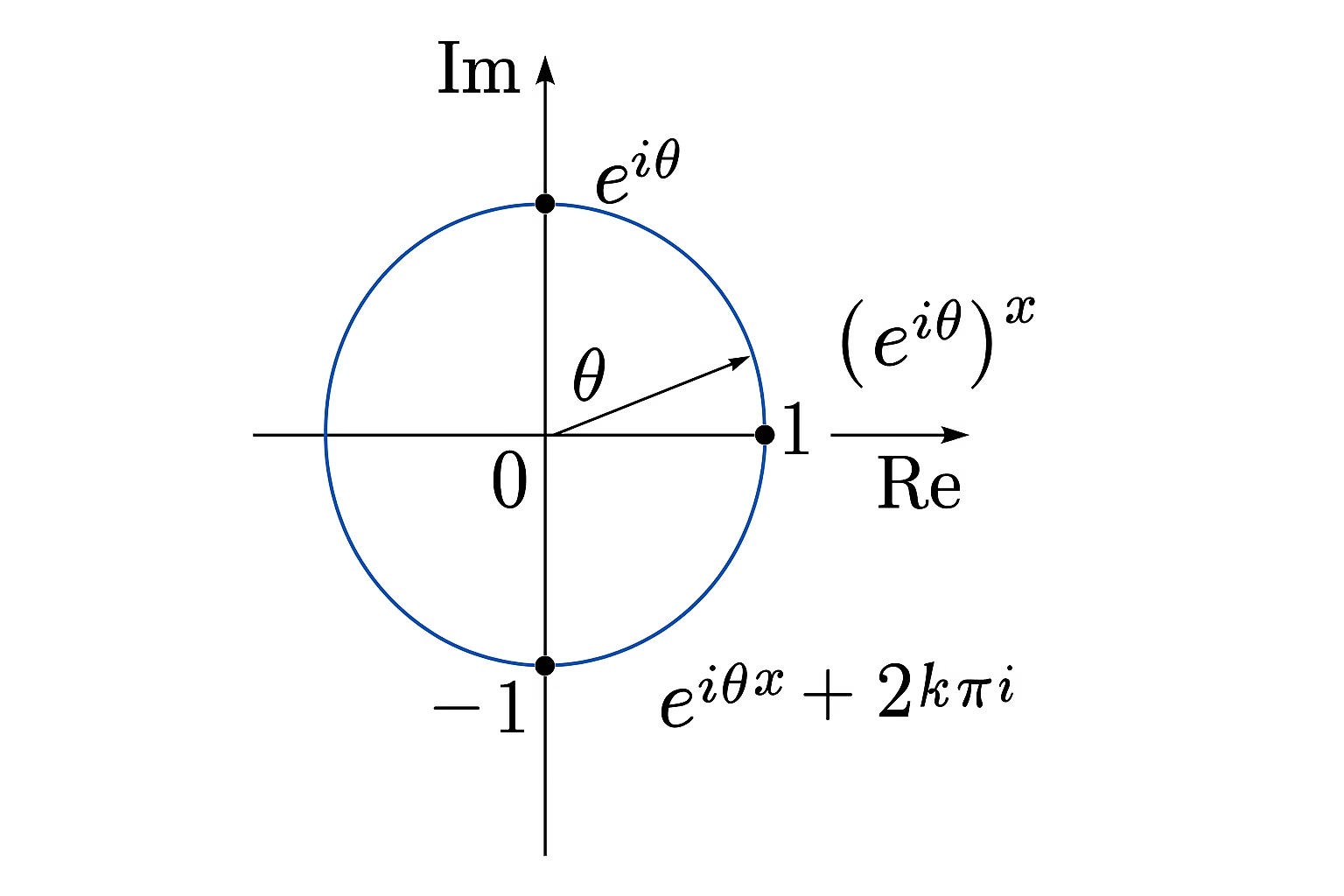
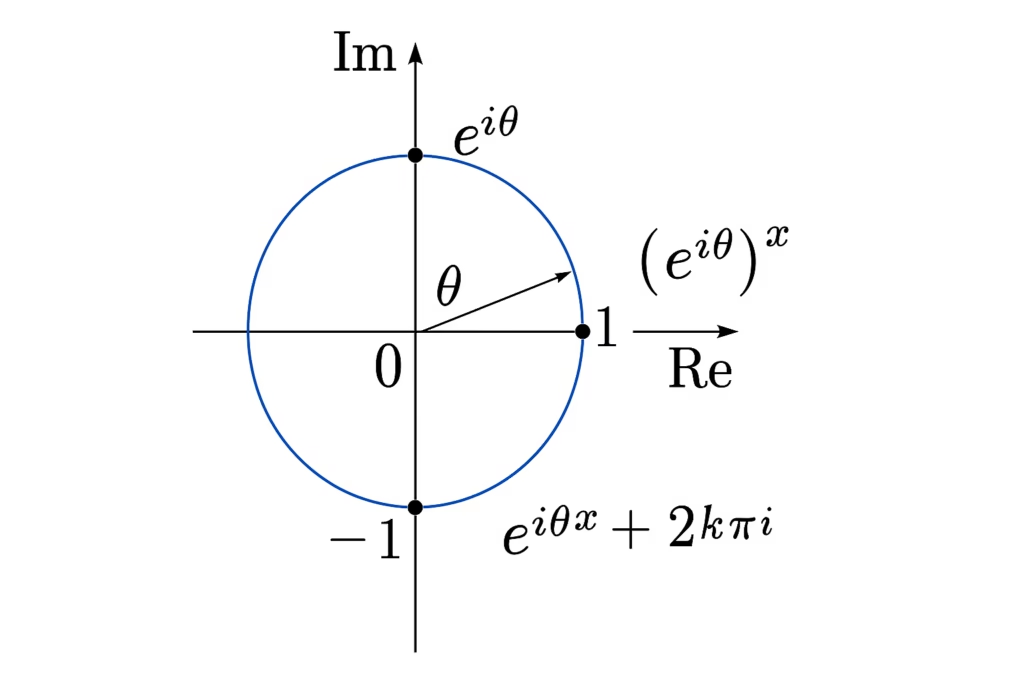
1 = e^i2kπ, -1 = e^i(2k+1)π
From there, we wrote:
1^x = (e^i2kπ)^x = e^i2kπx
and concluded:
e^i2kπx = e^i(2k+1)π
This led to:
x = (2k+1) / 2k
At first glance, this suggests infinitely many real solutions.
The Key Question
If this reasoning is correct, why does direct substitution always give:
1^x = 1
Clearly, something subtle is happening.
The Core Problem: Hidden Assumptions
The paradox arises because we silently used rules that are not universally valid in complex numbers.
1. Complex exponentiation is multi-valued
In real numbers:
a^x = e^x ln a
In complex numbers:
z^x = e^x log z
where:
log z = ln ∣z∣ + i (arg z + 2kπ)
👉 This means exponentiation is not single-valued.
2. The identity (e^a)^x = e^ax is not always valid
This step:
(e^i2kπ)^x = e^i2kπx
is only valid if we choose and stick to a single branch of the logarithm.
In the original argument, different branches were implicitly mixed.
3. Exponential equations are periodic
From:
e^a = e^b
we must write:
a = b + 2nπi
not simply a = b.
Ignoring this introduces extra “solutions” that are not valid.
Why the “Solutions” Fail
Take:
x = 3 / 2
Then:
1^(3/2) = 1
not −1.
The contradiction disappears once exponentiation is treated consistently.
A Subtle Trap: Roots in the Complex Plane
In the original article, we also used:
1 = (-1)^(1/x)
However, in complex numbers:
(-1)^r
is multi-valued, so expressions like:
(-1)^(2/3) = 1
are not uniquely defined—they depend on the chosen branch.
Final Resolution
The equation:
1^x = -1
has no real solutions.
The apparent paradox arises from:
- mixing branches of the logarithm
- applying real-number rules in a complex setting
- treating multi-valued functions as single-valued
What This Teaches Us
This example does not show that mathematics is inconsistent.
Instead, it shows that:
Mathematics is exact—but only when its definitions are used precisely.
Complex analysis requires greater care than real arithmetic, and intuition alone is not always reliable.
Closing Thought
The paradox explored in the previous article is not a flaw in mathematics—it is a reminder of its depth.
The more carefully we define our operations, the clearer the truth becomes.
One of the proofs of Euler’s formula:
Let it be
f(x) = cos x + i sin x (1)
The first derivative of the function is
f'(x) = -sin x + i cos x
Since it is
i(cos x + i sin x) = i cos x + i² sin x = i cos x – sin x = -sin x + i cos x
we get
f'(x) = if(x) (2)
Now let’s define a new function
g(x) = e⁻ⁱˣf(x)
Applying the product derivative rule, we get
g'(x) = (e⁻ⁱˣ)’f(x) + e⁻ⁱˣf'(x)
Since it is
(e⁻ⁱˣ)’ = -ie⁻ⁱˣ
and according to (2)
f'(x) = if(x)
follows
g'(x) = -ie⁻ⁱˣf(x) + e⁻ⁱˣif(x)
that is
g'(x) = -ie⁻ⁱˣf(x) + ie⁻ⁱˣf(x) = 0
Therefore, the function g(x) has a zero derivative, so it is constant.
Let’s determine that constant.
For x = 0 it holds
g(0) = e⁰f(0)
Since it is
f(0) = cos 0 + and sin 0 = 1
we get
g(0) = 1
Since g is a constant function, it follows
g(x) = 1
According to the definition of the function g
e⁻ⁱˣf(x) = 1
By multiplying both sides by eⁱˣ we get
f(x) = eⁱˣ
However, according to (1)
f(x) = cos x + i sin x
That’s why it’s finally valid
eⁱˣ = cos x + i sin x
which had to be proven.