
Introduction
Few symbols in mathematics are as universally recognized as π (pi).
Whether one studies elementary geometry, advanced calculus, engineering, physics, statistics, signal processing, or number theory, π appears repeatedly in formulas describing circles, waves, probabilities, and even the structure of the universe itself.
In previous articles, we explored three remarkable mathematical constants:
- the number e, the foundation of exponential growth and logarithms
- the imaginary unit i, which extends mathematics into the complex plane
- the Golden Ratio φ, famous for its appearance in geometry, art, architecture, and nature
Together with π, these constants form a remarkable collection of mathematical objects that connect seemingly unrelated areas of mathematics.
Among them, π occupies a unique position. It emerged from the study of circles thousands of years ago, yet today it appears in fields far removed from geometry, including probability theory, Fourier analysis, quantum mechanics, and number theory.
This article explores the definition, history, properties, formulas, and significance of π while revealing its surprising relationships with e, i, and φ.
What Is π
The number π is defined as the ratio between the circumference of any circle and its diameter:
π = C / d
where:
- C is the circumference
- d is the diameter
Remarkably, this ratio is the same for every circle regardless of size.
Its decimal expansion begins as
π = 3.141592653589793238462643383279502884197…
and continues infinitely without repeating.
Why Is π an Irrational Number
An irrational number cannot be expressed as a ratio of two integers.
In 1761, Johann Heinrich Lambert proved that π is irrational.
Consequently,
π ≠ a / b
for any integers a and b.
The decimal representation therefore never terminates and never develops a repeating pattern.
π Is Even More Special: It Is Transcendental
A transcendental number is a number that cannot be a solution of any polynomial equation with integer coefficients.
In 1882, Ferdinand von Lindemann proved that π is transcendental.
This result solved the ancient Greek problem known as the quadrature of the circle, demonstrating that constructing a square with exactly the same area as a given circle using only a ruler and compass is impossible.
Common Approximations of π
Since π is an irrational number with infinitely many non-repeating decimal places, practical calculations often rely on rational approximations.
One of the oldest and most famous approximations is
π ≈ 22 / 7
which gives
22 / 7 = 3.142857142857…
The error is approximately
22 / 7 – π ≈ 0.001264489
Although not exact, this approximation is accurate to about two decimal places and has been used for centuries in engineering, surveying, and elementary geometry.
An even better classical approximation is
π ≈ 355 / 113
known as the Milü approximation, discovered by the Chinese mathematician Zu Chongzhi in the fifth century.
Indeed,
355 / 113 = 3.141592920353982…
which differs from π by less than
2.7×10^(−7)
This extraordinary accuracy made it the best known rational approximation of π for nearly a thousand years.
The History of π
Ancient Civilizations
The earliest approximations of π appeared thousands of years ago.
Babylonians
π ≈ 3.125
Egyptians
The Rhind Mathematical Papyrus implies
π ≈ 3.1605
Archimedes’ Revolutionary Method
Around 250 BCE, Archimedes developed a geometric method using inscribed and circumscribed polygons.
He established that
3.1408 < π < 3.1429
which was extraordinarily accurate for its time.
The Symbol π
The symbol π was first introduced by Welsh mathematician William Jones in 1706.
Later, Leonhard Euler popularized its use, and it eventually became the universal mathematical notation.
Fundamental Formulas Involving π
Circumference of a Circle
C = 2πr
Area of a Circle
A = πr^2
Surface Area of a Sphere
S = 4πr^2
Volume of a Sphere
V = (4/3)πr^3
Area of an Ellipse
A = πab
where a and b are the semi-major and semi-minor axes.
Infinite Series for π
One reason π fascinated mathematicians is that it can be computed through infinitely many series.
Leibniz Formula
π / 4 = 1 − 1 / 3 + 1 / 5 – 1 / 7 + 1 / 9 − …
Although elegant, this series converges very slowly.
Nilakantha Series
π = 3 + 4 / 2⋅3⋅4 – 4 / 4⋅5⋅6 + 4 / 6⋅7⋅8 −⋯
This converges much faster.
π and Trigonometry
The radian measure of angles is defined using π.
A complete revolution corresponds to 2π radians.
Consequently, 180 degrees = π radians.
Almost every trigonometric formula depends on π.
The Extraordinary Connection Between π, e, and i
Among all formulas in mathematics, none is more celebrated than Euler’s Identity:
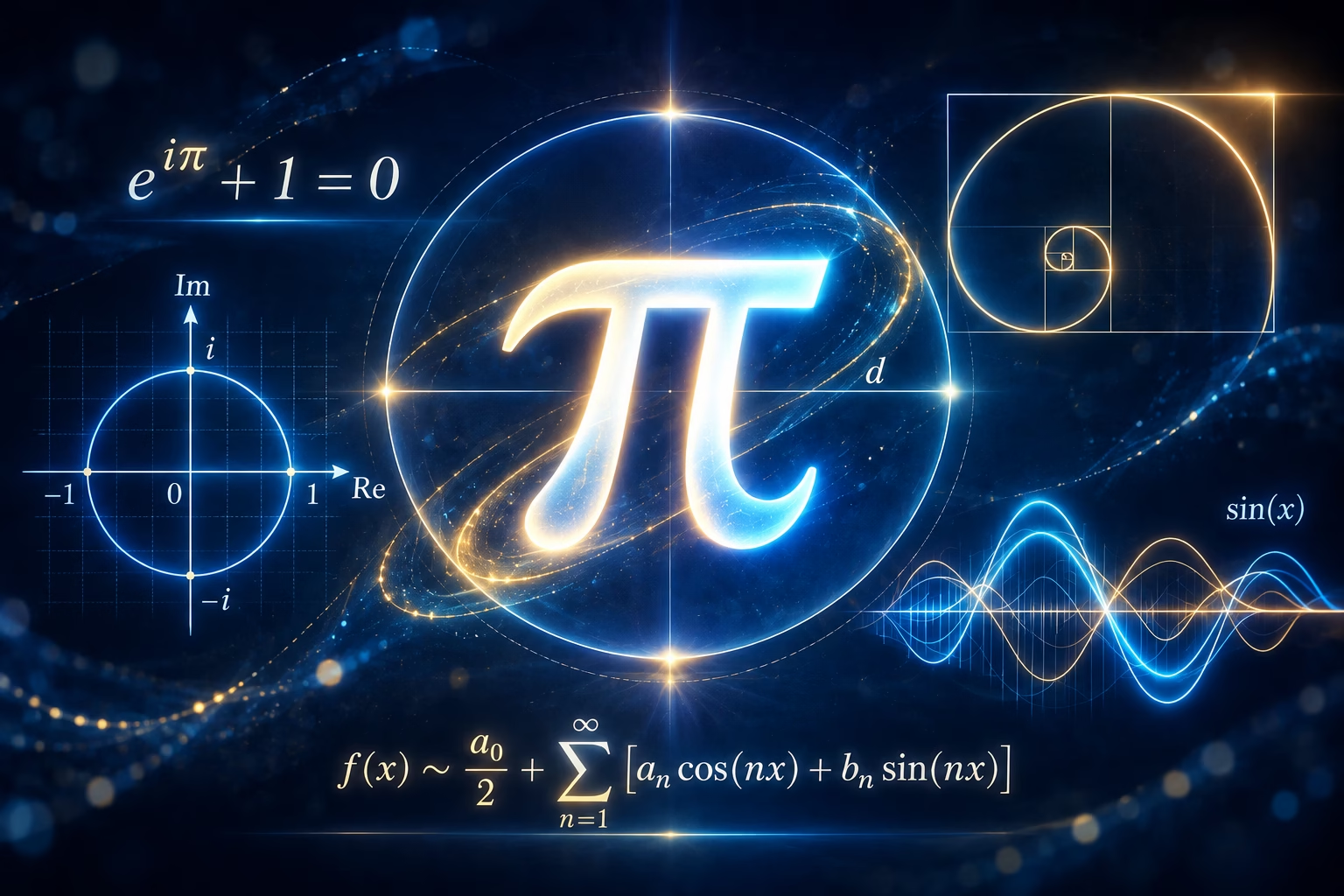
e^iπ + 1 = 0
This equation unites five of the most important mathematical constants:
0, 1, e, i, π
in a single elegant expression.
Many mathematicians regard it as the most beautiful equation ever discovered because it links algebra, geometry, complex numbers, and analysis simultaneously.
This identity provides a natural bridge between our previous discussions of the number e and the imaginary unit i, showing how π unexpectedly emerges from complex exponential functions.
π and the Golden Ratio φ
The relationship between π and the Golden Ratio
φ = [1 + sqrt(5)] / 2
is not as direct as the connection between π, e, and i.
Nevertheless, both constants frequently appear together in advanced geometry, dynamical systems, continued fractions, and certain Fibonacci-related identities.
A fascinating approximation is
φ^2 ≈ π / sqrt(5)
which highlights the surprising numerical proximity between these two famous constants.
Although not an exact equality, such relationships illustrate how mathematical constants often emerge together in unexpected contexts.
π Beyond Geometry
Many people associate π exclusively with circles.
In reality, π appears throughout mathematics and science.
Probability Theory
The famous Gaussian distribution contains
sqrt(2π)
in its normalization factor.
Fourier Analysis
Wave decomposition and signal processing rely heavily on π.
Physics
π appears in:
- electromagnetism
- quantum mechanics
- relativity
- optics
- fluid dynamics
- thermodynamics
Engineering
Electrical engineering, communications, control systems, and digital signal processing all use π extensively.
Computing the Digits of π
Modern algorithms have calculated trillions of digits of π.
While only a few decimal places are needed for most practical applications, the pursuit of additional digits remains important for testing computer hardware, numerical algorithms, and high-performance computing systems.
Remarkably, using only about 39 decimal places of π is sufficient to calculate the circumference of a circle with a radius equal to the observable universe to an accuracy smaller than the diameter of a hydrogen atom.
Why π Matters
The importance of π extends far beyond circles.
It serves as a bridge between:
- geometry
- algebra
- calculus
- complex analysis
- probability
- physics
- engineering
Like e, i, and φ, π demonstrates that mathematics is deeply interconnected. Concepts originating in one branch often reappear in completely unexpected areas.
Conclusion
The number π is far more than the ratio of a circle’s circumference to its diameter.
It is an irrational and transcendental constant that appears throughout mathematics and science, linking geometry with analysis, probability, physics, and engineering.
Together with the number e, the imaginary unit i, and the Golden Ratio φ, π belongs to a small group of mathematical constants that have profoundly shaped our understanding of the mathematical universe.
From ancient geometry to modern quantum mechanics, π continues to reveal new connections and deeper insights, reminding us that some of the most fundamental truths in mathematics emerge from surprisingly simple ideas.