
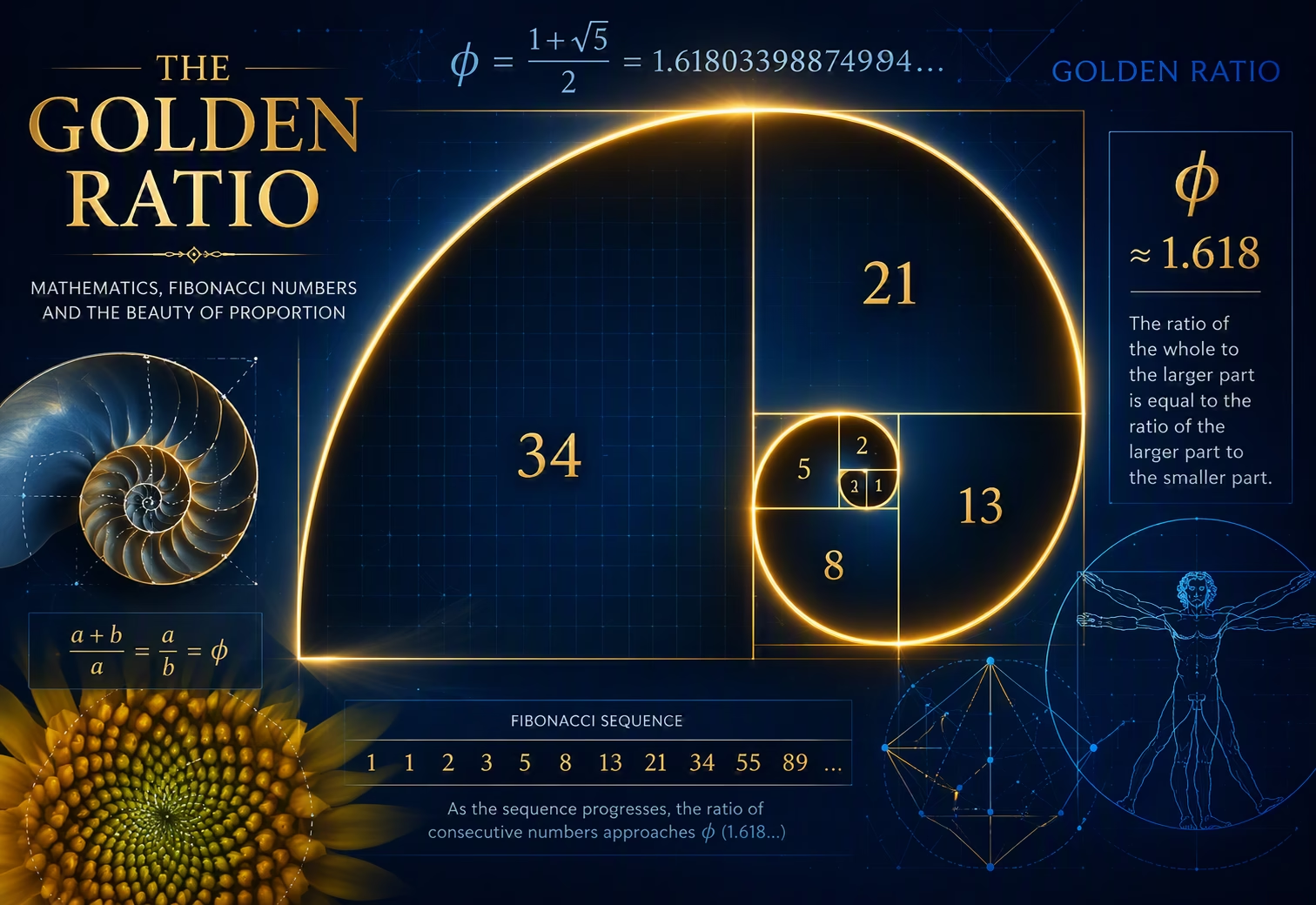
The Golden Ratio is one of the most fascinating numbers in all of mathematics.
It appears in geometry, number theory, algebra, computer science, architecture, art, biology, and countless natural growth processes. For centuries, mathematicians, philosophers, artists, and scientists have been intrigued by its unique mathematical properties and its surprising appearance in the world around us.
While many people have heard about the Golden Ratio through famous works of art or architectural monuments, few realize that there is a bridge in Serbia dedicated entirely to this remarkable mathematical phenomenon.
In the spa town of Vrnjačka Banja stands the Golden Ratio Bridge (also known as the Golden Bridge or the Bridge of Mathematics), one of the rare bridges in the world dedicated to mathematics itself. A commemorative plaque on the bridge beautifully illustrates the fundamental definition of the Golden Ratio and serves as a reminder that mathematics is not merely an abstract science – it is deeply connected with the world around us.
This article explores the Golden Ratio from both a mathematical and cultural perspective. We will derive its famous formula, examine its connection to Fibonacci numbers, study its geometric properties, and discuss its role in nature, science, and human creativity.
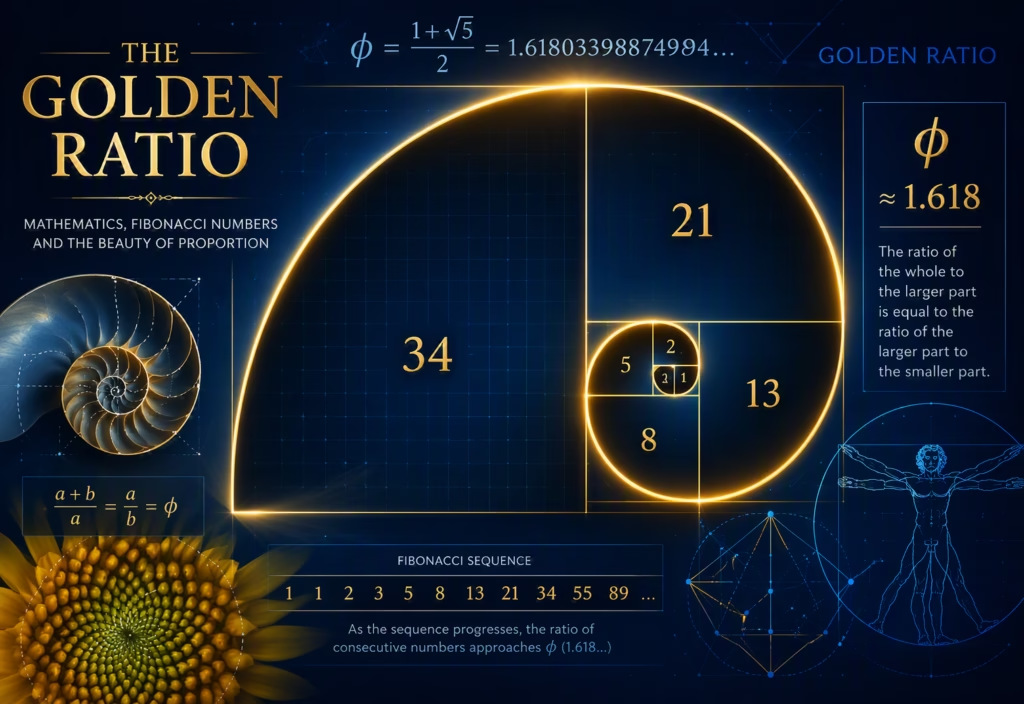
What Is the Golden Ratio
Consider a line segment AB divided at a point C.
Let
∣AB∣ = a + b
where
∣AC∣ = a
and
∣CB∣ = b
with
a > b > 0
The segment is said to be divided according to the Golden Ratio if
∣AB∣ : ∣AC∣ = ∣AC∣ : ∣CB∣
In other words:
The ratio of the entire segment to the larger part equals the ratio of the larger part to the smaller part.
This special proportion defines the Golden Ratio.
Deriving the Formula for the Golden Ratio
Let
φ = a / b
From the defining condition,
(a + b) / a = a / b
Substituting φ = a / b,
(a + b) / a = 1 + b / a = 1 + 1 / φ
Therefore,
φ = 1 + 1 / φ
Multiplying both sides by φ,
φ^2 = φ + 1
Bringing everything to one side gives
φ^2 – φ – 1 = 0
Applying the quadratic formula:
φ = [1 ± sqrt(5)] / 2
Since φ must be positive,
φ = [1 + sqrt(5)] / 2
and numerically
φ ≈ 1.618033988749894…
This irrational number is known as the Golden Ratio, Golden Section, or simply Phi.
Why Is the Symbol φ Used
The symbol φ is the Greek letter phi.
It was adopted in the early twentieth century in honor of the Greek sculptor Phidias, who is often associated – although not without historical debate – with proportions believed to involve the Golden Ratio.
Today, φ is the universally accepted mathematical symbol for the Golden Ratio.
A Remarkable Algebraic Property
The equation
φ^2 = φ + 1
implies several beautiful identities.
For example,
φ – 1 = 1 / φ
Proof:
From
φ^2 = φ + 1
divide by φ:
φ = 1 + 1 / φ
Subtract 1:
φ – 1 = 1 / φ
Thus,
φ – 1 = 1 / φ
which is one of the most elegant self-referential relationships in mathematics.
The Fibonacci Sequence
The famous Fibonacci sequence is
0, 1, 1, 2, 3, 5, 8, 13, 21, 34, 55, …
Each term equals the sum of the previous two:
F_n = F_(n – 1) + F_(n – 2)
For example:
34 = 21 + 13
55 = 34 + 21
The sequence was introduced to Western mathematics by Leonardo of Pisa, better known as Fibonacci, in the year 1202.
The Extraordinary Connection Between Fibonacci Numbers and the Golden Ratio
Consider ratios of consecutive Fibonacci numbers:
1 /1 = 1
2 / 1 = 2
3 / 2 = 1.5
5 / 3 = 1.6667
8 / 5 = 1.6
13 / 8 = 1.625
21 / 13 = 1.61538
34 / 21 = 1.61905
55 / 34 = 1.61765
The values oscillate around the Golden Ratio while getting progressively closer.
Mathematically,
lim_(n→∞) [F_(n + 1) / F_n] = φ
This is one of the most celebrated limits in mathematics.
Binet’s Formula
An even deeper connection emerges through Binet’s Formula:
F_n = (φ^n − ψ^n) / sqrt(5)
where
ψ = [1 – sqrt(5)] / 2
This formula allows any Fibonacci number to be computed directly without calculating all previous terms.
Because
∣ψ∣ < 1
the term ψ^n becomes negligible for large n, yielding
F_n ≈ φ^n / sqrt(5)
Thus, Fibonacci numbers grow approximately as powers of the Golden Ratio.
The Golden Rectangle
A rectangle is called a Golden Rectangle when
length / width = φ
One remarkable property is that removing a square from a Golden Rectangle leaves a smaller rectangle that is also golden.
This self-similarity explains why the Golden Ratio appears in recursive geometric constructions.
The Golden Spiral
By repeatedly removing squares from Golden Rectangles and drawing quarter-circles, we obtain an approximation of the famous Golden Spiral.
The spiral is closely related to logarithmic spirals, which occur in numerous natural growth patterns.
Although many popular sources exaggerate the appearance of exact Golden Spirals in nature, logarithmic spirals are undeniably common in biological and physical systems.
The Golden Ratio Bridge in Vrnjačka Banja
One of the most interesting mathematical landmarks in Serbia is the Golden Ratio Bridge in Vrnjačka Banja.
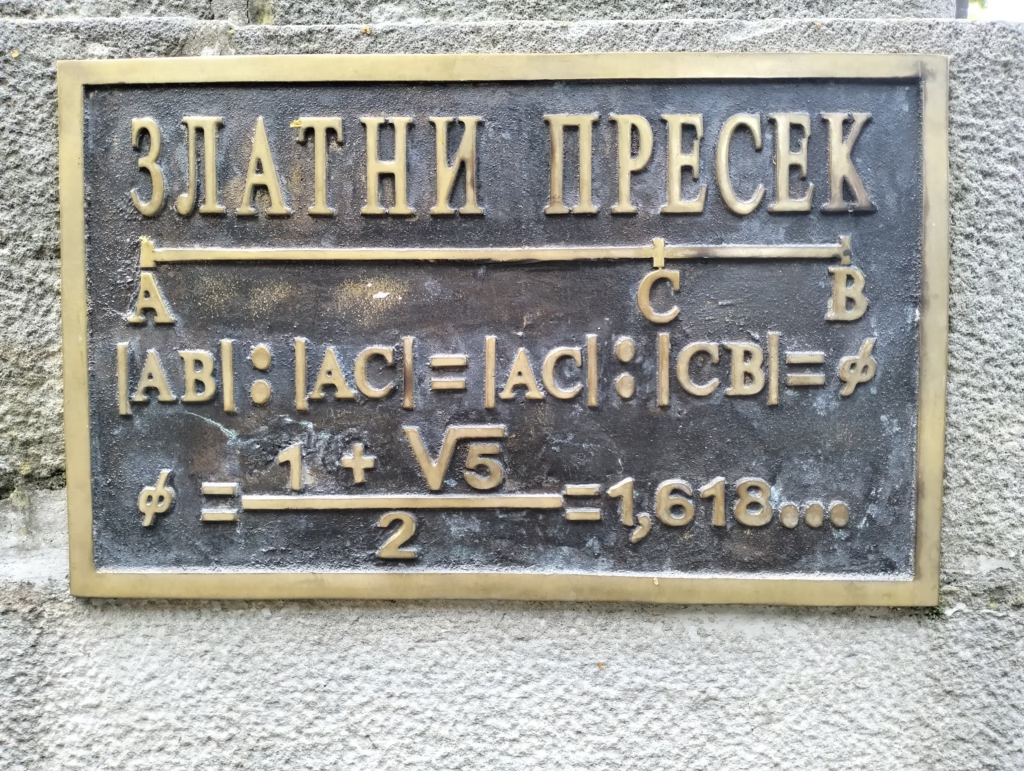
Often referred to as the Golden Bridge or the Bridge of Mathematics, it is among the rare bridges in the world dedicated specifically to a mathematical concept.
The idea originated in 2011 when the renowned Yugoslav chess grandmaster Svetozar Gligorić organized a chess exhibition near the river. During the same event period, the First International Symposium of Mathematicians was held, inspiring the dedication of a bridge to one of mathematics’ most beautiful ideas.
A plaque on the bridge presents the defining relationship of the Golden Ratio:
∣AB∣ : ∣AC∣ = ∣AC∣ : ∣CB∣ = φ
along with the famous value
φ = [1 + sqrt(5)] / 2 ≈1.618
The bridge serves as a unique cultural monument celebrating mathematics as a universal language.
The Golden Ratio in Nature
The Golden Ratio is frequently associated with natural structures.
Examples often discussed include:
Phyllotaxis
The arrangement of leaves around stems frequently follows patterns related to Fibonacci numbers.
Seed Arrangements
Sunflower seed heads often exhibit spiral counts corresponding to neighboring Fibonacci numbers.
Branching Structures
Many plants display branching patterns connected to Fibonacci-type growth.
Biological Growth
Some biological forms can be modeled using logarithmic spirals whose geometry may approximate proportions associated with the Golden Ratio.
It is important to note that not every claim regarding the Golden Ratio in nature withstands rigorous scientific scrutiny. Nevertheless, the connection between Fibonacci patterns and biological growth is well established.
The Golden Ratio in Art and Architecture
For centuries, artists and architects have been fascinated by harmonious proportions.
The Golden Ratio has often been proposed in discussions of:
- Classical Greek architecture
- Renaissance art
- Geometric design
- Modern visual composition
However, modern scholarship generally treats some historical claims with caution. In many cases, exact intentional use of the Golden Ratio remains debated.
What is beyond debate is that proportions near
1.618
are frequently perceived as visually balanced and aesthetically pleasing.
The Golden Ratio in Modern Mathematics
The Golden Ratio appears in many advanced mathematical topics:
Continued Fractions
φ = 1 + 1 / (1 + 1 / (1 + 1 / …
Nested Radicals
φ = sqrt(1 + sqrt(1 + sqrt(1 + ⋯
Pentagons
The ratio of a diagonal to a side of a regular pentagon equals φ.
Number Theory
The Golden Ratio appears in Diophantine approximation and irrationality theory.
Dynamical Systems
Phi emerges in recursive processes and self-similar structures.
Why Mathematicians Love the Golden Ratio
The Golden Ratio is remarkable because it connects:
- Geometry
- Algebra
- Number theory
- Recursive sequences
- Natural growth
- Symmetry
- Aesthetics
Few mathematical constants unify so many different branches of knowledge.
Alongside
the Golden Ratio stands among the most celebrated constants in mathematics.
Conclusion
The Golden Ratio,
φ = [1 + sqrt(5)] / 2
is far more than a curious number.
It arises naturally from a simple geometric division, appears in the limiting behavior of Fibonacci numbers, possesses extraordinary algebraic properties, and continues to inspire mathematicians, scientists, artists, and educators.
Whether encountered in a geometric proof, a Fibonacci sequence, a pentagon, or on the Golden Ratio Bridge in Vrnjačka Banja, the number φ serves as a beautiful reminder that mathematics can reveal deep patterns hidden within both nature and human creativity.