The Wall of Death: The Physics Behind a Motorcycle Defying Gravity

How can a motorcycle travel horizontally along a vertical wooden wall without falling? The answer combines circular motion, Newton’s laws, static friction, torque, and the remarkable skill of the rider.

A Childhood Question That Physics Eventually Answered

When I was a child, I had the opportunity to witness one of the most spectacular motorcycle attractions ever performed at travelling fairs: the Wall of Death.

I stood with the other spectators at the top of a large wooden cylindrical structure and looked down as a motorcyclist entered the arena. The rider began near the bottom, accelerated along the lower sloping section, climbed progressively higher, and finally started moving around the nearly vertical wall.

The motorcycle was no longer travelling on a horizontal floor. It was moving along the inner surface of a vertical wooden cylinder, while the rider’s body was almost parallel to the ground.

To a child, the scene appeared impossible.

  • Why did the motorcycle not fall?
  • What held the rider against the wall?
  • How could a heavy motorcycle and a human body remain on a vertical surface while gravity was constantly pulling them downward?

At that age, I did not know the language of Newtonian mechanics. I knew nothing about centripetal acceleration, normal forces, static friction, inertial reference frames, or rotational equilibrium. I only knew that I was watching something extraordinary.

Years later, after I had studied mathematics, physics, and engineering, the mystery disappeared. Yet the disappearance of the mystery did not diminish the beauty of the spectacle. On the contrary, understanding the science made the experience even more impressive.

What had once looked like a temporary suspension of the laws of nature turned out to be a remarkably elegant consequence of those very laws.

The motorcycle does not remain on the wall because gravity has ceased to act. It remains there because gravity, friction, circular motion, and mechanical equilibrium interact in precisely the right way.

The Wall of Death is not a violation of classical mechanics. It is a dramatic demonstration of it.

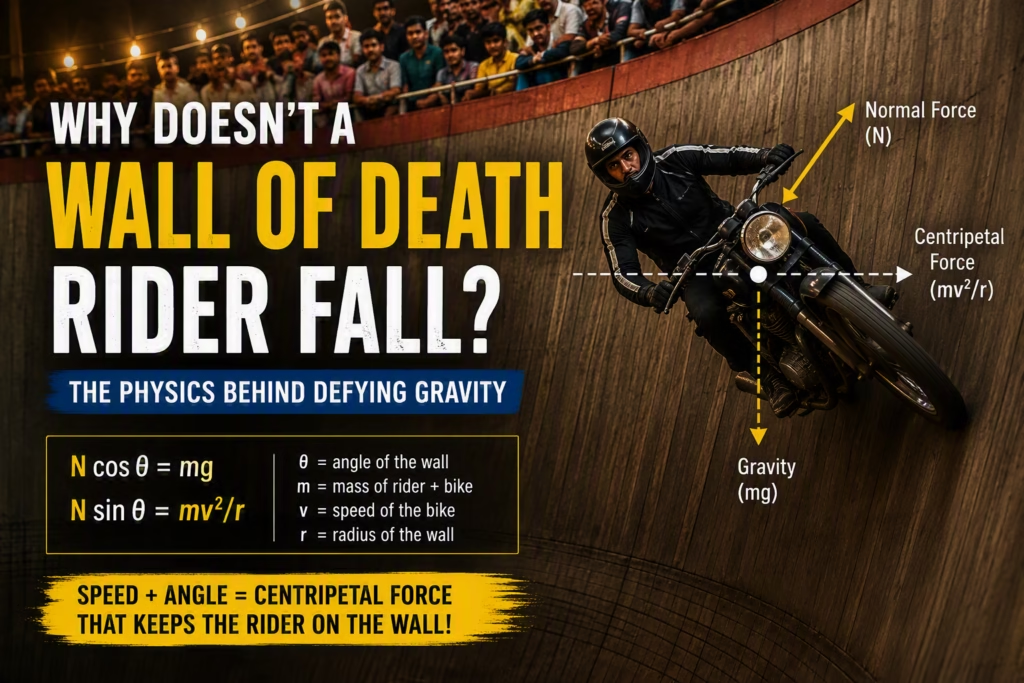
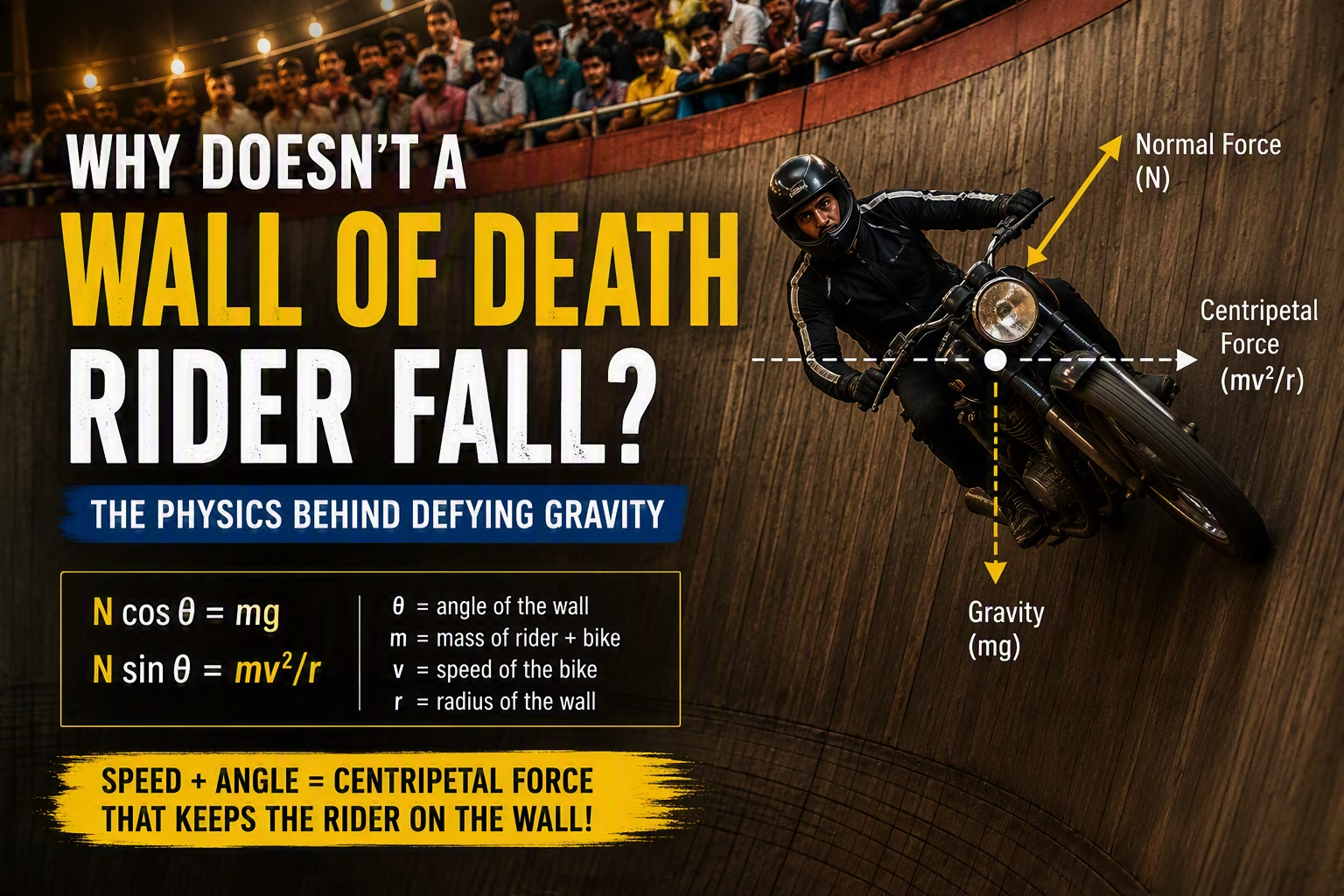
Motorcyclist riding horizontally on the vertical Wall of Death, illustrating the normal force, gravity, friction and centripetal acceleration

What Is the Wall of Death

The Wall of Death, also known as a motordrome, silodrome, or well of death, is a motorcycle stunt performed inside a large cylindrical structure, traditionally constructed from wooden planks.

The rider initially accelerates along the lower, inclined part of the arena. After reaching sufficient speed, the motorcycle climbs onto the vertical cylindrical wall and follows an approximately horizontal circular path.

Spectators usually stand around the upper edge of the cylinder and observe the performance from above.

From the spectator’s perspective, the motorcycle appears to be held against the wall by some mysterious outward force. A rigorous explanation, however, requires us to distinguish carefully between:

  • the motorcycle’s velocity
  • its centripetal acceleration
  • the normal force exerted by the wall
  • the frictional force acting at the tires
  • the gravitational force
  • and the reference frame from which the motion is described

The Idealized Physical Model

To isolate the essential physics, let us begin with an idealized mathematical model.

Basic Assumptions

Assume that:

  • the combined mass of the motorcycle and rider is m
  • the cylindrical wall has radius R
  • the motorcycle moves with constant speed v
  • the motorcycle follows a horizontal circular path
  • the coefficient of static friction between the tires and the wall is μₛ
  • the wall is perfectly vertical
  • the motorcycle remains at a constant height
  • aerodynamic drag and rolling losses are initially neglected

Angular Speed

The relationship between linear speed and angular speed is:

ω = v/R

where:

  • ω is the angular speed, measured in radians per second
  • v is the linear speed of the motorcycle
  • R is the radius of the cylindrical wall

Centripetal Acceleration

A body moving along a circular path experiences centripetal acceleration directed toward the centre of the circle:

ac = v²/R

Using angular speed, the same acceleration can be written as:

ac = ω²R

Therefore:

ac = v²/R = ω²R

The centripetal acceleration is horizontal and directed radially inward, toward the central axis of the cylindrical arena.

Centripetal Force Is Not a Separate Force

The expression centripetal force does not describe an additional physical interaction. It describes the radial component of the resultant force directed toward the centre of the circular trajectory.

According to Newton’s second law:

ΣFᵣ = mac

Therefore:

ΣFᵣ = mv²/R

In the Wall of Death, the wall’s normal force provides the radial force required for circular motion.

Forces Acting on the Motorcycle and Rider

Three principal forces must be considered in the simplified Wall of Death model:

  1. the gravitational force
  2. the normal force exerted by the wall
  3. the static-friction force between the tires and the wall

The Gravitational Force

The combined weight of the motorcycle and rider is:

W = mg

This force acts vertically downward.

Gravity does not disappear during the stunt. The motorcycle remains at a constant height only because another force balances its weight.

The Normal Force

The motorcycle pushes outward against the cylindrical wall. According to Newton’s third law, the wall exerts an equal and opposite force on the motorcycle.

This force is called the normal force because it acts perpendicular to the wall’s surface.

Since the wall is vertical, its normal direction is horizontal and radial. The normal force therefore points toward the cylinder’s axis.

Applying Newton’s second law in the radial direction gives:

N = mv²/R

or, equivalently:

N = mω²R

The normal force changes the direction of the motorcycle’s velocity and keeps the motorcycle moving along its circular path.

Why the Normal Force Cannot Prevent Downward Motion by Itself

The normal force is directed horizontally toward the cylinder’s centre. It has no upward component in the idealized model.

Therefore, the normal force cannot directly balance gravity.

The upward force that prevents the motorcycle from falling must come from static friction.

The Static-Friction Force

The motorcycle has a tendency to move downward because of gravity, so the static-friction force exerted by the wall acts upward.

If the motorcycle remains at a constant height, its vertical acceleration is zero:

ΣFᵥ = 0

Taking upward as the positive direction:

fₛ − mg = 0

Therefore:

fₛ = mg

The static-friction force balances the combined weight of the motorcycle and rider.

The Different Roles of the Normal Force and Friction

The two contact-force components perform fundamentally different functions:

  • N = mv²/R provides the required centripetal force
  • fₛ = mg prevents downward sliding

The motorcycle remains on the wall because these two conditions are satisfied simultaneously.

Why the Friction Is Static, Not Kinetic

At first sight, it may appear that the tires are sliding rapidly across the wooden wall. Under ideal rolling conditions, however, the instantaneous point of contact between a tire and the wall is momentarily at rest relative to the wall.

The tire surface enters the contact region, is instantaneously stationary relative to the wall, and then leaves the contact region as the wheel rotates.

The friction is therefore ideally static friction, not kinetic friction.

The Static-Friction Inequality

The static-friction force does not always equal the product of the coefficient of static friction and the normal force.

The correct relationship is:

|fₛ| ≤ μₛN

The maximum possible magnitude is:

fₛ,ₘₐₓ = μₛN

During steady motion at constant height, the required friction is:

fₛ = mg

Therefore, the condition for avoiding downward slipping is:

mg ≤ μₛN

Only at the threshold of impending downward motion does the friction reach its limiting value:

mg = μₛN

Derivation of the Minimum Speed

We can now derive the most important formula in the physics of the Wall of Death.

Step 1: Write the Radial Equation

The normal force provides the centripetal force:

N = mv²/R

Step 2: Write the No-Slip Condition

To prevent the motorcycle from sliding downward:

mg ≤ μₛN

Step 3: Substitute the Normal Force

Substituting N = mv²/R gives:

mg ≤ μₛmv²/R

Step 4: Cancel the Mass

Dividing both sides by m gives:

g ≤ μₛv²/R

Step 5: Solve for the Speed

Multiplying both sides by R:

gR ≤ μₛv²

Dividing by μ:

gR/μₛ ≤ v²

Taking the positive square root:

v ≥ √(gR/μₛ)

Therefore, the minimum theoretical speed is:

vₘᵢₙ = √(gR/μₛ)

Physical Meaning of the Minimum-Speed Formula

The motorcycle must move fast enough for the wall to exert a sufficiently large normal force.

A larger normal force permits a larger maximum static-friction force:

fₛ,ₘₐₓ = μₛN

If the speed is too low, the normal force becomes too small, the available static friction becomes insufficient, and the motorcycle begins to slide downward.

Minimum Angular Speed, Frequency, and Rotation Rate

The minimum-speed condition can also be expressed in terms of angular speed, rotational frequency, and revolutions per minute.

These alternative forms are useful because a Wall of Death rider follows a circular path, so the motion can be described either by the linear speed along the wall or by the rate at which the motorcycle completes revolutions around the cylinder.

Minimum Angular Speed

The relationship between linear speed and angular speed is:

ω = v/R

At the limiting condition:

ω_min = v_min/R

Since:

v_min = √(gR/μ_s)

we obtain:

ω_min = √(gR/μ_s)/R

Because:

√R/R = 1/√R

the expression simplifies to:

ω_min = √[g/(μ_sR)]

Therefore, the minimum angular speed is:

ω_min = √[g/(μ_sR)]

where:

  • ω_min is the minimum angular speed
  • g is gravitational acceleration
  • R is the radius of the cylindrical wall
  • μ_s is the coefficient of static friction

Minimum Rotational Frequency

Angular speed and frequency are related by:

ω = 2πf

Therefore:

f = ω/(2π)

At the limiting condition:

f_min = ω_min/(2π)

Substituting the expression for the minimum angular speed gives:

f_min = [1/(2π)]√[g/(μ_sR)]

Therefore:

f_min = (1/2π)√[g/(μ_sR)]

The unit of frequency is the hertz:

1 Hz = 1 revolution per second

Minimum Number of Revolutions per Minute

If the rotational frequency is measured in revolutions per second, the corresponding number of revolutions per minute is:

n = 60f

Therefore:

n_min = 60f_min

Substituting the expression for f_min gives:

n_min = 60 · (1/2π)√[g/(μ_sR)]

After simplification:

n_min = (30/π)√[g/(μ_sR)]

This result gives the theoretical minimum number of complete revolutions per minute required to prevent downward slipping in the idealized model.


A Numerical Example

Let us consider a cylindrical Wall of Death with radius:

R = 5.0 m

Assume that the effective coefficient of static friction between the tires and the wooden wall is:

μ_s = 0.70

Take gravitational acceleration to be:

g = 9.81 m/s²

The minimum theoretical speed is:

v_min = √(gR/μ_s)

Substituting the numerical values:

v_min = √[(9.81 m/s²)(5.0 m)/0.70]

First, calculate the quantity inside the square root:

(9.81 × 5.0)/0.70 = 70.0714 m²/s²

Therefore:

v_min = √(70.0714 m²/s²)

and:

v_min ≈ 8.37 m/s

Converting the Speed to Kilometres per Hour

To convert metres per second to kilometres per hour, multiply by 3.6:

v_min ≈ 8.37 × 3.6 km/h

Therefore:

v_min ≈ 30.1 km/h

Thus, for the assumed values of radius and friction coefficient, the theoretical minimum speed is approximately:

v_min ≈ 8.37 m/s ≈ 30.1 km/h

This is only an ideal limiting value. A rider could not safely rely on operating exactly at this threshold because even a small decrease in speed or friction could cause the no-slip condition to fail.

Angular Speed in the Numerical Example

The angular speed is:

ω_min = v_min/R

Substituting the numerical values:

ω_min = 8.37/5.0 rad/s

Therefore:

ω_min ≈ 1.67 rad/s

Rotational Frequency

The rotational frequency is:

f_min = ω_min/(2π)

Therefore:

f_min = 1.67/(2π) Hz

Since:

2π ≈ 6.283

we obtain:

f_min ≈ 0.266 Hz

This means that the motorcycle completes approximately 0.266 revolutions per second.

Revolutions per Minute

The corresponding rotation rate is:

n_min = 60f_min

Therefore:

n_min = 60 × 0.266 rpm

and:

n_min ≈ 16.0 rpm

Thus, the limiting motion in this example corresponds to approximately:

16 complete revolutions per minute

Why the Rider Needs a Safety Margin

The value calculated above represents the boundary between possible static equilibrium and downward slipping in an idealized model.

At exactly:

v = v_min

the available static friction is at its maximum value:

f_s = μ_sN = mg

Any small disturbance could then cause the required friction to exceed the maximum available friction.

Such disturbances may include:

  • a slight reduction in speed
  • a dusty or contaminated section of the wall
  • a change in the effective path radius
  • tire deformation
  • local irregularities in the wooden surface
  • changes in load distribution
  • steering corrections
  • vibration of the motorcycle or structure

For this reason, the theoretical minimum speed should be understood as a physical threshold, not as a practical operating recommendation.

The Wall of Death is a professional stunt and must not be attempted outside a purpose-built environment with trained performers, controlled equipment, and appropriate safety measures.


Why the Rider’s Mass Cancels

One of the most interesting properties of the minimum-speed formula is that it does not explicitly contain the mass of the motorcycle and rider.

The required upward friction is:

f_s = mg

The maximum available static friction is:

f_s,max = μ_sN

The normal force is:

N = mv²/R

Therefore:

f_s,max = μ_smv²/R

The no-slip condition is:

mg ≤ μ_smv²/R

The mass m appears on both sides of the inequality, so it can be cancelled:

g ≤ μ_sv²/R

Consequently:

v ≥ √(gR/μ_s)

The combined mass of the motorcycle and rider does not appear in the final expression.

The Physical Reason for the Mass Cancellation

If the total mass increases, the weight increases in direct proportion:

W = mg

This means that a larger upward frictional force is required.

However, at the same speed and radius, the normal force also increases in direct proportion to mass:

N = mv²/R

Because the maximum available static friction is proportional to the normal force:

f_s,max = μ_sN

the available friction also increases in direct proportion to mass.

Therefore:

  • a larger mass produces a proportionally larger downward gravitational force
  • the same larger mass also produces a proportionally larger normal force
  • the larger normal force permits a proportionally larger static-friction force

These proportional changes cancel in the minimum-speed equation.

Why Mass Still Matters in Reality

The cancellation of mass from the minimum-speed formula does not mean that mass is irrelevant to the real Wall of Death.

A greater total mass increases:

  • the absolute normal force exerted on the wall
  • the absolute frictional force
  • the load on the tires
  • the load on the wooden structure
  • the stresses in the wheels, frame, suspension, and steering system
  • the motorcycle’s kinetic energy
  • the energy involved in acceleration and deceleration

The kinetic energy is:

K = mv²/2

Therefore, at the same speed, doubling the total mass doubles the kinetic energy.

Similarly, the normal force is:

N = mv²/R

so doubling the mass also doubles the normal force.

Mass cancels only from the idealized condition that determines whether sufficient static friction is theoretically available.


Centripetal Force and Centrifugal Force

One of the most common sources of confusion in the Wall of Death is the distinction between centripetal and centrifugal force.

The correct interpretation depends on the reference frame from which the motion is analysed.

The Inertial Reference Frame

Consider an observer standing outside the cylindrical arena.

Relative to this observer, the motorcycle is moving along a circular path. Although the magnitude of its velocity may be constant, the direction of the velocity is continually changing.

A change in velocity means that the motorcycle is accelerating.

The centripetal acceleration is:

ac = v²/R

and it is directed toward the central axis of the cylinder.

According to Newton’s second law, the corresponding radial resultant force must be:

ΣF_r = mac

Therefore:

ΣF_r = mv²/R

In the idealized analysis, the wall’s normal force provides this radial force:

N = mv²/R

There is no real outward centrifugal force acting on the motorcycle in this inertial-frame description.

What Would Happen If the Wall Disappeared

If the wall suddenly ceased to exert its normal force, the motorcycle would no longer have the inward force required for circular motion.

The motorcycle would not continue moving around the circle, nor would the motorcycle initially move directly outward along a radius.

Instead, according to Newton’s first law, the motorcycle would initially continue in the direction of its instantaneous velocity.

That direction is tangent to the circular path.

This thought experiment shows that an inward force is necessary to continually bend the trajectory into a circle.

The Rotating Reference Frame

Now consider the motion from a reference frame rotating together with the motorcycle.

Relative to that rotating frame, the motorcycle remains approximately at the same radial position.

However, a rotating frame is non-inertial. Newton’s laws cannot be applied in their usual equilibrium form unless appropriate inertial forces are introduced.

One of these is the centrifugal pseudo-force:

F_cf = mv²/R

This pseudo-force is directed radially outward.

The radial equilibrium equation in the rotating frame can then be written as:

N − F_cf = 0

or:

N = F_cf

Therefore:

N = mv²/R

Vertically, the equilibrium equation remains:

f_s − mg = 0

Therefore:

f_s = mg

Does Centrifugal Force Exist

The most precise answer is:

  • in an inertial frame, centrifugal force is not a real interaction force acting on the motorcycle
  • in a rotating frame, centrifugal force is introduced as a pseudo-force that allows Newton’s equations to be written in an equilibrium-like form

The statement that “centrifugal force holds the motorcycle against the wall” is therefore incomplete unless the chosen reference frame is specified.

For an observer standing outside the arena, the physically precise statement is:

The wall exerts an inward normal force on the motorcycle, producing the centripetal acceleration required for circular motion.

For an observer using the rotating frame of the motorcycle, the outward centrifugal pseudo-force balances the inward normal force.

Both descriptions can be mathematically consistent, but the forces in the two descriptions do not have the same physical status.


The Ratio of Static Friction to Normal Force

During steady motion at constant height:

f_s = mg

The normal force is:

N = mv²/R

Therefore, the ratio of the required static-friction force to the normal force is:

f_s/N = mg/(mv²/R)

Cancelling the mass gives:

f_s/N = gR/v²

Thus:

f_s/N = gR/v²

This equation gives a useful measure of how much of the available friction is being used.

The Ratio at the Minimum Speed

At the threshold of slipping:

v_min² = gR/μ_s

Substituting this into the ratio gives:

f_s/N = gR/(gR/μ_s)

Therefore:

f_s/N = μ_s

This is precisely the limiting condition:

f_s = μ_sN

What Happens When the Speed Increases?

The required upward friction remains:

f_s = mg

as long as the motorcycle remains at a constant height.

However, the normal force increases with the square of the speed:

N = mv²/R

Therefore, as v increases, the ratio:

f_s/N = gR/v²

decreases.

This means that a smaller fraction of the maximum available static friction is required at higher speeds.

However, this does not mean that unlimited speed is desirable or safe. Increasing speed also increases the normal force, radial acceleration, structural loading, kinetic energy, and physiological stress.


Radial Acceleration and G-Loading

The centripetal acceleration is:

ac = v²/R

It is useful to express this acceleration as a multiple of gravitational acceleration g.

Define the radial G-loading as:

G_r = a_c/g

Substituting the expression for centripetal acceleration gives:

G_r = v²/(Rg)

Therefore:

G_r = v²/(Rg)

Radial G-Loading at the Minimum Speed

At the minimum speed:

v_min² = gR/μ_s

Substituting this into the G-loading equation:

G_r,min = (gR/μ_s)/(Rg)

After cancellation:

G_r,min = 1/μ_s

Therefore:

G_r,min = 1/μ_s

For the numerical example:

μ_s = 0.70

so:

G_r,min = 1/0.70

Therefore:

G_r,min ≈ 1.43

At the theoretical limiting speed, the radial acceleration is therefore approximately:

ac ≈ 1.43g

Why G-Loading Increases Rapidly With Speed

Because:

G_r = v²/(Rg)

the radial G-loading is proportional to the square of the speed:

G_r ∝ v²

If the speed doubles:

G_r,new = (2v)²/(Rg)

Therefore:

G_r,new = 4v²/(Rg)

and:

G_r,new = 4G_r

Thus, doubling the speed produces four times the radial acceleration.

Similarly, increasing the speed by 50% gives:

v_new = 1.5v

Therefore:

G_r,new = (1.5)²G_r

and:

G_r,new = 2.25G_r

A 50% increase in speed therefore produces a 125% increase in radial G-loading.

This quadratic dependence is one of the most important practical limitations of high-speed motion on the Wall of Death.


The Total Contact Force Exerted by the Wall

The wall exerts two perpendicular contact-force components on the motorcycle:

  1. the inward normal force N
  2. the upward static-friction force f_s

The magnitude of their vector resultant is:

F_contact = √(N² + f_s²)

Substituting:

N = mv²/R

and:

f_s = mg

gives:

F_contact = √[(mv²/R)² + (mg)²]

Factoring out inside the square root:

F_contact = √{m²[v⁴/R² + g²]}

Therefore:

F_contact = m√(v⁴/R² + g²)

Contact Force Relative to Ordinary Weight

Dividing the total contact force by the ordinary weight mg gives:

F_contact/(mg) = √[(mv²/R)² + (mg)²]/(mg)

After simplification:

F_contact/(mg) = √[1 + (v²/Rg)²]

Since:

G_r = v²/(Rg)

we obtain:

F_contact/(mg) = √(1 + G_r²)

This relation distinguishes between:

  • the radial acceleration ratio G_r
  • the magnitude of the total contact force relative to ordinary weight

For example, if:

G_r = 1.43

then:

F_contact/(mg) = √(1 + 1.43²)

Therefore:

F_contact/(mg) ≈ √3.045

and:

F_contact/(mg) ≈ 1.75

In this idealized example, the magnitude of the resultant contact force would be approximately 1.75 times the ordinary weight of the motorcycle-rider system.


What Happens If the Speed Falls Below the Minimum Value

Suppose that the motorcycle’s speed decreases below:

v_min = √(gR/μ_s)

The normal force is:

N = mv²/R

As the speed decreases, the normal force decreases with the square of the speed.

The maximum available static friction becomes:

f_s,max = μ_sN

Therefore:

f_s,max = μ_smv²/R

If:

μ_smv²/R < mg

the maximum possible static friction is no longer sufficient to balance the weight.

The motorcycle then begins to accelerate downward.

Downward Acceleration After Sliding Begins

Once relative sliding occurs, kinetic friction becomes relevant.

Let μ_k be the coefficient of kinetic friction.

The kinetic-friction force is modelled as:

f_k = μ_kN

If downward is selected as the positive vertical direction, Newton’s second law gives:

mg − f_k = ma_z

Substituting:

f_k = μ_kN

gives:

mg − μ_kN = ma_z

Since:

N = mv²/R

we obtain:

mg − μ_kmv²/R = ma_z

Cancelling the mass gives:

g − μ_kv²/R = a_z

Therefore:

a_z = g − μ_kv²/R

This simplified equation describes the initial downward acceleration under the assumptions that the motorcycle remains in radial contact with the wall and that its speed and path radius can be treated as approximately constant during the short interval considered.

In a real loss-of-grip event, the motorcycle’s orientation, tire rotation, vertical speed, radial contact, and trajectory may change simultaneously, so the actual dynamics would be considerably more complex.


How Wall and Tire Conditions Affect the Minimum Speed

The minimum-speed equation is:

v_min = √(gR/μ_s)

Therefore:

v_min ∝ 1/√μ_s

This means that reducing the coefficient of static friction increases the minimum required speed.

A wet, dusty, oily, worn, or contaminated contact surface may produce a smaller effective coefficient of friction.

A Reduced-Friction Example

Retain the same cylinder radius:

R = 5.0 m

but suppose that the effective coefficient of friction decreases to:

μ_s = 0.40

The minimum speed becomes:

v_min = √[(9.81)(5.0)/0.40]

Therefore:

v_min = √122.625

and:

v_min ≈ 11.07 m/s

Converting to kilometres per hour:

v_min ≈ 11.07 × 3.6 km/h

Therefore:

v_min ≈ 39.9 km/h

For comparison:

  • when μ_s = 0.70, the theoretical minimum speed is approximately 30.1 km/h
  • when μ_s = 0.40, the theoretical minimum speed is approximately 39.9 km/h

The reduction in friction therefore produces a substantial increase in the required minimum speed.

Why a Small Reduction in Grip Can Be Important

The friction coefficient appears in the denominator:

v_min = √(gR/μ_s)

A reduction in μ_s increases the theoretical minimum speed and reduces the available friction margin at any given speed.

This is why the physical condition of the tires and the wooden wall is fundamental to the mechanics of the stunt.

How the Radius of the Wall Affects the Required Speed

The minimum-speed equation is:

v_min = √(gR/μ_s)

If gravitational acceleration and the coefficient of static friction remain constant, then:

v_min ∝ √R

Therefore, a larger cylindrical wall requires a greater minimum linear speed.

For example, if the radius is increased by a factor of four:

R_new = 4R

then:

v_min,new = √[g(4R)/μ_s]

Therefore:

v_min,new = 2√(gR/μ_s)

and consequently:

v_min,new = 2v_min

A fourfold increase in the radius produces a twofold increase in the minimum linear speed.

Why a Larger Radius Requires a Greater Linear Speed

The normal force required for circular motion is:

N = mv²/R

For a fixed speed, increasing the radius reduces the centripetal acceleration:

ac = v²/R

and therefore reduces the normal force.

Since the maximum available static friction is:

f_s,max = μ_sN

a smaller normal force means a smaller maximum static-friction force.

To maintain sufficient upward friction in a larger cylinder, the motorcycle must therefore move faster.

The Effect of Radius on Angular Speed

The minimum angular speed is:

ω_min = √[g/(μ_sR)]

Therefore:

ω_min ∝ 1/√R

This means that a larger cylinder requires a smaller minimum angular speed, even though it requires a greater minimum linear speed.

At first, these conclusions may appear contradictory:

  • the minimum linear speed increases with radius
  • the minimum angular speed decreases with radius

However, there is no contradiction.

Linear speed and angular speed are related by:

v = ωR

In a larger cylinder, the motorcycle travels a greater distance during each revolution. Consequently, the motorcycle can have a greater linear speed while completing fewer revolutions per unit time.

The Minimum Period of Revolution

The period of revolution is:

T = 2π/ω

At the minimum angular speed:

T_min = 2π/ω_min

Substituting:

ω_min = √[g/(μ_sR)]

gives:

T_min = 2π/√[g/(μ_sR)]

Therefore:

T_min = 2π√(μ_sR/g)

Thus:

T_min ∝ √R

For fixed μ_s and g, a larger cylindrical wall has a longer limiting period of revolution.

Linear Speed and Rotation Rate Describe Different Aspects of the Motion

The linear speed tells us how rapidly the motorcycle moves along the wooden wall.

The angular speed tells us how rapidly the motorcycle changes its angular position around the cylinder’s axis.

The rotation frequency tells us how many complete revolutions are performed per unit time.

A larger cylinder has a greater circumference:

C = 2πR

Therefore, even if the rider completes fewer revolutions per minute, the distance travelled during each revolution is greater.


Dimensional Analysis of the Minimum-Speed Formula

Dimensional analysis provides an important consistency check for any physical equation.

The minimum-speed equation is:

v_min = √(gR/μ_s)

The coefficient of static friction μ_s is dimensionless.

The dimensions of gravitational acceleration are:

[g] = L/T²

The dimensions of radius are:

[R] = L

Therefore:

[gR] = (L/T²)L

and:

[gR] = L²/T²

Taking the square root gives:

[√(gR)] = L/T

The dimensions L/T are precisely the dimensions of velocity.

Therefore:

[v_min] = L/T

The minimum-speed equation is dimensionally consistent.

What Dimensional Analysis Can and Cannot Prove

Dimensional consistency is a necessary condition for a physically correct equation, but it is not a sufficient condition.

An equation with incorrect numerical factors or an incomplete physical model may still be dimensionally consistent.

For example, each of the following expressions has the dimensions of velocity:

√(gR)

2√(gR)

π√(gR)

Dimensional analysis alone cannot determine which numerical factor is correct.

However, if an expression proposed for speed had dimensions such as L²/T or 1/T, dimensional analysis would immediately show that the expression cannot be correct.


A Dimensionless Formulation of Wall of Death Physics

A dimensionless formulation often reveals the structure of a physical problem more clearly than an equation written only in dimensional variables.

Define the dimensionless parameter:

Λ = v²/(gR)

Since:

ac = v²/R

we can also write:

Λ = a_c/g

Thus, Λ represents the radial acceleration expressed as a multiple of gravitational acceleration.

The no-slip condition is:

μ_smv²/R ≥ mg

After cancelling the mass:

μ_sv²/R ≥ g

Dividing both sides by g:

μ_sv²/(gR) ≥ 1

Using the definition of Λ:

μ_sΛ ≥ 1

Therefore:

Λ ≥ 1/μ_s

The limiting condition is:

Λ_min = 1/μ_s

Physical Interpretation of the Dimensionless Parameter

The quantity:

Λ = v²/(gR)

compares two characteristic accelerations:

  • the radial acceleration v²/R
  • gravitational acceleration g

If:

Λ < 1

the radial acceleration is smaller than gravitational acceleration.

If:

Λ = 1

the radial acceleration has the same magnitude as gravitational acceleration.

If:

Λ > 1

the radial acceleration is greater than gravitational acceleration.

However, avoiding downward slipping does not merely require Λ ≥ 1. The coefficient of static friction must also be considered.

The full condition is:

μ_sΛ ≥ 1

or:

Λ ≥ 1/μ_s

Dynamically Similar Wall of Death Systems

Two idealized Wall of Death systems with different radii and speeds can satisfy the same dimensionless condition if they have the same value of:

v²/(gR)

and the same coefficient of static friction.

Suppose that:

v₁²/(gR₁) = v₂²/(gR₂)

Then:

v₁²/R₁ = v₂²/R₂

The two systems have the same radial acceleration and, for the same value of μ_s, the same ratio of required friction to normal force.

This is one reason dimensionless analysis is valuable in engineering and mathematical modelling: it allows systems of different physical sizes to be compared through common nondimensional parameters.


Sensitivity of the Minimum Speed

The minimum-speed equation can be written in power-law form:

v_min = g^(1/2)R^(1/2)μ_s^(-1/2)

This form makes the dependence on each variable particularly clear.

Taking the logarithm of both sides gives:

ln(v_min) = (1/2)ln(g) + (1/2)ln(R) − (1/2)ln(μ_s)

Differentiating gives:

dv_min/v_min = (1/2)(dg/g) + (1/2)(dR/R) − (1/2)(dμ_s/μ_s)

At a fixed location on Earth, changes in g are negligible for this analysis, so:

dg ≈ 0

Therefore:

dv_min/v_min ≈ (1/2)(dR/R) − (1/2)(dμ_s/μ_s)

Sensitivity to the Radius

If the radius increases by a small percentage while μ_s remains constant, then:

Δv_min/v_min ≈ (1/2)(ΔR/R)

Thus, approximately:

  • a 1% increase in radius produces a 0.5% increase in minimum speed
  • a 10% increase in radius produces approximately a 5% increase in minimum speed, within the small-change approximation

Sensitivity to the Coefficient of Friction

If the coefficient of static friction changes while the radius remains constant:

Δv_min/v_min ≈ −(1/2)(Δμ_s/μ_s)

Therefore:

  • an increase in μ_s decreases the minimum speed
  • a decrease in μ_s increases the minimum speed

For small relative changes, a 10% reduction in μ_s produces approximately a 5% increase in the minimum speed.

Exact Calculation Versus Linear Approximation

The differential relation provides only a first-order approximation for small changes.

For larger changes, the exact ratio should be used:

v_min,2/v_min,1 = √[(R₂/R₁)(μ_s,1/μ_s,2)]

If only the coefficient of friction changes:

v_min,2/v_min,1 = √(μ_s,1/μ_s,2)

If only the radius changes:

v_min,2/v_min,1 = √(R₂/R₁)

These exact relations should be used when the changes in radius or friction coefficient are not small.


Uncertainty in the Calculated Minimum Speed

In a theoretical exercise, the values of R and μ_s may be treated as exact.

In a real physical system, both quantities have uncertainty.

The radius may vary slightly along the wooden structure, while the effective friction coefficient can depend on:

  • the tire compound
  • tire pressure
  • tire temperature
  • wooden-surface texture
  • moisture
  • dust
  • oil or other contamination
  • local deformation
  • normal loading
  • small amounts of slip

For independent small uncertainties, a standard first-order propagation model gives:

(Δv_min/v_min)² ≈ (1/4)(ΔR/R)² + (1/4)(Δμ_s/μ_s)²

Therefore:

Δv_min/v_min ≈ (1/2)√[(ΔR/R)² + (Δμ_s/μ_s)²]

If uncertainty in g is also included:

Δv_min/v_min ≈ (1/2)√[(Δg/g)² + (ΔR/R)² + (Δμ_s/μ_s)²]

For an ordinary Wall of Death analysis at a fixed location, uncertainty in g is normally negligible compared with uncertainty in the effective coefficient of friction.

Why the Friction Coefficient Is Not a Perfect Constant

The elementary dry-friction model treats μ_s as a constant.

In reality, the effective tire-wall interaction is more complicated. A rubber tire is deformable, the wooden wall is not perfectly uniform, and the contact occurs over a finite region rather than at a mathematical point.

Therefore, the value of μ_s used in the basic formula should be understood as an effective parameter within a simplified model.

The formula:

v_min = √(gR/μ_s)

is valuable because it identifies the dominant physical relationship. It should not be mistaken for a complete description of every microscopic and engineering detail involved in tire-wall contact.


Mechanical Energy in the Wall of Death

The translational kinetic energy of the combined motorcycle-rider system is:

K_trans = mv²/2

The rotating wheels also possess rotational kinetic energy.

For a wheel with moment of inertia I and angular speed ω_w:

K_rot = Iω_w²/2

For two rotating wheels, the total rotational energy is approximately:

K_wheels = (I_fω_f²)/2 + (I_rω_r²)/2

where the subscripts f and r refer to the front and rear wheels.

The total kinetic energy of the real system includes:

  • translational kinetic energy of the motorcycle and rider
  • rotational kinetic energy of both wheels
  • rotational energy of engine and drivetrain components
  • smaller contributions from other moving mechanical parts

Does the Centripetal Force Perform Work

Mechanical work is defined by:

dW = F · ds

The instantaneous power delivered by a force is:

P = F · v

In uniform circular motion, the normal force is directed radially inward, while the velocity is tangent to the circular path.

The angle between the normal force and velocity is 90 degrees.

Therefore:

P_N = Nv cos(90°)

Since:

cos(90°) = 0

we obtain:

P_N = 0

Thus, the normal force does no work on the centre of mass in the idealized steady circular motion.

The normal force changes the direction of the velocity but not its magnitude.

Does Static Friction Perform Work?

Under ideal rolling without slipping, the instantaneous point of tire-wall contact is at rest relative to the wall.

In the idealized model, static friction therefore does no mechanical work at the instantaneous contact point.

This does not mean that friction is dynamically unimportant.

Static friction is essential because it supplies the upward force:

f_s = mg

A force can be essential for determining the motion even when its instantaneous mechanical power is zero under ideal constraints.

A Necessary Qualification About Static Friction and Work

Statements about the work performed by static friction require careful specification of:

  • the system being analysed
  • the reference frame
  • the location of the force application
  • whether tire deformation is neglected

Real tires deform and exhibit hysteresis. Energy is dissipated through internal deformation, heating, microscopic slip, and vibration.

Therefore, although ideal static friction performs no work at an ideal non-slipping point of contact, a real tire-wall interaction is not perfectly lossless.


Why the Engine Must Continue Producing Power

If the normal force does no work and ideal static friction does no work at the point of contact, it may appear that the engine should require no power once the motorcycle reaches a constant speed.

That conclusion would be valid only for a completely ideal system without dissipative forces.

A real motorcycle must continuously overcome:

  • aerodynamic drag
  • rolling resistance
  • tire deformation
  • bearing friction
  • drivetrain losses
  • engine losses
  • mechanical vibration
  • small steering and speed corrections

During steady motion, the motorcycle’s kinetic energy remains approximately constant.

Therefore:

dK/dt = 0

The average engine power must then balance the total dissipative power:

P_engine = P_drag + P_rolling + P_tire + P_drivetrain + P_other

Aerodynamic Drag

A simplified expression for aerodynamic drag is:

F_D = (1/2)ρ_airC_DAv²

where:

  • ρ_air is the air density
  • C_D is the drag coefficient
  • A is the effective frontal area
  • v is the speed relative to the surrounding air

The power required to overcome aerodynamic drag is:

P_D = F_Dv

Substituting the drag-force expression gives:

P_D = (1/2)ρ_airC_DAv³

Therefore:

P_D ∝ v³

Under this simplified model, doubling the speed increases aerodynamic power by a factor of eight:

P_D,new/P_D,old = (2v)³/v³ = 8

This is another reason why large increases in speed produce rapidly increasing mechanical demands.

Energy Required to Reach the Wall

Before establishing steady motion on the vertical wall, the motorcycle must accelerate.

The increase in translational kinetic energy from rest to speed v is:

ΔK_trans = mv²/2

The wheels and other rotating components must also gain rotational kinetic energy.

If the motorcycle gains height h while moving from the lower part of the arena to the vertical wall, its gravitational potential energy increases by:

ΔU = mgh

The engine must therefore provide energy for:

  • increasing translational kinetic energy
  • increasing rotational kinetic energy
  • increasing gravitational potential energy
  • overcoming dissipative losses during the transition

The Transition From the Floor to the Vertical Wall

The final horizontal circular motion is only one stage of the performance.

The rider must first move from the lower part of the arena onto the vertical wall.

The sequence can be idealized as follows:

  1. the motorcycle accelerates along the lower surface
  2. the motorcycle enters a curved transition region
  3. the trajectory rises upward
  4. the wall becomes progressively steeper
  5. the motorcycle reaches the nearly vertical cylindrical section
  6. the rider stabilizes the motorcycle at approximately constant height

During this transition, the motion is more complicated than uniform horizontal circular motion.

Tangential and Normal Acceleration

For motion along a general curved path, acceleration can be decomposed into tangential and normal components:

a = a_t t̂ + a_n n̂

The tangential component is:

a_t = dv/dt

This component changes the magnitude of the velocity.

The normal component is:

a_n = v²/ρ

where ρ is the local radius of curvature of the trajectory.

This component changes the direction of the velocity.

During the transition:

  • the speed may be increasing
  • the trajectory’s curvature may be changing
  • the direction of the normal force may be changing
  • the motorcycle may be gaining height
  • the vertical acceleration may be nonzero

Consequently, the steady-state equations:

N = mv²/R

and:

f_s = mg

do not necessarily apply in their simple forms throughout the entire transition.

A General Force Equation Along the Transition

Newton’s second law remains valid in vector form:

ΣF = ma

However, the normal and tangential equations depend on the local geometry of the path.

In local path coordinates:

ΣF_t = ma_t

and:

ΣF_n = mv²/ρ

As the motorcycle moves from the lower surface to the vertical wall, the directions represented by and continually change.

Gravity can therefore have both tangential and normal components during the transition.

Why the Simple Minimum-Speed Formula Applies Only to the Vertical Section

The formula:

v_min = √(gR/μ_s)

was derived under the following conditions:

  • the wall is vertical
  • the circular path is horizontal
  • the path radius is constant
  • the vertical acceleration is zero
  • the speed is approximately constant

These conditions apply to the stabilized motion on the vertical cylindrical wall.

They do not fully describe the initial acceleration, the curved transition, or the final descent from the wall.


From a Point Particle to a Real Motorcycle

The minimum-speed equation treats the motorcycle and rider as a single particle of mass m.

This approximation is useful because it captures the essential translational dynamics.

However, a real motorcycle is an extended rigid-body system with:

  • a finite wheelbase
  • two separate tire contact patches
  • a centre of mass located away from both contact points
  • rotating wheels
  • steering geometry
  • suspension
  • a rider whose body position can change
  • aerodynamic forces distributed over the motorcycle and rider

For a complete mechanical description, both translational and rotational dynamics must be considered.

The translational equation is:

ΣF = ma_CM

where a_CM is the acceleration of the combined centre of mass.

The rotational equation about the centre of mass is:

Στ_CM = dL_CM/dt

where:

  • Στ_CM is the net torque about the centre of mass
  • L_CM is the angular momentum about the centre of mass

Translational Equilibrium Is Not Sufficient

The equations:

N = mv²/R

and:

f_s = mg

ensure the required translational motion of the centre of mass in the idealized model.

However, these equations alone do not guarantee that the motorcycle will maintain the correct orientation.

If the forces produce a net roll torque, the motorcycle will undergo angular acceleration.

Therefore, a real rider must position the combined centre of mass and control the motorcycle so that the force and torque conditions are simultaneously compatible with stable motion.

Front and Rear Tire Forces

Let:

  • N_f be the radial normal force at the front tire
  • N_r be the radial normal force at the rear tire
  • f_f be the vertical friction force at the front tire
  • f_r be the vertical friction force at the rear tire

The total radial-force equation is:

N_f + N_r = mv²/R

The total vertical-force equation is:

f_f + f_r = mg

However, the distribution of these forces between the front and rear tires depends on:

  • centre-of-mass position
  • wheelbase
  • motorcycle orientation
  • rider posture
  • acceleration or braking
  • applied driving torque
  • steering input
  • suspension behaviour

Each tire must also satisfy its own friction constraint.

In a simplified form:

|f_f| ≤ μ_fN_f

and:

|f_r| ≤ μ_rN_r

A complete tire model may need to consider simultaneous longitudinal, vertical, and lateral force components rather than only a single friction direction.

Lean Angle, Force Alignment, and Torque Balance

The translational equations determine the motion of the combined centre of mass, but they do not by themselves determine the motorcycle’s orientation.

A real motorcycle is an extended body. Gravity acts through the combined centre of mass, while the contact forces act through the front and rear tire contact regions.

If these forces do not produce the appropriate moment balance, the motorcycle experiences angular acceleration.

The general rotational equation about the combined centre of mass is:

Στ_CM = dL_CM/dt

where:

  • Στ_CM is the resultant torque about the combined centre of mass
  • L_CM is the angular momentum about the combined centre of mass

For an idealized steady orientation relative to the cylindrical wall, the relevant components of the resultant torque must be compatible with the motorcycle’s constant orientation and its continuously changing direction of motion.

The Resultant Contact Force

The wall exerts two principal force components on the motorcycle:

  • the inward normal force N
  • the upward frictional force f_s

The vector sum of these forces is the resultant contact force:

F_contact = N + f_s

Its magnitude is:

F_contact = √(N² + f_s²)

During steady motion:

N = mv²/R

and:

f_s = mg

Therefore:

F_contact = √[(mv²/R)² + (mg)²]

The resultant contact force points both inward and upward.

Direction of the Resultant Contact Force

Let α be the angle between the resultant contact force and the inward horizontal direction.

Then:

tan(α) = f_s/N

Using:

f_s = mg

and:

N = mv²/R

we obtain:

tan(α) = mg/(mv²/R)

After cancelling the mass:

tan(α) = gR/v²

Therefore:

α = arctan(gR/v²)

As the motorcycle’s speed increases, the normal force increases while the required upward friction remains equal to mg.

Consequently, the resultant contact force becomes more nearly horizontal and radially inward.

The Complementary Angle

If β is measured from the upward vertical direction rather than from the inward horizontal direction, then:

β = 90° − α

Therefore:

tan(β) = N/f_s

and:

tan(β) = v²/(gR)

Thus:

β = arctan[v²/(gR)]

The two relations:

tan(α) = gR/v²

and:

tan(β) = v²/(gR)

describe the same resultant-force direction using complementary reference angles.

Why This Angle Is Not Automatically the Motorcycle’s Lean Angle

It is tempting to conclude immediately that the motorcycle itself must be aligned with the resultant contact force.

That conclusion requires additional assumptions.

The motorcycle’s actual orientation depends on:

  • the position of the combined centre of mass
  • the locations of the two tire contact patches
  • the distribution of normal and frictional forces between the wheels
  • steering geometry
  • rider posture
  • wheel angular momentum
  • driving and braking torques
  • suspension deformation
  • transient control inputs

Therefore, the equation:

tan(β) = v²/(gR)

rigorously determines the direction of the idealized resultant contact force relative to the vertical. It does not, by itself, provide a complete geometrical description of the real motorcycle’s orientation.

Under an additional simplified assumption that the relevant resultant passes through the combined centre of mass and that no uncompensated roll moment exists, the force-resultant direction can be related to an effective equilibrium orientation.

That simplified interpretation must not be confused with a complete motorcycle-dynamics model.


A Simplified Torque-Balance Model

To illustrate why torque balance matters, consider an idealized cross-sectional view of the motorcycle-rider system.

Suppose the combined centre of mass is displaced from the effective line of action of the tire contact forces.

The torque produced by a force is:

τ = r × F

The magnitude of the torque is:

τ = rF sin(φ)

where:

  • r is the distance from the chosen axis to the point of force application
  • F is the magnitude of the force
  • φ is the angle between r and F

If gravity and the tire-wall contact forces produce a nonzero resultant roll torque, then:

Στ_roll ≠ 0

and the motorcycle undergoes roll angular acceleration:

Στ_roll = I_rollα_roll

where:

  • I_roll is the effective moment of inertia about the roll axis
  • α_roll is the roll angular acceleration

For a steady orientation, the appropriate time-averaged roll dynamics must satisfy the required rotational condition.

In a highly simplified quasi-static representation:

Στ_roll ≈ 0

However, the complete motion is not truly static. The motorcycle is moving along a curved path, the orientation of the radial direction changes continuously, and the spinning wheels possess angular momentum.

The expression Στ_roll ≈ 0 should therefore be interpreted only as a simplified local balance condition.

Why the Rider’s Body Position Matters

Changing body position changes the location of the combined centre of mass.

If the motorcycle has mass m_m and centre-of-mass position r_m, while the rider has mass m_r and centre-of-mass position r_r, the combined centre of mass is:

r_CM = (m_mr_m + m_rr_r)/(m_m + m_r)

A shift in the rider’s position changes r_r and therefore changes r_CM.

This changes:

  • the moment arms of gravity and the contact forces
  • the distribution of load between the front and rear tires
  • the torque required to maintain the desired orientation
  • the response of the system to disturbances

The rider is therefore not merely a passive mass. The rider forms an active part of the mechanical and control system.


The Role of Gyroscopic Effects

Each rotating wheel possesses angular momentum.

For a simplified axisymmetric wheel:

L_w = I_wω_w

where:

  • L_w is the wheel’s angular momentum
  • I_w is the wheel’s moment of inertia about its rotation axis
  • ω_w is the wheel’s angular speed

If the direction of the wheel’s angular-momentum vector changes, a torque is required:

τ = dL_w/dt

For idealized steady precession, this is often written in magnitude form as:

τ_p = ΩL_w

or:

τ_p = ΩI_wω_w

where Ω is the relevant precession rate.

Why the Wheel Axes Change Direction

As the motorcycle travels around the cylindrical wall, the orientation of the local radial direction changes continuously.

Even if the motorcycle maintains an approximately constant orientation relative to the local wall, the wheel axes change direction relative to an inertial frame.

The rotating wheels can therefore contribute gyroscopic torques.

These torques may affect:

  • steering effort
  • roll response
  • stability during disturbances
  • the transition onto the vertical wall
  • corrections made by the rider

Why Gyroscopic Effects Do Not Hold the Motorcycle Up

Gyroscopic effects are not the principal reason the motorcycle avoids falling.

The required upward translational force remains:

f_s = mg

The radial equation remains:

N = mv²/R

If the coefficient of friction were zero, there would be no upward frictional force to balance gravity, regardless of the wheel angular momentum.

Therefore:

Gyroscopic effects can influence orientation, steering, and stability, but static friction provides the upward force that prevents downward sliding.

The Gyroscopic Explanation Is Often Overstated

A common popular explanation claims that a moving motorcycle remains stable entirely because of the gyroscopic effect of its wheels.

That explanation is incomplete.

Motorcycle and bicycle dynamics also depend on:

  • steering geometry
  • trail
  • mass distribution
  • tire behaviour
  • speed
  • frame properties
  • rider control
  • the coupling between steering and roll

The gyroscopic effect is one component of the complete dynamics, not a universal explanation for every aspect of motorcycle stability.


Driving Force, Wheel Rotation, and Available Friction

The analysis so far has treated the vertical friction force as though it were the only tangential tire force.

A real powered motorcycle must also transmit driving force through at least one tire contact region.

The available tire-wall friction must therefore support more than one mechanical function.

Multiple Friction Components

Let:

  • f_z be the upward friction component that supports the motorcycle against gravity
  • f_t be the tangential driving or braking component along the direction of motion

A simplified combined-friction condition is:

√(f_z² + f_t²) ≤ μ_sN

During perfectly steady motion at constant speed:

f_z = mg

The tangential component must balance resistive forces:

f_t = F_resistance

Therefore, the combined condition becomes:

√[(mg)² + F_resistance²] ≤ μ_sN

Using:

N = mv²/R

gives:

√[(mg)² + F_resistance²] ≤ μ_smv²/R

This condition is more restrictive than the elementary relation:

mg ≤ μ_sN

whenever the tire must transmit a significant driving or braking force.

The Elementary Minimum-Speed Formula Is an Ideal Lower Bound

The familiar formula:

v_min = √(gR/μ_s)

assumes that the available friction is used only to prevent downward sliding.

If some of the available friction must also provide:

  • acceleration
  • braking
  • resistance compensation
  • steering correction
  • additional stabilizing forces

then the real required speed or friction margin may be greater than the elementary result suggests.

The elementary formula should therefore be interpreted as an ideal theoretical threshold under a restricted set of assumptions.


A More General Friction-Limited Model

Suppose the total non-radial contact-force demand has magnitude F_T.

The friction constraint is:

F_T ≤ μ_sN

Since:

N = mv²/R

we obtain:

F_T ≤ μ_smv²/R

Solving for speed gives:

v² ≥ F_TR/(μ_sm)

Therefore:

v ≥ √[F_TR/(μ_sm)]

If the only non-radial force is the upward force balancing gravity, then:

F_T = mg

and the familiar result follows:

v ≥ √[(mg)R/(μ_sm)]

Therefore:

v ≥ √(gR/μ_s)

Including a Tangential Resistive Force

If the vertical and tangential friction components are perpendicular:

F_T = √[(mg)² + F_resistance²]

The limiting speed becomes:

v_min,general = √{[R/(μ_sm)]√[(mg)² + F_resistance²]}

Dividing the force expression by m can make the structure clearer.

Define the equivalent resistive acceleration:

a_res = F_resistance/m

Then:

F_T/m = √(g² + a_res²)

Therefore:

v_min,general = √{(R/μ_s)√(g² + a_res²)}

If:

a_res = 0

the result reduces to:

v_min = √(gR/μ_s)

This generalized expression remains an idealized friction-circle model, but it demonstrates why the elementary minimum-speed formula does not include every demand placed on the tire-wall contact.


Structural Loading of the Cylindrical Wall

The motorcycle exerts an outward radial force on the wall.

By Newton’s third law, the magnitude of this force is equal to the inward normal force exerted by the wall on the motorcycle:

N = mv²/R

The structure must withstand this moving load as the motorcycle travels around the cylinder.

Dependence of Structural Load on Speed

The normal force is proportional to the square of the speed:

N ∝ v²

If the speed is increased by a factor k:

v_new = kv

then:

N_new = m(kv)²/R

Therefore:

N_new = k²N

Examples:

  • increasing speed by 10% multiplies the normal force by 1.1² = 1.21
  • increasing speed by 50% multiplies the normal force by 1.5² = 2.25
  • doubling the speed multiplies the normal force by 4

A moderate increase in speed can therefore produce a much larger increase in radial structural loading.

A Moving and Repeated Load

The point or region of maximum local load moves around the circumference together with the motorcycle.

The wall is therefore subjected to:

  • repeated loading
  • local bending
  • vibration
  • dynamic amplification
  • cyclic stresses
  • forces transmitted through joints and supporting members

If several motorcycles are present simultaneously, the total structural loading depends not only on the individual forces but also on the angular positions of the motorcycles around the cylinder.

Why the Wall Cannot Be Treated as Perfectly Rigid

The elementary model assumes that the wall is perfectly rigid and perfectly cylindrical.

A real wooden structure can deform under load.

Deformation may change:

  • the local surface orientation
  • the effective radius
  • the distribution of contact pressure
  • vibration levels
  • tire-wall interaction

A complete engineering analysis would therefore require a structural model in addition to the vehicle-dynamics model.


Human Physiology and Apparent Loading

The motorcycle and rider experience a large inward acceleration:

ac = v²/R

The rider’s body must be accelerated together with the motorcycle.

For a body segment of mass m_b, the required inward resultant force is approximately:

F_b = m_bv²/R

From the rider’s rotating reference frame, this corresponds to the familiar sensation of being pressed outward against the motorcycle and wall.

Radial Loading Relative to Body Weight

The radial acceleration expressed in units of g is:

G_r = v²/(Rg)

The magnitude of the combined effective acceleration in the rotating-frame interpretation is:

a_eff = √(g² + a_c²)

Substituting:

ac = v²/R

gives:

a_eff = √[g² + (v²/R)²]

Dividing by g:

a_eff/g = √[1 + (v²/(Rg))²]

Therefore:

a_eff/g = √(1 + G_r²)

This is mathematically equivalent to the ratio previously obtained for the magnitude of the resultant contact force:

F_contact/(mg) = √(1 + G_r²)

High Speed and Human Limitations

As speed increases, radial acceleration increases as .

This can make it increasingly difficult for the rider to:

  • maintain posture
  • move the head and limbs
  • steer accurately
  • make rapid corrections
  • tolerate sustained mechanical loading

The physical limits of a high-speed Wall of Death performance are therefore not determined only by the minimum-friction condition.

They also depend on:

  • human tolerance
  • motorcycle strength
  • tire behaviour
  • wall strength
  • available engine power
  • stability and controllability

Minimum Speed and Maximum Practical Speed Are Different Problems

The minimum-speed problem asks:

What speed is required to make sufficient upward friction possible?

The maximum practical speed asks a much broader question involving:

  • physiological limits
  • structural limits
  • tire limits
  • available power
  • aerodynamic effects
  • control authority
  • acceptable safety margins

The formula:

v_min = √(gR/μ_s)

answers only the first question.

It does not determine the maximum safe or practical speed.


Why Greater Speed Is Not Automatically Safer

Within the elementary friction model, increasing speed increases the normal force:

N = mv²/R

This increases the maximum available static friction:

f_s,max = μ_smv²/R

Consequently, increasing speed creates a larger margin against downward slipping.

However, other quantities also increase.

Quantities That Increase With the Square of Speed

The following quantities scale with :

  • centripetal acceleration:

ac = v²/R

  • radial G-loading:

G_r = v²/(Rg)

  • normal force:

N = mv²/R

  • translational kinetic energy:

K = mv²/2

  • simplified aerodynamic drag:

F_D = ρ_airC_DAv²/2

Aerodynamic Power Increases With the Cube of Speed

The simplified aerodynamic power is:

P_D = ρ_airC_DAv³/2

Therefore:

P_D ∝ v³

This means that the required power can increase even more rapidly than the radial force.

Competing Effects of Increasing Speed

Increasing speed has both favourable and unfavourable consequences.

The favourable effect is:

  • a greater available friction margin against downward sliding

The unfavourable effects include:

  • greater radial acceleration
  • greater structural load
  • greater tire load
  • greater kinetic energy
  • greater aerodynamic resistance
  • greater required engine power
  • greater physiological loading
  • potentially more severe consequences of a disturbance

Therefore:

A speed above the theoretical minimum is necessary, but unlimited speed is neither necessary nor desirable.


Common Misconceptions About the Wall of Death

Several incomplete or incorrect explanations are frequently used to describe the Wall of Death.

Misconception 1: The Motorcycle Defeats Gravity

The motorcycle does not defeat or eliminate gravity.

Gravity continues to act downward:

W = mg

The motorcycle remains at constant height because static friction acts upward:

f_s = mg

The vertical resultant force is zero, but neither gravity nor friction is absent.

Misconception 2: Centripetal Force Is an Additional Force

Centripetal force is not an additional force that should be drawn separately from the normal force.

The expression:

F_c = mv²/R

specifies the required net inward force.

In the ideal Wall of Death model:

N = F_c

The normal force is the real physical force that performs the centripetal role.

Misconception 3: Static Friction Always Equals μ_sN

The general static-friction condition is:

|f_s| ≤ μ_sN

During steady motion:

f_s = mg

If the speed is greater than the minimum speed:

mg < μ_sN

Therefore, static friction is smaller than its maximum possible value.

The equality:

f_s = μ_sN

holds only at the limiting condition immediately before slipping.

Misconception 4: Increasing Speed Increases the Required Upward Friction

At constant height, the required upward friction remains:

f_s = mg

Increasing speed increases the normal force and the maximum available friction.

It does not increase the upward force required to balance the same weight.

Misconception 5: Centrifugal Force Is Always Fictitious and Must Never Be Used

Centrifugal force should not be introduced as a real interaction force in an inertial frame.

However, it can be used consistently as a pseudo-force in a rotating reference frame.

The important requirement is to identify the reference frame clearly.

Misconception 6: Gyroscopic Effects Alone Prevent the Motorcycle From Falling

Gyroscopic effects can influence orientation and stability, but the upward force balancing gravity is static friction.

Without sufficient friction, wheel rotation alone cannot prevent downward sliding.

Misconception 7: The Rider’s Mass Never Matters

Mass cancels from the ideal minimum-speed formula:

v_min = √(gR/μ_s)

However, mass still affects:

  • normal force
  • friction-force magnitudes
  • tire loading
  • structural loading
  • kinetic energy
  • acceleration and braking demands

Misconception 8: The Calculated Minimum Speed Is a Safe Operating Speed

The calculated minimum speed is an ideal threshold.

It does not include:

  • variable surface conditions
  • speed fluctuations
  • tire deformation
  • multiple friction demands
  • rider-control errors
  • structural vibration
  • engineering safety factors

It must not be interpreted as a practical safety instruction.

Misconception 9: The Wall of Death Is the Same as a Vertical Loop

In the Wall of Death, the motorcycle follows a horizontal circular path inside a vertical cylindrical wall.

In a vertical loop, the trajectory lies in a vertical plane.

In a vertical loop, the radial and tangential components of gravity vary continuously with position.

The two problems therefore have different force equations and different minimum-speed conditions.


Why the Wall of Death Is an Exceptional Physics Example

The Wall of Death connects a striking real-world spectacle with many fundamental concepts of classical mechanics.

The phenomenon illustrates:

  • Newton’s first law
  • Newton’s second law
  • Newton’s third law
  • uniform circular motion
  • centripetal acceleration
  • normal force
  • static friction
  • limiting friction
  • inertial reference frames
  • rotating reference frames
  • centrifugal pseudo-force
  • translational dynamics
  • rotational dynamics
  • torque balance
  • angular momentum
  • energy and power
  • dimensional analysis
  • scaling laws
  • uncertainty
  • structural loading
  • vehicle control

The basic mechanism can be expressed through two remarkably simple equations:

N = mv²/R

and:

f_s = mg

Yet those equations open the door to a much deeper analysis involving realistic tire behaviour, torque balance, rotating wheels, structural mechanics, human physiology, and control theory.

The Difference Between Explanation and Reduction

A scientific explanation does not reduce the Wall of Death to something trivial.

The physics explains why the stunt is possible, but the performance remains demanding.

The laws of mechanics do not automatically produce a successful ride. The performer must control a real motorcycle in a real structure under rapidly changing and potentially severe physical conditions.

The phenomenon is therefore both:

  • an elegant demonstration of physical law
  • an extraordinary example of human skill applied within those laws

Compact Mathematical Summary

The essential physics of the Wall of Death can be summarized through a relatively small number of equations.

Assume that:

  • m is the combined mass of the motorcycle and rider
  • R is the radius of the cylindrical wall
  • v is the motorcycle’s linear speed
  • ω is its angular speed
  • μ_s is the coefficient of static friction
  • g is gravitational acceleration
  • N is the normal force exerted by the wall
  • f_s is the static-friction force

Linear and Angular Speed

The relationship between linear speed and angular speed is:

v = ωR

Therefore:

ω = v/R

Centripetal Acceleration

The motorcycle’s centripetal acceleration is:

ac = v²/R

or:

ac = ω²R

Therefore:

ac = v²/R = ω²R

Radial Force Equation

The normal force exerted by the wall provides the required centripetal force:

N = mac

Therefore:

N = mv²/R

or:

N = mω²R

Vertical Force Equation

During steady motion at constant height, the vertical acceleration is zero.

Therefore:

f_s − mg = 0

and:

f_s = mg

Static-Friction Constraint

The magnitude of the static-friction force must satisfy:

|f_s| ≤ μ_sN

Because the required upward friction is mg, the no-slip condition becomes:

mg ≤ μ_sN

Substituting the normal force:

mg ≤ μ_smv²/R

Minimum Linear Speed

After cancelling the mass and solving for the speed:

v² ≥ gR/μ_s

Therefore:

v ≥ √(gR/μ_s)

The theoretical minimum speed is:

v_min = √(gR/μ_s)

Minimum Angular Speed

Since:

ω = v/R

the minimum angular speed is:

ω_min = √[g/(μ_sR)]

Minimum Rotational Frequency

Because:

f = ω/(2π)

the minimum frequency is:

f_min = (1/2π)√[g/(μ_sR)]

Minimum Rotation Rate in Revolutions per Minute

Since:

n = 60f

the minimum rotation rate is:

n_min = (30/π)√[g/(μ_sR)]

Radial Acceleration in Units of g

The radial G-loading is:

G_r = a_c/g

Therefore:

G_r = v²/(Rg)

At the theoretical minimum speed:

G_r,min = 1/μ_s

Required Friction-to-Normal-Force Ratio

During steady motion:

f_s/N = mg/(mv²/R)

Therefore:

f_s/N = gR/v²

At the limiting speed:

f_s/N = μ_s

Resultant Contact Force

The total contact force exerted by the wall has an inward normal component and an upward frictional component.

Its magnitude is:

F_contact = √(N² + f_s²)

Therefore:

F_contact = m√(v⁴/R² + g²)

Relative to ordinary weight:

F_contact/(mg) = √[1 + (v²/Rg)²]

Using G_r = v²/(Rg):

F_contact/(mg) = √(1 + G_r²)

Direction of the Resultant Contact Force

If α is measured upward from the inward horizontal direction:

tan(α) = f_s/N

Therefore:

tan(α) = gR/v²

and:

α = arctan(gR/v²)

If the complementary angle β is measured from the upward vertical:

tan(β) = v²/(gR)

and:

β = arctan[v²/(gR)]

These equations determine the direction of the idealized resultant contact force. Relating this direction directly to the actual orientation of a real motorcycle requires additional assumptions about the force lines of action and torque balance.

Downward Acceleration After Sliding Begins

If downward sliding begins and kinetic friction is modelled by the coefficient μ_k, then:

mg − μ_kN = ma_z

Using:

N = mv²/R

gives:

a_z = g − μ_kv²/R

Dimensionless No-Slip Condition

Define:

Λ = v²/(gR)

Then the no-slip condition becomes:

μ_sΛ ≥ 1

or:

Λ ≥ 1/μ_s

Dependence on Radius and Friction

The minimum speed scales as:

v_min ∝ √R

and:

v_min ∝ 1/√μ_s

The minimum angular speed scales as:

ω_min ∝ 1/√R

Sensitivity Relation

For small changes:

dv_min/v_min = (1/2)(dg/g) + (1/2)(dR/R) − (1/2)(dμ_s/μ_s)

At a fixed location, where dg ≈ 0:

dv_min/v_min ≈ (1/2)(dR/R) − (1/2)(dμ_s/μ_s)

Translational Kinetic Energy

The translational kinetic energy is:

K_trans = mv²/2

Normal Force and Mechanical Power

Because the normal force is perpendicular to the instantaneous velocity:

P_N = N · v = 0

In the ideal steady model, the normal force changes the direction of the velocity but not its magnitude.

Simplified Aerodynamic Drag and Power

The aerodynamic drag force can be modelled as:

F_D = (1/2)ρ_airC_DAv²

The corresponding aerodynamic power is:

P_D = (1/2)ρ_airC_DAv³

Therefore:

P_D ∝ v³


What the Wall of Death Teaches Us About Physics

The Wall of Death is much more than an entertaining application of one elementary equation.

It connects several fundamental areas of classical mechanics:

  • Newton’s laws of motion
  • uniform circular motion
  • centripetal acceleration
  • normal force
  • static and kinetic friction
  • inertial and rotating reference frames
  • centrifugal pseudo-force
  • translational dynamics
  • torque and rotational dynamics
  • angular momentum
  • gyroscopic effects
  • mechanical energy and power
  • dimensional analysis
  • dimensionless parameters
  • uncertainty and sensitivity
  • structural mechanics
  • motorcycle control and stability
  • human tolerance to acceleration

The most basic explanation depends on two equations:

N = mv²/R

and:

f_s = mg

The first equation describes the horizontal dynamics. The wall’s normal force continually changes the direction of the motorcycle’s velocity and makes circular motion possible.

The second equation describes the vertical balance. Static friction prevents the motorcycle and rider from sliding downward under gravity.

Combining these equations with the static-friction limit gives:

v_min = √(gR/μ_s)

This formula captures the essential physical mechanism, but the real phenomenon is richer than the formula alone.

A real Wall of Death performance also involves:

  • two deformable tires
  • separate front and rear contact forces
  • a moving combined centre of mass
  • steering corrections
  • torque balance
  • rotating wheels
  • aerodynamic resistance
  • structural deformation
  • engine-power limitations
  • physiological loading
  • a rider continuously controlling the system

The textbook model explains why the stunt is physically possible.

The engineering model explains why performing it reliably is difficult.


From Childhood Wonder to Scientific Understanding

As a child watching the Wall of Death, I did not see vectors, equations, or force diagrams.

I saw a motorcycle moving where, according to everyday intuition, a motorcycle should not be able to move.

The wall was vertical. Gravity was pulling downward. There appeared to be nothing beneath the motorcycle that could support it.

The scene contradicted everything that ordinary experience seemed to suggest.

At that time, I asked the natural question:

Why does the motorcycle not fall?

Years later, mathematics and physics provided the answer.

The motorcycle requires inward acceleration to follow the circular path. The wall supplies the necessary inward normal force:

N = mv²/R

The large normal force makes an upward static-friction force possible. That friction balances the weight:

f_s = mg

The motorcycle can remain at constant height only if the maximum available static friction is at least as large as the gravitational force:

μ_sN ≥ mg

Therefore:

v ≥ √(gR/μ_s)

The mystery was replaced by understanding.

But the fascination did not disappear.

On the contrary, the spectacle became even more impressive.

What had once appeared to be an exception to the laws of nature turned out to be a particularly elegant expression of those laws.


Physics Does Not Destroy Wonder

Scientific understanding is sometimes described as though it diminishes the beauty of an experience.

According to that view, a phenomenon is fascinating only while it remains unexplained.

The Wall of Death suggests the opposite.

Before understanding the physics, we may admire the apparent impossibility of the stunt.

After understanding the physics, we can admire far more:

  • the precision of the force balance
  • the relationship between speed and normal force
  • the role of static friction
  • the cancellation of mass from the minimum-speed condition
  • the distinction between inertial and rotating reference frames
  • the quadratic growth of acceleration with speed
  • the rider’s control of a complex mechanical system
  • the fact that a simple set of laws can explain such a dramatic spectacle

The explanation does not make the phenomenon ordinary.

The explanation reveals the hidden structure that makes the phenomenon possible.

Science does not tell us that nothing remarkable happened.

Science tells us exactly what was remarkable about it.


Conclusion: It Was Never Magic, but It Was Always Beautiful

When I watched the Wall of Death as a child, the spectacle seemed to contradict gravity.

A motorcycle travelled horizontally around a vertical wooden wall. The rider was not supported by a floor, yet the motorcycle did not fall.

The explanation can be summarized in three steps.

First, circular motion requires inward centripetal acceleration:

ac = v²/R

Second, the wall provides the necessary inward normal force:

N = mv²/R

Third, the normal force makes sufficient upward static friction possible:

f_s = mg

subject to the condition:

mg ≤ μ_sN

Therefore:

v ≥ √(gR/μ_s)

The motorcycle does not remain on the wall because gravity has been defeated.

It remains there because gravity is balanced by friction, while the wall’s normal force produces the required centripetal acceleration.

The Wall of Death does not suspend the laws of physics.

It displays them.

What appeared miraculous to a child became understandable to an adult through mathematics, physics, and engineering.

Yet understanding did not make the memory less powerful.

It made it deeper.

First came the spectacle.

Then came the question.

Finally came the mathematics.

And although mathematics removed the mystery, it preserved the wonder.


Frequently Asked Questions About Wall of Death Physics

Why Does the Motorcycle Not Fall From the Wall of Death

The motorcycle does not fall because static friction between the tires and the wall acts upward and balances the combined weight of the motorcycle and rider.

During steady motion:

f_s = mg

The friction is possible because the wall exerts a large normal force on the motorcycle.

What Force Provides the Centripetal Force

The normal force exerted by the wall provides the centripetal force.

The radial equation is:

N = mv²/R

The term centripetal force describes the role of the inward resultant force. It is not a separate force in addition to the normal force.

What Is the Minimum Speed in the Wall of Death

In the idealized model, the minimum speed is:

v_min = √(gR/μ_s)

where:

  • g is gravitational acceleration
  • R is the radius of the wall
  • μ_s is the coefficient of static friction

This is a theoretical limiting value, not a practical safety recommendation.

Why Does Greater Speed Increase the Available Friction

The maximum available static friction is:

f_s,max = μ_sN

The normal force is:

N = mv²/R

Therefore:

f_s,max = μ_smv²/R

As speed increases, the normal force and the maximum available static friction increase proportionally to .

Does the Required Upward Friction Increase With Speed

No.

If the motorcycle remains at a constant height, the required upward friction is:

f_s = mg

This value does not increase with speed.

Increasing speed increases the maximum friction that can be available, not the upward force required to balance the same weight.

Is the Friction Static or Kinetic

Under ideal rolling conditions, the tire contact points do not slide relative to the wall, so the friction is static.

Kinetic friction becomes relevant if relative sliding begins.

Does Static Friction Always Equal μ_sN

No.

The general condition is:

|f_s| ≤ μ_sN

Static friction adjusts to the value required by the motion, up to its maximum possible magnitude.

The equality:

f_s = μ_sN

applies only at the threshold of slipping.

Does Centrifugal Force Hold the Motorcycle Against the Wall

The answer depends on the reference frame.

In an inertial frame outside the arena, the wall exerts a real inward normal force that produces centripetal acceleration.

In the rotating frame of the motorcycle, an outward centrifugal pseudo-force can be introduced.

Therefore, centrifugal force can be used consistently in a rotating-frame analysis, but it is not a real interaction force in the inertial-frame force diagram.

Does the Rider’s Mass Affect the Minimum Speed

Not in the idealized minimum-speed equation.

The mass cancels:

mg ≤ μ_smv²/R

which gives:

v_min = √(gR/μ_s)

However, mass still affects the magnitudes of the normal force, friction force, structural loading, kinetic energy, and tire loading.

Would the Motorcycle Remain on a Perfectly Smooth Wall

No.

If:

μ_s = 0

then the wall cannot exert an upward frictional force.

The normal force is horizontal and cannot balance gravity by itself.

Therefore, a perfectly frictionless vertical wall could not support the motorcycle at constant height, regardless of speed.

What Happens If the Motorcycle Slows Down Too Much

If the speed falls below:

v_min = √(gR/μ_s)

the maximum available static friction becomes smaller than the motorcycle’s weight.

The tires can no longer maintain the required no-slip condition, and the motorcycle begins to move downward.

Why Is the Wall Usually Made of Wood

The traditional construction and the tire-wall interaction are both relevant to the attraction. From the physical point of view, the wall must provide a sufficiently reliable contact surface and withstand the repeated moving loads produced by the motorcycle.

A full comparison of construction materials would require measured friction, wear, deformation, and structural data for the specific wall and tires.

Does a Larger Wall Require a Greater Speed

A larger radius requires a greater minimum linear speed:

v_min ∝ √R

However, the minimum angular speed decreases:

ω_min ∝ 1/√R

A motorcycle travels a greater distance during each revolution in a larger cylinder, even if it completes fewer revolutions per unit time.

Is a Higher Speed Always Safer

No.

A higher speed increases the available friction margin, but it also increases:

  • radial acceleration
  • normal force
  • structural loading
  • tire loading
  • kinetic energy
  • aerodynamic resistance
  • engine-power demand
  • physiological loading

Therefore, the minimum-speed condition describes only one part of the overall physical and engineering problem.

Do Gyroscopic Effects Keep the Motorcycle on the Wall

Gyroscopic effects can influence steering, orientation, and stability, but they do not provide the upward force that balances gravity.

The upward force is static friction:

f_s = mg

Without sufficient friction, gyroscopic effects alone cannot prevent downward sliding.

Why Does the Rider Need to Control Body Position

Changing body position changes the combined centre of mass of the rider-motorcycle system.

This affects:

  • torque balance
  • front and rear tire loading
  • the moment arms of the forces
  • the motorcycle’s response to disturbances
  • the control input required to maintain the desired orientation

Is the Wall of Death the Same as a Vertical Loop

No.

In the Wall of Death, the motorcycle normally follows a horizontal circular path inside a vertical cylindrical wall.

In a vertical loop, the circular path lies in a vertical plane.

In the vertical-loop problem, the radial and tangential components of gravity vary continuously with position. The equations and minimum-speed conditions are therefore different.

Does the Normal Force Perform Work

In ideal uniform circular motion, the normal force is perpendicular to the instantaneous velocity.

Therefore:

P_N = N · v = 0

The normal force changes the direction of the velocity but not its magnitude.

If the Normal Force Does No Work, Why Is Engine Power Required

A real motorcycle must overcome energy losses caused by:

  • aerodynamic drag
  • rolling resistance
  • tire deformation
  • bearing friction
  • drivetrain losses
  • vibration
  • continuous control corrections

During acceleration and transition onto the wall, the engine must also increase the system’s kinetic and gravitational potential energy.

Can the Minimum-Speed Formula Be Used as a Safety Rule

No.

The formula:

v_min = √(gR/μ_s)

is derived from an idealized model.

It does not fully include:

  • variable friction
  • tire deformation
  • separate front and rear tire forces
  • simultaneous driving and vertical friction demands
  • wall deformation
  • rider-control errors
  • structural vibration
  • engineering safety factors
  • human physiological limitations

The Wall of Death is a professional stunt and must not be attempted as an informal physics experiment.


Suggested Further Reading

To develop the concepts introduced in this article, the following topics provide a natural continuation:

Uniform Circular Motion

Study the relationship between linear speed, angular speed, centripetal acceleration, period, and frequency.

Key equations include:

v = ωR

ac = v²/R

ac = ω²R

Newton’s Laws of Motion

The Wall of Death provides a direct application of all three Newtonian laws:

  • inertia and tangential motion
  • force and acceleration
  • the action-reaction pair between the motorcycle and the wall

Static and Kinetic Friction

A deeper study of friction should include:

  • the static-friction inequality
  • limiting friction
  • transition to sliding
  • kinetic friction
  • the limitations of the elementary Coulomb-friction model

Inertial and Rotating Reference Frames

This topic explains the distinction between:

  • real forces in inertial frames
  • centrifugal and Coriolis pseudo-forces in rotating frames

Torque and Rigid-Body Dynamics

A realistic motorcycle model requires:

  • torque balance
  • centre-of-mass analysis
  • moments of inertia
  • angular momentum
  • rotational equations of motion

Motorcycle Dynamics and Stability

A more advanced treatment can examine:

  • steering geometry
  • trail
  • countersteering
  • roll-steer coupling
  • tire mechanics
  • rider control
  • gyroscopic effects

Energy and Power

The Wall of Death also provides a useful context for studying:

  • translational kinetic energy
  • rotational kinetic energy
  • gravitational potential energy
  • mechanical work
  • dissipative forces
  • aerodynamic power

Dimensional Analysis and Scaling Laws

The formula:

v_min = √(gR/μ_s)

is an excellent example of:

  • dimensional consistency
  • power-law dependence
  • similarity between systems
  • dimensionless modelling
  • uncertainty and sensitivity analysis

References and Further Resources

  1. OpenStax, University Physics, Volume 1. Sections on Newton’s laws, friction, and uniform circular motion.
  2. Physics LibreTexts, Motion in a Curved Path. General treatment of centripetal acceleration and the radial application of Newton’s second law.
  3. University of Cambridge, Science Behind a Wall of Death Motorcycle World Record. Engineering discussion of the Wall of Death, high radial acceleration, surface condition, and physiological limitations.
  4. Universiti Putra Malaysia, The Wall of Death. Educational discussion of circular motion, friction, normal force, and torque.
  5. J. P. Meijaard, J. M. Papadopoulos, A. Ruina, and A. L. Schwab, Linearized Dynamics Equations for the Balance and Steer of a Bicycle: A Benchmark and Review, Proceedings of the Royal Society A.
  6. D. J. N. Limebeer and R. S. Sharp, Bicycles, Motorcycles, and Models, IEEE Control Systems Magazine.
  7. R. S. Sharp, The Stability and Control of Motorcycles, Journal of Mechanical Engineering Science.

Author’s Final Note

The Wall of Death remained in my memory because it was one of those rare childhood experiences that created a question long before I possessed the knowledge required to answer it.

At first, I saw only the spectacle.

Later, I recognized the mechanics.

The same physical laws that describe satellites, rotating machinery, vehicles, and planetary motion also explain why a motorcycle can travel around a vertical wooden wall without falling.

That connection between an unforgettable childhood image and a precise mathematical explanation is one of the reasons I value physics so deeply.

Physics allows us to return to the questions of childhood with the intellectual tools of adulthood.

And sometimes, when the answer finally arrives, it is even more fascinating than the mystery that inspired it.

Leave a Comment