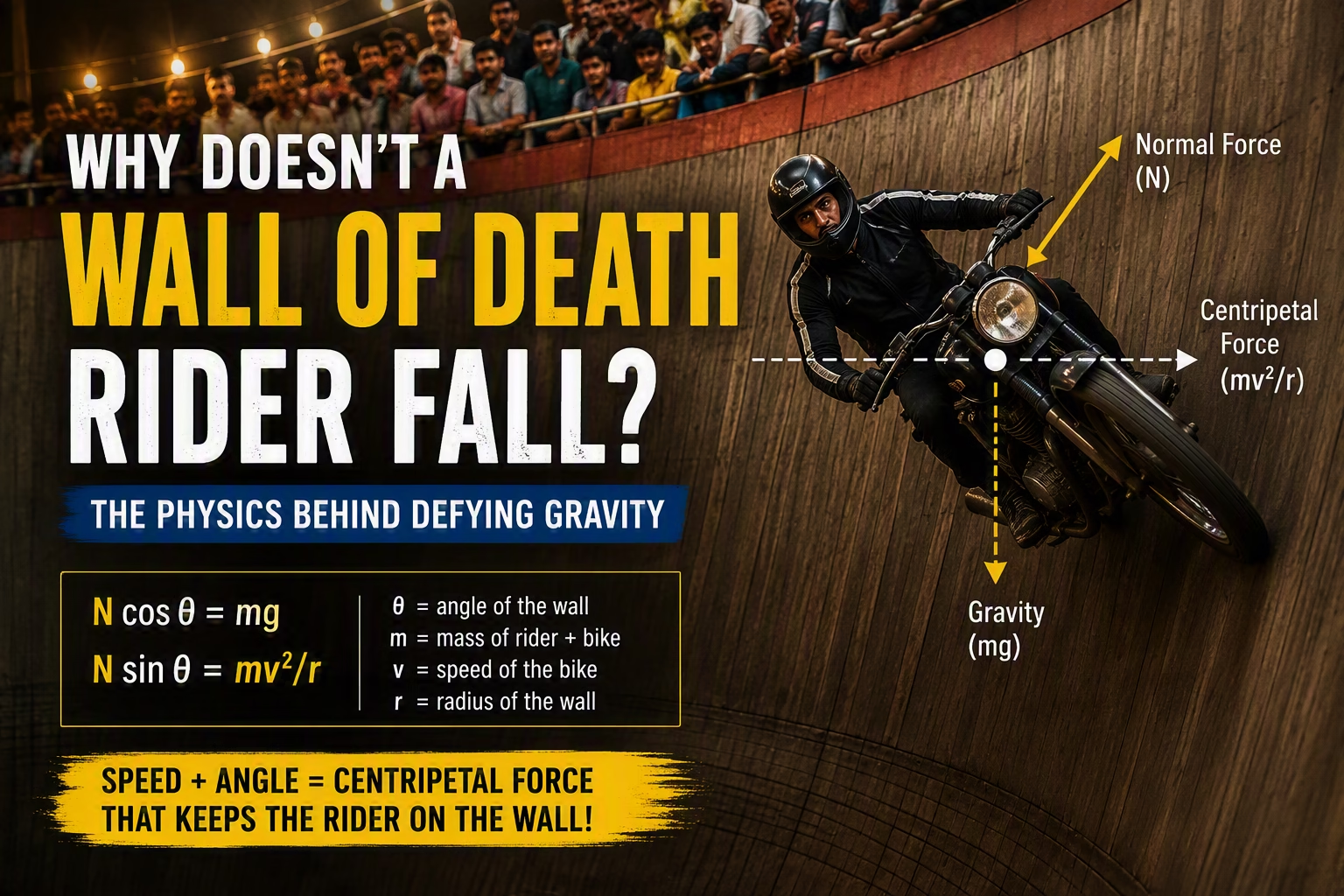
The Wall of Death: The Physics Behind a Motorcycle Defying Gravity

Motorcyclist riding horizontally on the vertical Wall of Death, illustrating the normal force, gravity, friction and centripetal acceleration

How can a motorcycle travel horizontally along a vertical wooden wall without falling? The answer combines circular motion, Newton’s laws, static friction, torque, and the remarkable skill of the rider. A Childhood Question That Physics Eventually Answered When I was a child, I had the opportunity to witness one of the most spectacular motorcycle attractions … Read more

Unraveling The Catenary: Calculating Distance Between Suspension Poles

Mathematical illustration of a catenary curve formed by a cable suspended between two tall poles, with the curve labeled using a coordinate system and hyperbolic function equation.

Mastering the Math Behind Hanging Cables: A Deep Dive into Catenary Curves Have you ever wondered about the precise distance between two suspension poles, like those holding power lines or bridge cables? It’s not as simple as drawing a straight line! The curve formed by a hanging cable, under its own weight, is a special … Read more

Unleashing Power: The Critical Role Of Starting Speed In Javelin Throw

Athlete performing a powerful javelin throw with high starting speed, showcasing proper technique, projectile motion, and launch angle against a stadium backdrop. Visual elements highlight physics and explosive athleticism.

Javelin throwing is not just about raw strength – it’s an intricate blend of physics, technique, and explosive speed. In this post, we delve into the crucial role that starting speed plays in javelin throwing, explore the underlying physics, and share training tips to help athletes maximize performance. While it might seem intuitive that strength … Read more