
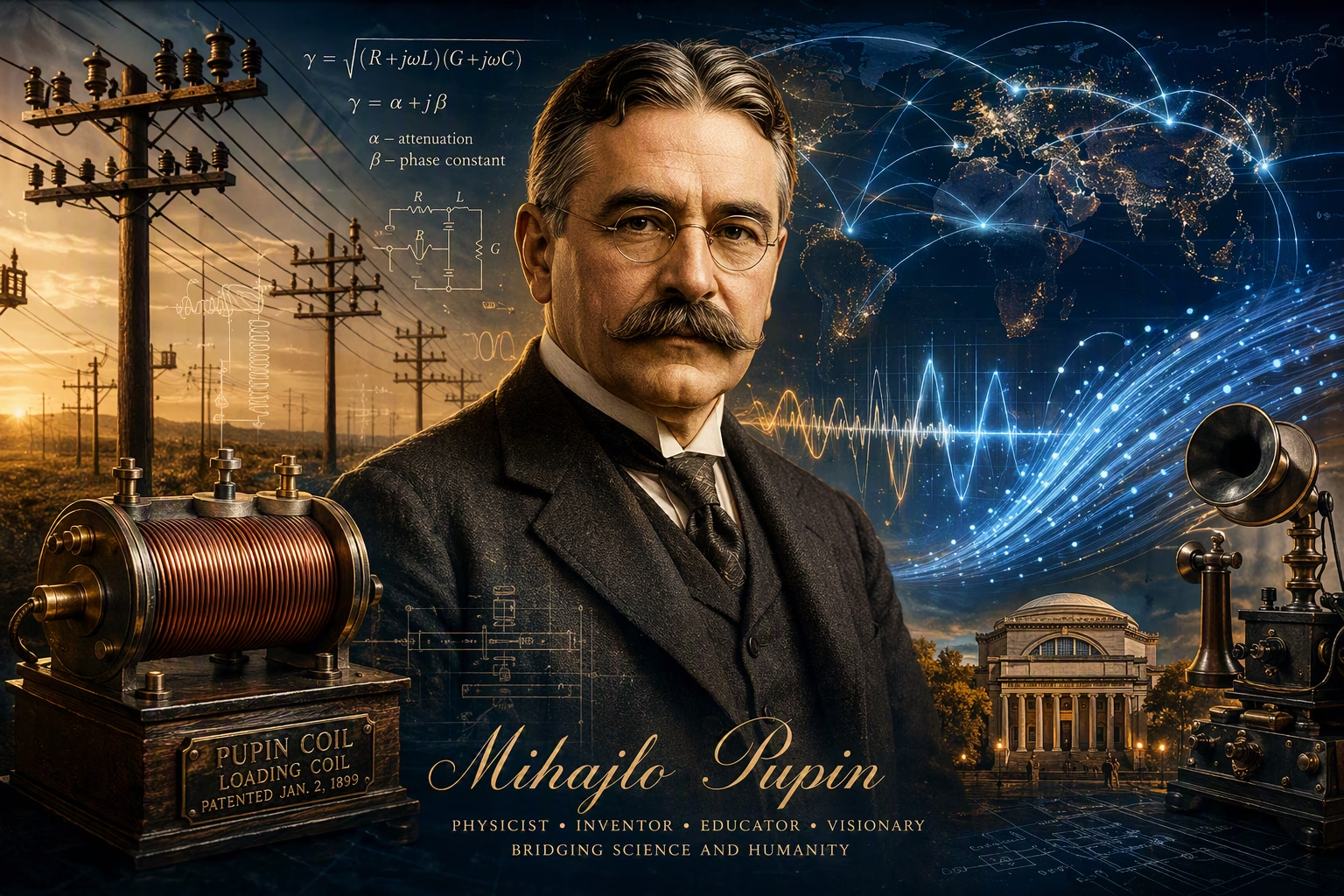
Introduction: Why Pupin Deserves a Place Among the Great Scientific Minds
Mihajlo Idvorski Pupin was one of the most important scientist-inventors in the history of electrical engineering, telecommunications, and applied mathematical physics. He was a Serbian-American physicist, inventor, professor, writer, and public intellectual whose work helped extend the practical range of long-distance telephone communication through loading coils, a technology widely associated with the word Pupinization.
His name is still not mentioned as often as it deserves to be. When the history of electrical engineering is discussed, names such as Michael Faraday, James Clerk Maxwell, Thomas Edison, Alexander Graham Bell, Guglielmo Marconi, Nikola Tesla, Oliver Heaviside, and Claude Shannon often dominate the conversation. Each of them deserves serious attention. But Pupin belongs in that intellectual constellation because his work connects theoretical physics, practical engineering, mathematical modeling, industrial innovation, higher education, and the rise of modern global communication.
This article is written with a simple conviction: Mihajlo Pupin was not merely an important Serbian scientist. He was one of the builders of modern technological civilization.
As a Serbian engineer with a professional interest in telecommunications, I find Pupin’s legacy especially meaningful. Serbia is rightly proud of Nikola Tesla, one of the most extraordinary inventors in human history. But Serbian scientific heritage does not end with Tesla. Pupin represents another form of genius: the mathematically trained physicist-engineer who transformed a real technological bottleneck into an industrially applicable solution.
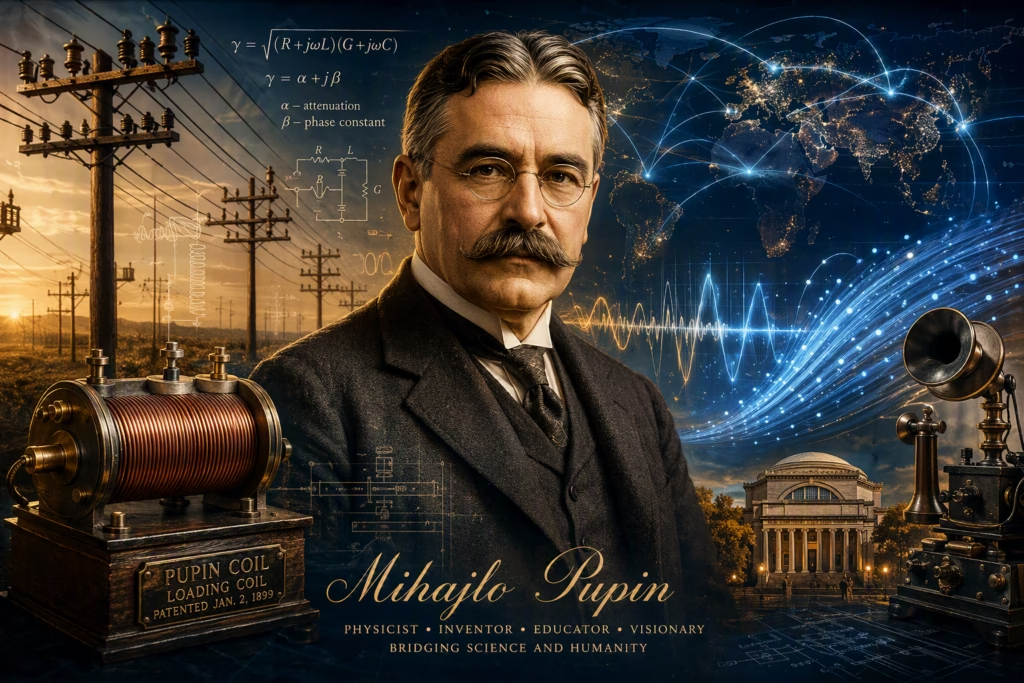
A Scientist Between Theory and Practice
Pupin’s greatness cannot be reduced to one invention. He was a physicist, inventor, professor, patent holder, writer, institutional leader, and public intellectual. What made him exceptional was the rare unity of these roles. He understood physical principles mathematically, engineering problems practically, scientific education institutionally, and invention commercially.
Theoretical Understanding
Pupin’s scientific work was rooted in mathematical physics. After Columbia, he studied in Europe and earned his doctorate in Berlin under Hermann von Helmholtz, one of the great scientific figures of the nineteenth century. He later returned to Columbia, where he taught mathematical physics. This background matters because Pupin did not approach telephone transmission merely as a workshop problem. He approached it as a physical and mathematical problem involving signals, distributed electrical parameters, attenuation, distortion, resonance, and wave propagation.
A long-distance telephone line is not simply a wire. It is a distributed electromagnetic system. A simplified model of a transmission line contains four primary parameters per unit length:
R = series resistance per unit length
L = series inductance per unit length
C = shunt capacitance per unit length
G = shunt conductance per unit length
In sinusoidal steady state, the propagation constant of such a line is commonly written as:
γ = √[(R + jωL)(G + jωC)]
where:
γ = α + jβ
α = attenuation constant
β = phase constant
This mathematical structure is essential. If the line’s propagation characteristics are unfavorable, speech becomes weakened, phase-shifted, and distorted. Pupin’s insight was that the behavior of a long telephone line could be improved by increasing its effective inductance at suitable intervals.
The Historical Context: The Age of Electricity
The nineteenth century was the century in which electricity moved from laboratory curiosity to civilizational infrastructure. Telegraphy transformed communication. Electric lighting transformed cities. Motors transformed industry. Telephone networks began to reshape business and social life. Electromagnetic theory provided the mathematical foundation for technologies that would later lead to radio, radar, television, digital communication, optical networks, and the internet.
Pupin lived at exactly the right historical moment. He entered science when electrical engineering was becoming a formal discipline and when the boundary between physics and engineering was still highly creative.
From Telegraphy to Telephony
The telegraph had already shown that electrical signals could transmit information over long distances, but telegraphy was based on coded symbols. The telephone was more demanding. It had to transmit the continuously varying waveform of human speech. Speech contains many frequency components and subtle temporal patterns. If different components are attenuated or delayed differently, the received voice becomes weak, muffled, or unintelligible.
The Mathematical Nature of the Problem
The voltage and current along a transmission line can be described by the telegrapher’s equations:
∂V/∂x = −L ∂I/∂t − R I
∂I/∂x = −C ∂V/∂t − G V
For sinusoidal signals, using phasors, these become:
dV/dx = −(R + jωL) I
dI/dx = −(G + jωC) V
Combining them gives:
d²V/dx² = γ² V
d²I/dx² = γ² I
γ = √[(R + jωL)(G + jωC)]
The line does not simply carry the signal. It reshapes it. Pupin’s work belongs precisely to this bridge between mathematical physics and practical communication.
Birth, Serbian Roots, and the Power of Education
Mihajlo Idvorski Pupin was born in Idvor, in Banat, in what is today Serbia. His life is powerful not only because of where it ended, but because of where it began: in a rural Serbian environment far removed from the major scientific centers of Europe and America.
Different sources present inconsistencies in the exact year and date of Pupin’s birth, so a careful reference article should avoid false certainty where the historical record is not fully uniform. What is beyond dispute is the extraordinary transformation: a boy from Idvor became a Columbia professor, a Pulitzer Prize-winning author, a major inventor, and a figure in the history of global telecommunications.
Idvor as More Than a Birthplace
Idvor was not merely a geographical fact. It became part of Pupin’s intellectual identity. His adopted middle name, Idvorski, often anglicized as Idvorsky, preserved the memory of his native village. That choice symbolized a permanent connection between local origin and global achievement.
Education as Destiny
For Pupin, education was not merely a path to employment. It was a form of liberation. Education allowed him to move from Idvor to Pančevo, from Europe to America, from manual labor to Columbia, from student to professor, and from immigrant to inventor. His autobiography, From Immigrant to Inventor, is therefore more than a memoir. It is a philosophical statement about knowledge, work, discipline, and transformation.
Poverty + Education + Discipline + Scientific Imagination → Creative Power
This is not a physical equation. It is a symbolic expression of Pupin’s life.
America, Columbia, Cambridge, Berlin, and the Formation of a Scientific Mind
Pupin immigrated to the United States in the nineteenth century and endured the uncertainty of immigrant life before entering Columbia College, where he earned his B.A. and became a U.S. citizen in 1883. This was a decisive turning point. Columbia gave him access to formal scientific education, but he did not merely absorb knowledge. He transformed himself into a scientist capable of original contribution.
Mathematics as Intellectual Foundation
For Pupin, mathematics was not an ornament of science. It was the language through which nature could be understood. In electrical engineering, mathematics is not optional. A resistor, capacitor, inductor, transmission line, electromagnetic wave, or resonant circuit becomes scientifically intelligible only when expressed mathematically.
ZL = jωL
ZC = 1/(jωC)
V = V(x,t), I = I(x,t)
This is the world in which Pupin’s mind operated: not merely wires and devices, but differential equations, wave propagation, and physical meaning.
Cambridge and Berlin
After Columbia, Pupin continued his education in Europe, studying at Cambridge and Berlin. Berlin was especially important because there he earned his doctorate under Hermann von Helmholtz. To study under Helmholtz meant entering a rigorous scientific environment in which physical law, mathematical reasoning, and experimental discipline were inseparable.
Idvor → America → Columbia → Cambridge → Berlin → Columbia
This path was not only geographical. It was intellectual. Each stage added something: origin, struggle, formal education, mathematical physics, doctoral rigor, and finally the transformation from learner to creator.
Pupinization: The Technical Core of Pupin’s Greatness
Pupin’s most famous contribution was his method for improving long-distance telephone transmission by inserting inductive loading coils at intervals along a line. The method became known as Pupinization, and the coils became known as Pupin coils. To understand why this was revolutionary, we must go deeper than the sentence “Pupin invented loading coils.”
A telephone line is a distributed physical system. Its resistance, inductance, capacitance, and leakage are spread along its length. A signal traveling through such a system is attenuated, delayed, phase-shifted, and distorted. Pupin’s genius was to understand that this distortion could be reduced by changing the electromagnetic properties of the line itself.
The Signal-Preservation Problem
A speech signal can be represented as a superposition of frequency components:
s(t) = (1/2π) ∫[₋∞ to ∞] S(ω) e^(jωt) dω
A transmission line modifies those components. If the line has a transfer function H(ω), then:
Sout(ω) = H(ω) Sin(ω)
If H(ω) is not sufficiently flat in magnitude and sufficiently linear in phase over the relevant voice band, the signal becomes distorted. The problem of long-distance telephony was therefore a problem of spectral preservation.
The Heaviside Condition
Oliver Heaviside had shown theoretically that a line could transmit without waveform distortion under a special relationship among its distributed parameters. The Heaviside condition may be written as:
R/L = G/C
Equivalently:
RC = LG
Ordinary telephone lines did not naturally satisfy this condition. One practical route toward improvement was to increase the effective series inductance L. If L is too small, then R/L is too large. Increasing L lowers R/L and can move the line closer to the desired balance.
L ↑ ⇒ R/L ↓ ⇒ behavior closer to the distortionless condition
This does not mean that every real loaded line perfectly satisfies the ideal condition. Real engineering involves approximations, frequency-band design, coil resistance, spacing, cost, and manufacturing limitations. But the principle is clear: properly increased inductance can improve transmission behavior over the intended voice band.
Periodic Loading
Pupin’s practical breakthrough was periodic loading. Instead of trying to make the entire line continuously inductive, he inserted inductive coils at intervals. If the spacing between coils is small enough relative to the relevant wavelengths, the periodically loaded line approximates a line with larger effective inductance over the useful band.
Leff = L + Lc/d
Here L is the natural inductance per unit length, Lc is the inductance of each loading coil, and d is the spacing between loading coils. The loaded propagation constant can be approximated as:
γloaded = √[(R + jωLeff)(G + jωC)]
The purpose was not to amplify the signal. A loading coil does not create energy. It changes the propagation characteristics of the line. That is a deeper idea than a simple booster: a booster adds energy, but a loading coil changes the medium.
Why Pupinization Was Revolutionary
- It extended the practical range of long-distance telephone communication
- It transformed theory into infrastructure
- It demonstrated the power of mathematical engineering
- It showed that the physical medium itself could be optimized
- It made Pupin a foundational figure in the history of telecommunications
Pupinization was revolutionary because it made a communication system more scalable. Civilization depends not only on spectacular devices, but also on hidden mathematical and engineering solutions that make systems reliable over distance.
Beyond Pupin Coils: X-Rays, Patents, Teaching, and Public Influence
The invention of loading coils alone would secure Pupin’s place in engineering history, but reducing him to one invention would be a serious mistake. Pupin also contributed to X-ray science, accumulated a large international patent portfolio, educated future scientific leaders, wrote a Pulitzer Prize-winning autobiography, and participated in scientific and public life at a high level.
X-Ray Science
In 1896, shortly after Röntgen’s discovery of X-rays, Pupin worked on problems connected with X-ray imaging. Sources credit him with work on secondary X-ray radiation and short-exposure X-ray photographs. This part of his career is less famous than Pupinization, but it demonstrates the breadth of his scientific ability.
Patents and Technological Breadth
Pupin’s inventive activity was broad. His work touched telephony, electrical communications, electromagnetic transmission, resonant circuits, measurement, and X-ray applications. The deeper point is not only the number of patents, but the nature of his creativity: he saw engineering as an interconnected system of physical principles.
Physics → Mathematics → Engineering → Technology
Teacher and Institution Builder
Pupin’s impact as a teacher and academic figure is one of the most underrated parts of his legacy. A discovery has impact, and a patent has impact. But a teacher multiplies influence through generations. Pupin’s career at Columbia placed him in a position to shape American electrical science at a time when the discipline itself was forming.
One scientist → many discoveries
One great teacher → many scientists → many more discoveries
This is not a literal equation. It is a reminder that education amplifies intellectual influence across generations.
Pupin, Serbia, America, and the Meaning of Identity
Pupin’s life is also a story about identity. He became an American citizen and an American scientist, but he did not abandon his Serbian origin. He remained connected to Serbian causes and became a bridge between Serbian cultural memory and American scientific life.
Patriotism Without Provincialism
One admirable aspect of Pupin’s life is the balance he achieved between patriotism and universalism. He loved Serbia, but he did not define himself through hostility toward others. He became part of American science and world science while preserving the memory of where he came from. His life shows that national identity and scientific openness are not enemies. At their best, they can reinforce each other.
From Immigrant to Inventor
His autobiography From Immigrant to Inventor won the Pulitzer Prize in biography in 1924. The title remains one of the strongest ever chosen for a scientific autobiography because it compresses an entire life into four words: from uncertainty to mastery, from migration to creation, from anonymity to contribution.
The book is not merely a record of events. It is a document about perseverance, education, identity, ambition, science, and moral growth. Scientific achievement and literary achievement rarely meet so powerfully in the same person.
Pupin and Tesla: Two Serbian Giants, Two Different Forms of Genius
No serious discussion of Pupin can avoid comparison with Nikola Tesla. Both were Serbian-born figures who spent the most important parts of their careers in the United States. Both contributed profoundly to the electrical age. Both became symbols of Serbian intellectual achievement. Yet they were very different.
Tesla was the archetype of the visionary inventor. Pupin was the archetype of the mathematically trained scientist-engineer. Tesla’s genius often appeared as a dramatic leap of imagination. Pupin’s genius appeared as disciplined synthesis: theory, mathematics, experiment, education, patent strategy, and industrial application.
Fame Is Not the Same as Impact
Tesla became a global cultural icon partly because his life contains spectacle: dramatic demonstrations, high voltage, futuristic visions, conflict, mystery, solitude, and the image of the misunderstood genius. Pupin’s greatest invention was less visually dramatic. A loading coil does not produce lightning. It simply makes a communication line work better.
That is precisely why Pupin is less famous. The public remembers spectacle more easily than infrastructure. But civilization depends deeply on infrastructure. A working network rarely reminds users of the mathematics that makes it possible.
Complementary Figures
It would be a mistake to turn Tesla and Pupin into rivals in historical memory. They represent complementary dimensions of Serbian scientific genius. Tesla represents imagination, invention, boldness, and electrical vision. Pupin represents mathematical discipline, engineering optimization, academic leadership, and institutional impact.
Tesla reminds us that the future often begins as a vision. Pupin reminds us that a vision becomes civilization only when it can be engineered, stabilized, optimized, and deployed.
Pupin’s Relevance in the Twenty-First Century
At first glance, Pupin may seem to belong entirely to the age of copper wires and analog telephony. That impression is misleading. The specific technologies have changed, but the fundamental engineering questions remain similar:
- How does a signal propagate through a physical medium
- What causes attenuation
- What causes distortion
- How can usable transmission distance be increased
- How can mathematical modeling improve communication systems
These are Pupin-type questions. The medium changed. The philosophy did not.
From Copper Lines to Optical Fiber
In modern optical-fiber communication, engineers no longer solve the same capacitance-inductance problem that Pupin addressed in copper telephone lines. But they still solve problems of attenuation, dispersion, bandwidth, noise, and distance. The optical power along a fiber may be modeled approximately as:
P(z) = P₀ e^(−αz)
Here P₀ is the launched optical power, α is the attenuation coefficient, and z is distance along the fiber. The medium is different, but the conceptual question is familiar: how far can the signal travel before it becomes unusable?
Pupinization as Early Signal Compensation
In modern communication theory, a simplified channel model may be written as:
y(t) = x(t) * h(t) + n(t)
Y(ω) = H(ω)X(ω) + N(ω)
Pupin did not use this modern notation, but the intellectual essence is related. He modified the physical channel so that its behavior became more favorable for voice transmission. Modern systems may use equalizers, repeaters, optical amplifiers, dispersion compensation, forward error correction, adaptive filtering, or digital signal processing. Pupin used inductive loading. The tools changed. The engineering problem remained.
The Internet and the Physical Layer
The internet is often described as a digital revolution, but beneath every digital network lies physical infrastructure. Packets do not float in abstraction. They travel through cables, fibers, radio channels, routers, switches, antennas, amplifiers, and transceivers. The physical layer must repeatedly solve the same fundamental problem: send information reliably through an imperfect medium.
Medium + Signal + Propagation Effects + Compensation = Communication System
Pupin belongs to the deep history of the physical layer. He helped humanity learn how to make distance smaller.
Why Engineers Should Study Mihajlo Pupin
Mihajlo Pupin should be studied by electrical engineers, telecommunications engineers, physicists, historians of science, and students of innovation. Not merely because he was Serbian. Not merely because he was famous. Not merely because he held patents. He should be studied because his life demonstrates the complete chain of engineering greatness:
Scientific education → Mathematical understanding → Physical insight → Technological invention → Industrial impact → Civilizational consequence
Lessons for Young Engineers
Pupin’s life offers lessons that remain urgent today:
- Master mathematics, because engineering without mathematics becomes superficial
- Understand physics, because formulas must describe real systems
- Think in systems, not isolated devices
- Connect theory with practice, because theory without implementation is incomplete and implementation without theory is fragile
- Preserve intellectual identity while remaining open to universal science
Why Serbia Should Remember Pupin More Deeply
Serbia is rightly proud of Nikola Tesla, but Serbia should speak much more often and much more seriously about Mihajlo Pupin. Not as a secondary figure. Not as “another Serbian scientist.” Not as a footnote after Tesla. Pupin deserves his own central place.
A small nation honors itself not by exaggerating its great figures, but by presenting them accurately, rigorously, and confidently. There is no need to mythologize Pupin. The facts are already extraordinary.
Final Conclusion: Pupin and the Architecture of Modern Civilization
Mihajlo Idvorski Pupin was far more than the inventor of loading coils. He was a Serbian-American physicist, a professor of mathematical physics at Columbia University, a pioneer of long-distance telephony, a contributor to X-ray science, a prolific inventor, a mentor, a public intellectual, a patriot, and a Pulitzer Prize-winning author.
But even this list does not fully capture his importance. Pupin’s deeper significance lies in the kind of mind he represented. He was a bridge between Serbia and America, theory and practice, physics and engineering, mathematics and infrastructure, the nineteenth-century electrical revolution and the twentieth-century communication age.
His most famous invention may appear physically simple. But its meaning is profound. It showed that the limitations of a communication system could be overcome by understanding and modifying the mathematical structure of the transmission medium. That is a civilizational idea.
The modern world is built on communication. Telephone networks, radio systems, optical fibers, the internet, cloud computing, and artificial intelligence all depend on the ability to transmit information reliably through imperfect physical channels. Pupin stood near the beginning of that great story. He helped transform the human voice into a signal that could cross vast spaces. He helped build the nervous system of modern civilization.
For this reason, Mihajlo Pupin should not be remembered only as a Serbian scientist, nor only as a Columbia professor, nor only as the inventor of Pupin coils. He should be remembered as one of the great engineering minds who made the connected world possible.
Nikola Tesla may remain the more famous Serbian genius in popular culture. But Mihajlo Pupin deserves to stand beside him in the deeper history of science. Not in his shadow. Beside him.