
Introduction: A Mathematician Larger Than Mathematics
Some scientists are remembered for a theorem. Others become associated with an equation, an instrument, or a school of thought. Mihailo Petrović Alas belongs to a much rarer class: intellectual figures whose work cannot be contained within a single discipline.
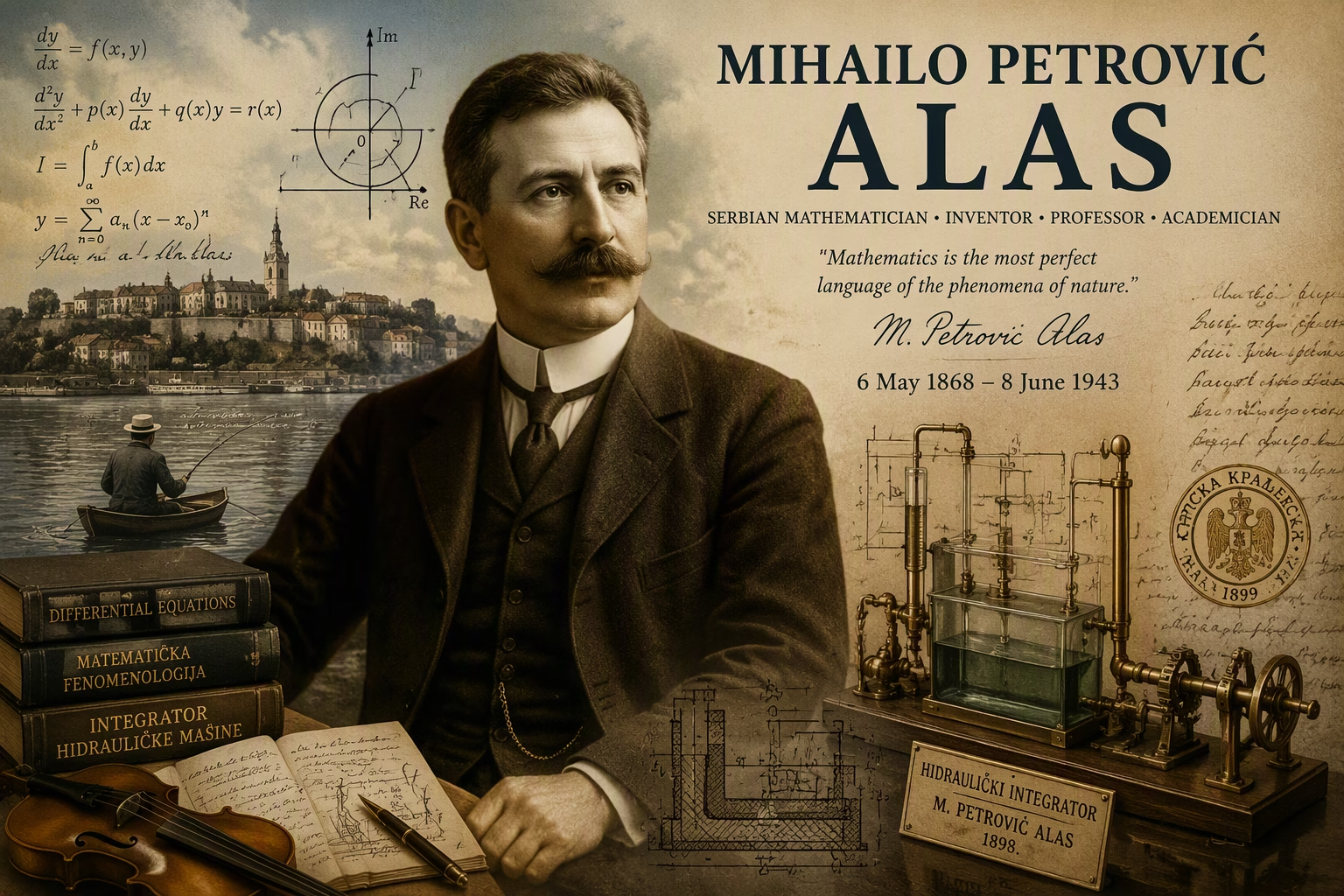
Born in Belgrade on 6 May 1868, Mihailo Petrović, widely known as Mika Alas, was a Serbian mathematician, inventor, university professor, academician, cryptographer, writer, musician, traveler, and master river fisherman. His principal mathematical interests included differential equations, the theory of functions, numerical analysis, mathematical spectra, and the original discipline he called mathematical phenomenology. He died in Belgrade on 8 June 1943.
Yet a list of professions does not explain why Petrović remains such a fascinating figure. His deeper importance lies in a unifying idea that ran through his science and his life: apparently different phenomena may be governed by the same mathematical mechanism.
For Petrović, mathematics was not merely a language used to describe reality after the essential scientific work had been completed. Mathematics was a method for discovering hidden kinships among processes that, on the surface, appeared unrelated.
A changing river level, a mechanical motion, a biological process, and the solution of a differential equation might belong to different domains of experience. Nevertheless, if the same relations governed their development, Petrović believed that they shared a common abstract structure.
This search for unity led him from pure analysis to mathematical philosophy, and from differential equations to the construction of a remarkable hydraulic computing machine.
Who Was Mihailo Petrović Alas
Mihailo Petrović was one of the central figures in the development of modern mathematics in Serbia. He studied in Belgrade and Paris, obtained a doctorate in mathematical sciences, built an internationally recognized research career, and spent more than four decades educating new generations of mathematicians. The Serbian mathematical tradition that developed around his teaching and doctoral supervision became known as the Belgrade School of Mathematics.
His nickname, Alas, comes from the Serbian word for a professional river fisherman. It was not a decorative nickname invented by journalists. Fishing was a serious and enduring part of his life. Petrović apprenticed as a fisherman while still a school student and passed the examination for master fisherman in 1895. He was therefore both a professor of mathematics and a formally qualified fishing professional.
This unusual combination has contributed greatly to his popular image, but it should not obscure the scale of his scientific achievement. Petrović was not simply a colorful professor who enjoyed fishing. He was an internationally active mathematician educated within the powerful French school of analysis, an original mathematical thinker, and an inventor whose hydraulic integrator belongs to the early history of analog computation.
Early Life and Education in Belgrade
A Childhood Near the Rivers
Mihailo Petrović was born into an educated family in old Belgrade. His father, Nikodim Petrović, was a theology professor. After Nikodim died while Mihailo was still young, Mihailo was raised largely by his mother, Milica Lazarević, and his maternal grandfather, Novica Lazarević.
Petrović completed the First Belgrade Gymnasium in 1885. His mathematical talent had already attracted attention, and he received prizes for his school work. At the same time, he developed the two interests that would remain with him throughout life: music and river fishing.
He continued his education in the Department of Mathematics and Natural Sciences at the Faculty of Philosophy of the Belgrade Grand School. The curriculum was broad and included mathematics, physics, chemistry, geology, biology, psychology, and philosophy. He completed his studies in 1889 and then left for Paris to pursue advanced mathematical education.
That broad early education is important for understanding Petrović’s later intellectual development. His mature work repeatedly crossed the boundaries between mathematics, natural science, technology, and philosophy.
The Paris Years and the French School of Mathematics
Studying Among Europe’s Leading Mathematicians
In Paris, Petrović prepared for and passed the entrance examination for the École Normale Supérieure. He attended lectures at the Sorbonne and studied under some of the most influential mathematicians of the period, including Henri Poincaré, Charles Hermite, Émile Picard, Paul Painlevé, Gaston Darboux, Paul Émile Appell, and Jules Tannery.
He received a degree in mathematics in 1892 and a degree in physics in 1893. His achievements placed him among the leading students of his generation and earned him invitations to receptions hosted by the President of the French Republic.
The Parisian environment exposed Petrović to a form of mathematics in which analysis, geometry, mechanics, and mathematical physics remained closely connected. The intellectual breadth associated with Henri Poincaré can also be recognized in Petrović’s later attempts to identify general mechanisms shared by different classes of phenomena.
Doctoral Dissertation on Differential Equations
In June 1894, Petrović submitted and defended his principal doctoral thesis:
Sur les zéros et les infinis des intégrales des équations différentielles algébriques
In English, the title may be translated as:
On the Zeros and Infinities of the Integrals of Algebraic Differential Equations.
His doctoral advisers were Charles Hermite and Émile Picard, while the examining committee consisted of Hermite, Picard, and Paul Painlevé. The thesis investigated zeros, poles, maxima, minima, and related properties of solutions of algebraic differential equations.
In modern notation, a first-order differential equation may be written as
F(x, y, dy/dx) = 0
or, in explicit form
dy/dx = f(x, y)
The central difficulty is not always to obtain a closed-form expression for y(x). In many important problems, no elementary expression exists. The mathematician must instead determine the qualitative behavior of the solution:
- Where is the solution defined
- Where does it become zero
- Does it approach infinity
- Can it attain a local maximum or minimum
- How does its behavior change near a singular point
- What can be concluded without writing the complete solution explicitly
These questions place Petrović’s dissertation within a major research movement in late nineteenth-century analysis: the effort to understand differential equations through the global and qualitative behavior of their solutions.
A Professor Who Transformed Serbian Mathematics
After receiving his doctorate, Petrović returned to Belgrade. In 1894 he was appointed professor of mathematical sciences at the Grand School. When the Grand School became the University of Belgrade in 1905, he was among the institution’s first regular professors. He remained associated with the university until his retirement in 1938.
His appointment had enormous consequences for the development of mathematics in Serbia. Petrović introduced contemporary European mathematical research into university teaching, published internationally, developed research programs, supervised doctoral candidates, and gathered talented young mathematicians around the university’s Mathematical Seminar.
Among the mathematicians shaped by his school were Jovan Karamata, Radivoje Kašanin, Tadija Pejović, Dragoslav Mitrinović, and other scholars who later developed important branches of Serbian and Yugoslav mathematics. The first doctorate in mathematical sciences at the University of Belgrade was defended in 1912 under Petrović’s supervision.
The Belgrade School of Mathematics
A mathematical school is not simply a group of people working in the same building. It exists when a recognizable research tradition, a method of education, and a chain of mentorship continue across generations.
Petrović helped create all three.
His work connected Serbian mathematics with the French analytical tradition. His students continued research in differential equations, mathematical analysis, function theory, and related fields. Some of them, especially Jovan Karamata and Dragoslav Mitrinović, established influential research traditions of their own.
In 1939, the University of Belgrade awarded Petrović an honorary doctorate. The official proposal emphasized that he had created the first mathematical school in Yugoslavia and elevated mathematical teaching at the university to the level of contemporary international institutions.
Petrović’s Work on Differential Equations
Differential equations formed the central axis of Petrović’s mathematical research. The precise body of his work extended far beyond a single method or equation, but its recurring concern was the behavior and integration of differential equations.
Consider a general first-order equation:
dy/dx = f(x, y)
Even when an explicit formula for y cannot be found, mathematics may still reveal:
- the existence or uniqueness of a solution
- the position of zeros and singularities
- monotonicity and oscillation
- asymptotic behavior
- dependence on initial conditions
- geometric properties of integral curves
For a second-order linear equation
d²y/dx² + p(x)dy/dx + q(x)y = r(x)
the coefficients p(x), q(x), and the forcing term r(x) influence the shape and stability of the solution. Petrović’s scientific world was one in which mathematicians were increasingly trying to understand such equations structurally, not merely to produce isolated symbolic answers.
His publications addressed differential equations, numerical analysis, complex function theory, the geometry of polynomials, interval calculation, and mathematical spectra. The official digital biography maintained by the Mathematical Institute of the Serbian Academy of Sciences and Arts describes him as producing first-rate results across several mathematical fields and publishing extensively in major European journals, primarily in French.
Qualitative Integration
Petrović later wrote Intégration qualitative des équations différentielles, published in 1931 as part of the series Mémorial des sciences mathématiques. The title itself captures an important distinction.
Symbolic integration asks for an explicit expression.
Qualitative integration asks what can be known about a solution from the structure of the equation, even when the solution cannot be expressed in a convenient closed form.
This distinction remains fundamental in modern applied mathematics. Engineers and scientists frequently study systems for which exact formulas are unavailable. Stability, boundedness, equilibrium, oscillation, and asymptotic behavior may be more important than an explicit expression.
Mathematical Phenomenology
Petrović’s Most Ambitious Intellectual Project
Among Petrović’s most original ideas was mathematical phenomenology, an attempt to classify and study phenomena according to the mathematical mechanisms underlying them.
The basic insight can be stated simply:
Two physically different phenomena may belong to the same mathematical type if they are governed by the same relations.
A cooling object, the decay of a substance, and the discharge of an electrical component are physically different processes. Under appropriate assumptions, however, each may be represented by an equation of the form
dy/dt = −ky
whose solution is
y(t) = y₀e⁻ᵏᵗ
This example is not presented as one of Petrović’s own specific models. It illustrates the general principle behind his search for common mathematical structures.
In Petrović’s framework, the task was not merely to attach an equation to an observed process. The deeper task was to identify a phenomenological type, an abstract mechanism shared by different phenomena. The official account of his work describes mathematical phenomenology as the establishment of analogies between physically disparate processes and their reduction to a common abstract essence.
He developed these ideas in works including:
- Elements of Mathematical Phenomenology from 1911
- Méchanismes communs aux phénomènes disparates from 1921
- Phenomenological Mapping from 1933.
From Analogy to Mathematical Model
Suppose two systems are described by state variables u(t) and v(t):
du/dt = F(u, t)
and
dv/dt = F(v, t)
The physical identities of u and v may be entirely different. Nevertheless, if the governing function F is structurally identical, the two systems may display corresponding forms of growth, decay, equilibrium, oscillation, or instability.
Petrović sought systematic ways to recognize such correspondences.
This should not be confused with claiming that all phenomena are identical. The point is subtler. Physically different systems may possess the same mathematical skeleton.
Why Mathematical Phenomenology Still Matters
Petrović’s terminology did not become standard vocabulary across modern mathematics. Nevertheless, the intellectual direction of his project remains highly recognizable.
Modern science routinely uses:
- mathematical modeling
- dynamical systems
- dimensional analysis
- systems theory
- mathematical analogies
- simulation
- state-space descriptions
- models transferable between disciplines
It would be historically careless to say that Petrović single-handedly invented these modern fields. It is reasonable, however, to recognize that his work belongs to the broader intellectual history of mathematical modeling and analogical reasoning in science.
The Hydraulic Integrator: Mathematics Made Physical
An Early Hydraulic Analog Computer
Petrović’s most famous invention was the hydraulic integrator, a machine designed to solve certain classes of differential equations through the controlled behavior of fluids.
His first paper on hydraulic integration appeared in 1897 in Comptes rendus de l’Académie des Sciences de Paris. A Serbian translation with additional explanations followed in 1898, and Petrović also published work on the subject in the American Journal of Mathematics.
The machine was based on a powerful idea: if a physical system obeys the same relations as a mathematical equation, observing the physical system can provide information about the equation’s solution.
This was Petrović’s concept of the materialization of mathematics.
The Mathematical Principle
The Mathematical Institute’s account describes a vessel and an immersed body whose horizontal cross-sectional areas are represented by functions Φ(y) and F(z). Conservation of displaced fluid volume gives the relation
[Φ(y) − F(z)]dy = F(z)dz
Using
z = x − y
the relation leads to a differential equation of the form
dy/dx = F(x − y) / Φ(y)
By altering the form of the vessel and the immersed body, the machine could embody different mathematical relations and therefore address more than one equation.
The significance of the integrator did not lie merely in replacing hand calculation with moving water. It demonstrated Petrović’s central scientific conviction in material form: an abstract mathematical problem could be transformed into a suitable physical analogue.
How the Machine Worked
The hydraulic integrator contained an arithmetic unit and an input-output system. Its essential components included:
- a vessel containing fluid
- a specially shaped body immersed in that fluid
- a float responding to changes in the fluid level
- input mechanisms representing prescribed data
- rotating cylinders on which solution curves could be recorded
The shapes of the vessel and immersed body encoded mathematical functions. Their interaction caused the fluid level and connected recording mechanisms to evolve according to the corresponding differential relation.
In modern language, the machine was an analog computer. It did not represent quantities as sequences of binary digits. Instead, continuous physical quantities represented mathematical variables.
A Precursor in the History of Computing
Petrović’s integrator should not be described as a digital computer, nor as a direct ancestor of every modern computer. Its historical importance lies in a different direction.
The device belonged to the tradition of analog computation, in which a mathematical problem is mapped onto a physical process with corresponding dynamics. Its use of replaceable physical forms to represent different functions makes it especially interesting from the perspective of programmable scientific instruments.
The hydrointegrator was displayed at the 1900 Paris Exposition. Sources disagree about the precise medal awarded. The Serbian Intellectual Property Office states that the machine received a bronze medal, while the digital legacy of Petrović maintained by the Mathematical Institute and the MacTutor biography state that it received a gold medal. Because these reputable sources conflict, a careful reference article should report the disagreement rather than silently select one version.
Mathematical Spectra and Numerical Thought
Petrović also developed a theory of mathematical spectra. His work in this field connected patterns in numerical sequences with broader questions in number theory, analysis, and cryptography.
The term should not automatically be identified with the modern spectrum of a linear operator. Petrović’s mathematical spectra belonged to his own conceptual framework and historical context.
His works included Les spectres numériques and Leçons sur les spectres mathématiques. He lectured on mathematical spectra at the Sorbonne during the 1927–1928 academic year.
His textbook and monographic work also covered interval calculation, elliptic functions, and integration by series. This breadth reveals a mathematician who was interested not only in abstract theory but also in calculation, construction, approximation, and the transmission of mathematical knowledge.
Inventor, Patent Holder, and Practical Scientist
The hydraulic integrator was not Petrović’s only invention. According to the Intellectual Property Office of the Republic of Serbia, he held nine French patents, one British patent, and one German patent. The protected inventions included mechanisms connected with distance measurement, transmission systems, calendars, engines, ship safety, and military calculation.
This record places Petrović within a tradition of mathematicians for whom theory and engineering were not opposing activities.
His inventions reveal three recurring aspects of his scientific personality:
- Abstraction: identifying the governing mathematical relation
- Representation: finding a physical system that embodies that relation
- Construction: turning the representation into a functioning device
That three-stage process is also visible in modern mathematical engineering, scientific instrumentation, and computational modeling.
Mika Alas: The Master Fisherman
Why “Alas” Was More Than a Nickname
For many readers, Petrović’s life as a fisherman is the most memorable element of his biography.
He fished on the Sava and Danube, trained professionally, became a master fisherman, and established fishing activities of his own. Reports state that the fishing diploma rather than an academic distinction occupied a place of honor in his study.
Fishing also connected him with practical questions concerning rivers, aquatic life, and fishing regulation. His interests were therefore not limited to recreation. They included expert knowledge and participation in matters concerning fishery and river management.
It is tempting to romanticize the relationship between fishing and mathematics. Any such interpretation should be expressed carefully. There is no need to claim that every theorem arose from observing the river. What can be said is that Petrović’s life united sustained mathematical abstraction with close contact with physical processes, changing waters, practical work, and nature.
His life rejects a narrow stereotype of the mathematician as someone isolated from the material world.
Musician, Writer, and World Traveler
Petrović was also an accomplished violinist. In 1896 he founded the musical ensemble Suz, which performed urban folk music and participated in the social and cultural life of Belgrade and other Serbian cities.
His travels took him through distant maritime and polar regions. He later transformed many of those experiences into travel books. His published literary works ranged from travel writing to reflections on nature, metaphor, fisheries, and the life cycle of the eel.
The diversity of these activities was not incidental to his intellectual identity. Petrović was interested in recurring forms across nature, science, human behavior, and language. His literary interest in metaphors and allegories was therefore conceptually related to his study of analogies among phenomena.
Cryptography, Military Service, and Public Duty
Petrović served as an officer during the Balkan Wars and the First World War. He also worked in cryptography, and the Serbian and Yugoslav military used cipher systems that he developed. Archival documentation described by MacTutor records his work on encoding methods, codebreaking, and training in cryptographic techniques.
In 1941, although already 73 years old, Petrović was again mobilized. He was captured after the invasion of Yugoslavia and spent a period in captivity before being released. His health deteriorated during the war, and he died at his home in Belgrade on 8 June 1943.
The Scientific Legacy of Mihailo Petrović Alas
Petrović’s legacy can be understood on several levels.
1. Original Mathematical Research
He produced substantial work in differential equations, function theory, numerical analysis, polynomial geometry, mathematical spectra, and mathematical phenomenology. His doctoral work and later publications were integrated into the European mathematical culture of his time.
2. Mathematical Education
He modernized mathematical teaching in Serbia and trained researchers capable of creating new mathematical traditions. His academic genealogy extends through generations of mathematicians.
3. Institution Building
Through the Mathematical Seminar, doctoral supervision, publishing, and international scientific participation, Petrović helped transform Belgrade into an important regional center of mathematical research.
4. Analog Computation
His hydraulic integrator gave physical form to differential equations and established him as a notable figure in the history of analog scientific computation.
5. Philosophy of Mathematical Modeling
Mathematical phenomenology expressed a broad and ambitious idea: the unity of different phenomena may be discovered through their common mathematical mechanisms.
Why Mihailo Petrović Alas Still Matters Today
Petrović’s work remains relevant because contemporary science increasingly depends on connections among disciplines.
Climate models, circuits, mechanical systems, population dynamics, fluid flows, epidemics, and economic processes may involve very different entities. Yet many are studied through related classes of differential equations.
For example, a general dynamical system may be represented as
d𝐱/dt = 𝐅(𝐱, t)
where 𝐱 is a state vector and 𝐅 describes the evolution of the system.
The meaning of 𝐱 changes from one discipline to another. It may represent temperatures, voltages, positions, concentrations, or population sizes. The mathematical framework, however, may remain comparable.
This is precisely the kind of structural kinship that fascinated Petrović.
Modern terminology has changed, computer technology has advanced beyond anything available in his lifetime, and scientific modeling has become vastly more sophisticated. Still, the questions at the heart of his work remain alive:
- What is the mathematical mechanism of a phenomenon
- Which physically different processes share the same structure
- Can an abstract equation be represented by a physical system
- What can we know about a solution without obtaining an explicit formula
- How can mathematical knowledge be transformed into a practical instrument
These are not merely historical questions. They are central questions of modern applied mathematics.
Frequently Asked Questions
Who was Mihailo Petrović Alas?
Mihailo Petrović Alas was a Serbian mathematician, inventor, professor, academician, writer, musician, traveler, cryptographer, and master fisherman. He was born in 1868 and died in 1943.
Why was he called Mika Alas?
“Mika” is a familiar form of Mihailo, while the Serbian word “alas” means a professional river fisherman. Petrović passed the master fisherman’s examination in 1895.
What was his main field of mathematics?
His central field was the theory and qualitative study of differential equations. He also worked in function theory, numerical analysis, interval calculation, polynomial geometry, mathematical spectra, and mathematical phenomenology.
What is mathematical phenomenology?
Mathematical phenomenology was Petrović’s attempt to identify common mathematical mechanisms behind physically different phenomena and classify those phenomena according to their shared abstract structures.
What was the hydraulic integrator?
The hydraulic integrator was a hydraulic analog computing machine designed to solve certain classes of differential equations by using the behavior of fluid, a shaped vessel, an immersed body, floats, and recording mechanisms.
Did Petrović study at the Sorbonne?
Yes. He studied mathematics and physics in Paris and defended his doctorate in mathematical sciences in 1894.
Did Petrović found the Belgrade School of Mathematics?
He is widely regarded as the founding figure of the Belgrade School of Mathematics because of his research, teaching, doctoral supervision, and decisive influence on later generations of Serbian mathematicians.
Was he only a theoretical mathematician?
No. Petrović combined theoretical mathematics with invention, analog computation, cryptography, fisheries, travel writing, music, and practical scientific work.
Conclusion: The Mathematician of the River and the Equation
Mihailo Petrović Alas was not remarkable merely because he succeeded in many different fields. His greater achievement was that those fields formed a coherent intellectual world.
Differential equations taught him to search for laws of change. Mathematical phenomenology encouraged him to recognize common mechanisms behind different processes. The hydraulic integrator transformed an equation into fluid motion. Fishing placed him in daily contact with rivers and natural variability. Music, travel, literature, and invention widened the range of phenomena through which he understood the world.
His life offered no sharp division between pure thought and practical experience.
The professor and the fisherman were the same person. The theoretician and the inventor followed the same intellectual instinct. The man studying an abstract differential equation was also searching for its physical counterpart.
That is why Petrović deserves recognition far beyond the history of Serbian mathematics. His work embodies one of the deepest ambitions of science: to discover unity beneath diversity.
Whenever two apparently unrelated systems are described by the same equation, whenever a physical process is used to compute an abstract result, and whenever mathematics reveals a hidden mechanism behind nature, we enter the intellectual territory that Mihailo Petrović Alas explored throughout his extraordinary life.