
How a Serbian Scientist Changed Our Understanding of Ice Ages, Planetary Climate, and Mathematical Geophysics
Few scientists have succeeded in transforming an entire scientific discipline through the power of mathematics. Among this select group stands Milutin Milanković (1879–1958), the Serbian mathematician, astronomer, climatologist, geophysicist, civil engineer, and visionary thinker whose work fundamentally changed humanity’s understanding of Earth’s long-term climate system.
Today, his name is immortalized through the Milankovitch Cycles, a theory explaining how subtle variations in Earth’s orbit and axial orientation influence climate over tens and hundreds of thousands of years. Modern paleoclimatology, climate science, planetary science, and geophysics all bear the unmistakable imprint of his intellectual legacy. His ideas continue to shape scientific discussions ranging from the causes of ice ages to the climate history of Mars.
More than a century after he began his groundbreaking research, Milanković remains one of the most influential scientists ever produced by Serbia and one of the greatest mathematical climatologists in history.
Early Life and Education
A Brilliant Mind from Dalj
Milutin Milanković was born on May 28, 1879, in the village of Dalj, then part of the Austro-Hungarian Empire and today located in Croatia. From an early age, he demonstrated exceptional intellectual abilities and a fascination with mathematics and the natural sciences.
He pursued higher education at the Vienna University of Technology (TU Wien), one of Europe’s leading technical institutions. There, he studied civil engineering and completed his doctorate in technical sciences in 1904. His doctoral work already revealed the analytical rigor that would later define his scientific achievements.
Before becoming a full-time scientist, Milanković established a successful engineering career in Vienna, specializing in reinforced concrete structures and registering several patents. Yet despite his professional accomplishments, his true passion lay in the fundamental laws governing the universe.
The Road to Scientific Greatness
From Civil Engineering to Celestial Mechanics
In 1909, Milanković accepted a professorship at the University of Belgrade. This decision marked a turning point not only in his life but also in the history of climate science.
Instead of continuing solely as an engineer, he devoted himself to investigating some of the most challenging scientific questions of his era:
- How does solar radiation influence Earth’s climate
- Why do ice ages occur
- Can long-term climate changes be predicted mathematically
- How do planetary orbits shape environmental conditions
At the beginning of the twentieth century, these questions remained largely unanswered. Milanković approached them with a rare combination of mathematical sophistication, physical intuition, and extraordinary persistence.
The Birth of the Milankovitch Cycles
A Mathematical Explanation for Ice Ages
Milanković’s greatest scientific achievement was his development of a rigorous mathematical theory linking changes in Earth’s orbital geometry to long-term climate fluctuations.
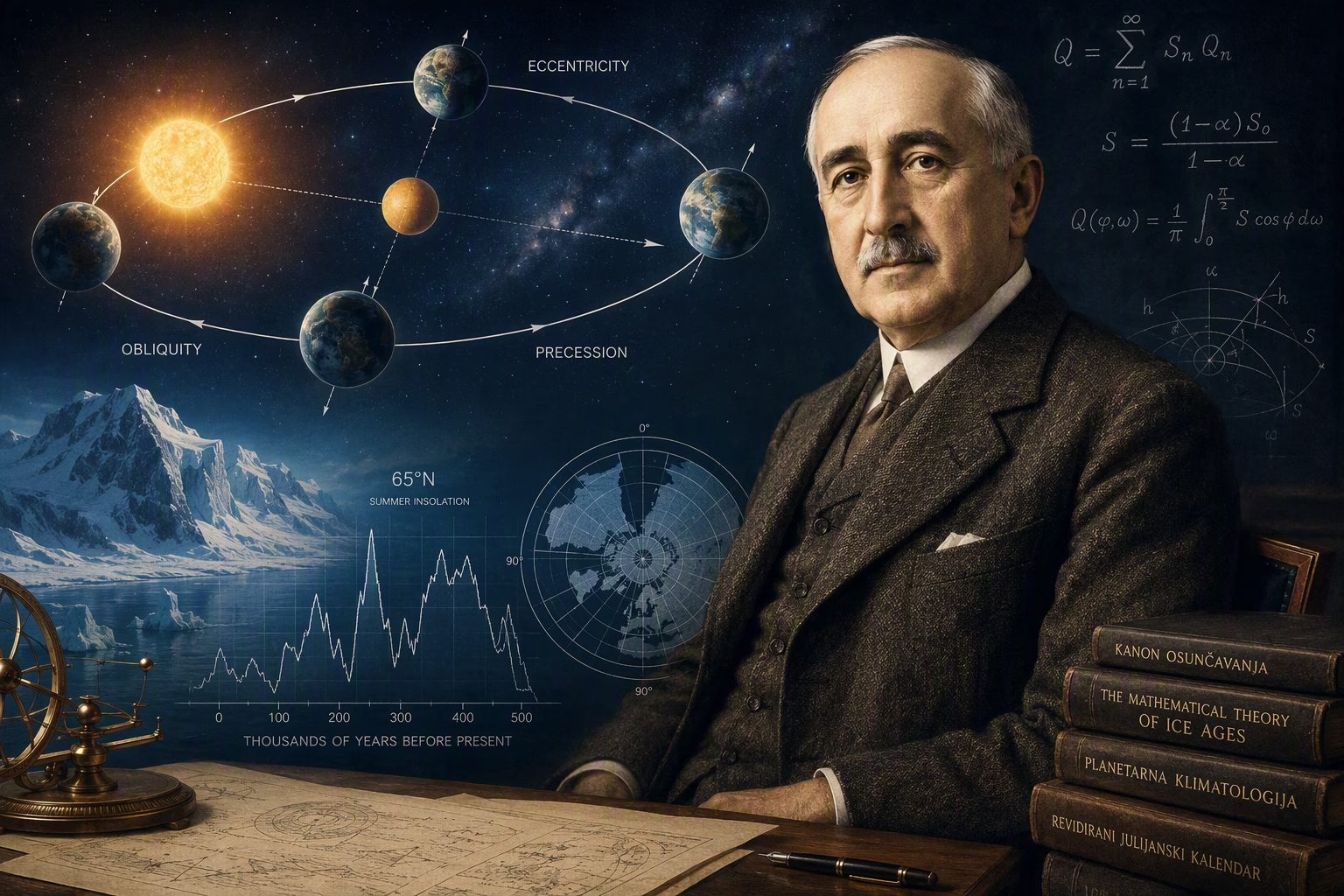
He recognized that the amount of solar energy reaching Earth is not perfectly constant over geological timescales. Instead, it is influenced by three cyclical variations:
1. Orbital Eccentricity
Earth’s orbit around the Sun is not always equally circular. Over periods of roughly 100,000 years and longer, the orbit becomes more or less elliptical.
These changes alter the distribution of solar radiation received by Earth throughout the year.
2. Axial Obliquity (Tilt)
Earth’s rotational axis changes its angle relative to its orbital plane.
The axial tilt varies approximately between 22.1° and 24.5° over a cycle of about 41,000 years. Larger tilts generally produce stronger seasonal contrasts.
3. Axial Precession
The rotational axis slowly wobbles like a spinning top.
This phenomenon alters the timing of seasons relative to Earth’s position along its orbit and affects the geographic distribution of incoming solar radiation.
The Revolutionary Insight
Milanković demonstrated that these orbital variations modify the distribution of solar energy reaching different latitudes, particularly around 65° north latitude.
He argued that summer solar radiation at these latitudes controls whether ice sheets expand or retreat. Reduced summer melting encourages glacier growth, while increased summer warming promotes ice-sheet retreat.
This elegant mathematical framework became known as the Milankovitch Theory of Climate.
Why Milanković Was Ahead of His Time
Decades Before Technology Could Confirm Him
Perhaps the most astonishing aspect of Milanković’s work is that he developed his theory without computers, satellites, deep-sea sediment cores, polar ice-core records, or modern climate models.
Using only mathematics, astronomical calculations, and physical reasoning, he computed long-term variations in solar radiation across hundreds of thousands of years.
When his ideas were first published, many scientists remained skeptical.
Yet beginning in the second half of the twentieth century, geological and oceanographic evidence increasingly revealed climatic cycles that closely corresponded to Milanković’s predictions. Deep-sea sediment records and ice-core analyses provided strong support for the role of orbital forcing in Earth’s glacial-interglacial cycles.
His theory eventually became one of the foundations of modern paleoclimatology.
Contributions Beyond Climate Science
Founder of Planetary Climatology
Milanković’s scientific influence extends far beyond Earth’s climate.
Long before space exploration became reality, he calculated thermal conditions on:
- Mercury
- Venus
- Mars
- The Moon
These pioneering studies helped establish the fields of planetary climatology and comparative planetology. His research demonstrated how mathematical physics could be applied to understand environments throughout the Solar System.
Celestial Mechanics and Geophysics
Milanković also made fundamental contributions to:
Mathematical Climatology
He transformed climate studies from a primarily descriptive discipline into a quantitatively rigorous science.
Geophysics
His research interconnected celestial mechanics and Earth sciences, enabling researchers to investigate geological events through astronomical causes.
Calendar Reform
Milanković participated in the development of the Revised Julian Calendar, one of the most accurate calendar systems ever designed.
Structural Engineering
Even while pursuing theoretical science, he continued producing influential work in reinforced concrete engineering and structural mechanics.
Milanković and Modern Climate Science
More Relevant Than Ever
In today’s era of climate research, Milanković’s work remains indispensable.
Scientific discussions about past climate change routinely reference orbital forcing and Milankovitch cycles. Modern climate models incorporate these astronomical parameters when reconstructing Earth’s climatic history over hundreds of thousands of years.
Although contemporary climate change is primarily associated with anthropogenic greenhouse-gas emissions rather than orbital variations, Milanković’s framework remains essential for understanding Earth’s natural climate rhythms and long-term geological climate transitions.
His work exemplifies how mathematics can reveal hidden patterns in nature that remain invisible through observation alone.
The Legacy of a Scientific Giant
A Serbian Scholar with Global Impact
Milutin Milanković belonged to a remarkable generation of scientists who viewed mathematics as a universal language capable of explaining natural phenomena across vast scales of time and space.
His intellectual legacy can be found in:
- Climate science
- Geophysics
- Astronomy
- Planetary science
- Applied mathematics
- Engineering
Today, his name appears in scientific textbooks, research papers, university curricula, and planetary investigations worldwide. The Milankovitch cycles have become an indispensable concept in Earth system science, and his theories continue to inspire new generations of researchers.
Conclusion
Milutin Milanković was far more than the scientist behind the Milankovitch cycles. He was a mathematician who transformed climate science, a geophysicist who connected astronomy and Earth history, an engineer who excelled in applied mechanics, and a visionary whose ideas anticipated discoveries that would not be fully confirmed until decades later.
His life demonstrates the extraordinary power of rigorous mathematical thinking. By studying the subtle motions of our planet through space, Milanković uncovered one of nature’s most profound secrets: that Earth’s climate follows rhythms written in the geometry of the heavens.
Few scientists have left a legacy as enduring, elegant, and globally influential as Milutin Milanković.