
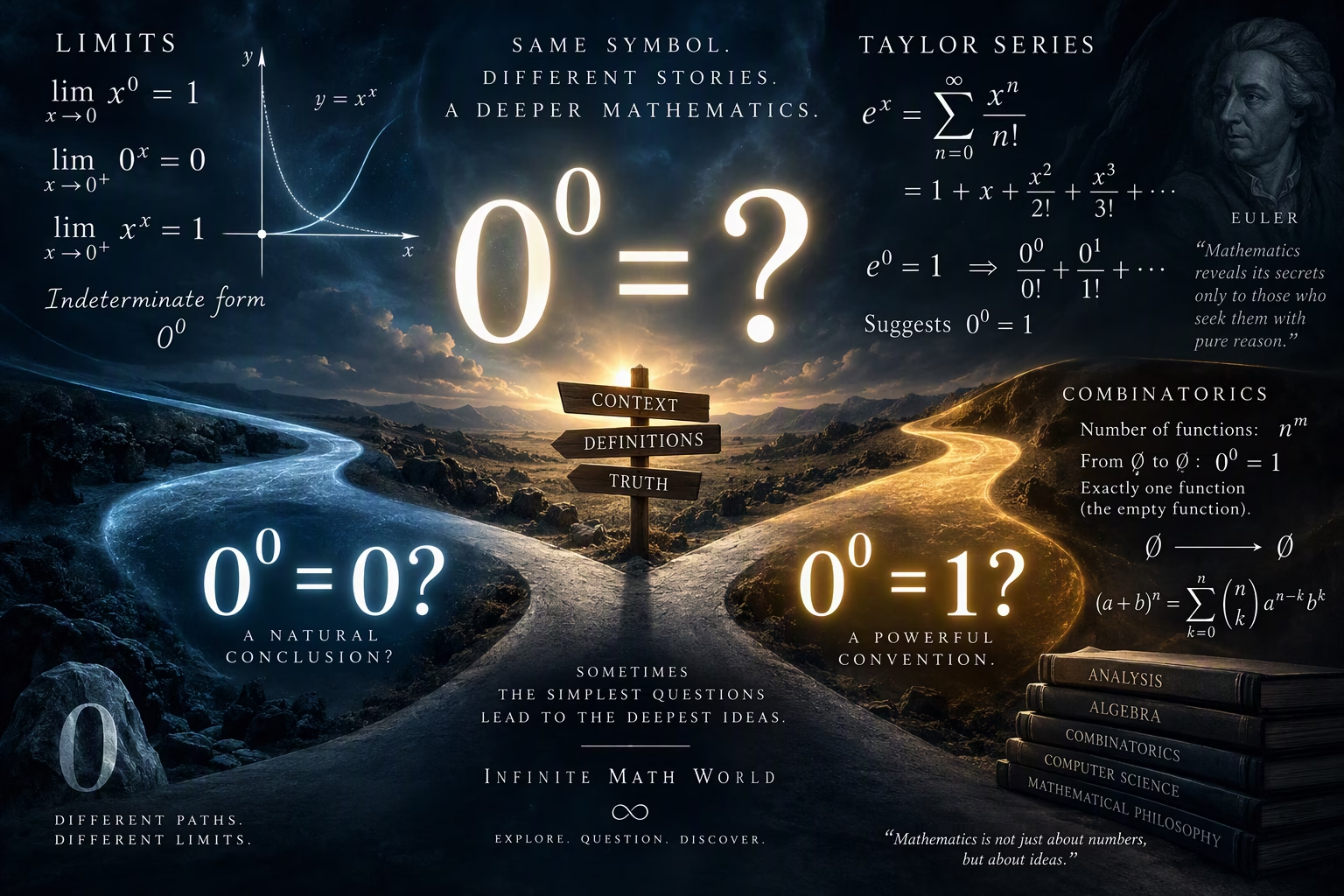
Introduction
Mathematics is often described as the science of certainty.
Unlike many other disciplines, mathematical questions are expected to have clear and definitive answers. Either a statement is true or it is false. Either a number exists or it does not. Either a formula is correct or it is not.
For this reason, most people are surprised when they encounter the seemingly innocent expression
0⁰
and learn that mathematicians have debated its meaning for centuries.
What could possibly be controversial about raising zero to the power of zero?
Some textbooks define
0⁰ = 1
without hesitation.
Others leave it undefined.
In calculus, 0⁰ is frequently classified as an indeterminate form.
Computer algebra systems and programming languages often return 1.
Meanwhile, many mathematicians insist that assigning a value to 0⁰ depends entirely on context.
How can all of these viewpoints coexist?
More importantly, how can experts disagree about an expression consisting of nothing more than two zeros?
The answer reveals something profound about mathematics itself. The controversy surrounding 0⁰ is not merely about arithmetic. It is about definitions, limits, abstraction, combinatorics, infinite series, and the surprising realization that mathematical truth is sometimes context-dependent.
To understand why, we must begin with two perfectly valid rules that appear to collide at a single point.
The Collision of Two Fundamental Rules
Rule 1: Any Nonzero Number Raised to the Power Zero Equals One
One of the most familiar identities in elementary mathematics is
a⁰ = 1
for every nonzero number a.
Examples include:
2⁰ = 1
5⁰ = 1
100⁰ = 1
10,000⁰ = 1
This rule is not arbitrary.
It follows naturally from the laws of exponents:
aⁿ / aⁿ = aⁿ⁻ⁿ = a⁰
but also
aⁿ / aⁿ = 1
Therefore:
a⁰ = 1
for every nonzero value of a.
If we continue this pattern toward zero, it seems natural to expect:
0⁰ = 1
Rule 2: Zero Raised to Any Positive Power Equals Zero
There is another familiar rule:
0ⁿ = 0
for every positive integer n.
Examples include:
0¹ = 0
0² = 0
0³ = 0
0¹⁰⁰ = 0
This pattern appears equally convincing.
If 0¹ = 0, 0² = 0, and 0³ = 0, one may be tempted to conclude:
0⁰ = 0
We immediately encounter a paradox.
One valid mathematical rule suggests 1.
Another valid mathematical rule suggests 0.
Which rule should prevail?
Why Calculus Considers 0⁰ an Indeterminate Form
The answer becomes much more subtle when limits enter the discussion.
Approaching Through the Base
Consider the function
f(x) = x⁰
For every nonzero x,
x⁰ = 1
Therefore,
lim(x→0) x⁰ = 1
This path suggests that 0⁰ should equal one.
Approaching Through the Exponent
Now consider
g(x) = 0ˣ
For every positive x,
0ˣ = 0
Thus,
lim(x→0⁺) 0ˣ = 0
This path suggests that 0⁰ should equal zero.
The Source of the Problem
The crucial observation is that different approaches toward the point (0,0) lead to different results.
When mathematicians describe 0⁰ as an indeterminate form, they do not mean that the expression is inherently meaningless.
They mean that simply knowing both the base and exponent are approaching zero does not uniquely determine the resulting limit.
The information is insufficient.
More analysis is needed.
The Famous Example of xˣ
A particularly elegant example is
f(x) = xˣ
At first glance, as x approaches zero, both the base and exponent approach zero.
One might therefore expect the behavior to be ambiguous.
Surprisingly, it is not.
ln(xˣ) = x ln(x)
As x approaches zero from the right:
x ln(x) → 0
Therefore
xˣ = e^(x ln(x)) → e⁰ = 1
Thus:
lim(x→0⁺) xˣ = 1
Here an expression of the form 0⁰ produces the value 1.
Other functions can yield entirely different results.
Some lead to 0.
Some lead to numbers strictly between 0 and 1.
This is precisely why calculus refuses to assign a universal limit value to the form 0⁰.
The Taylor Series Argument
The Hidden Role of 0⁰ in Exponential Functions
One of the strongest arguments for defining 0⁰ as 1 emerges from the Taylor series of the exponential function.
The famous expansion of eˣ is
eˣ = 1 + x + x²/2! + x³/3! + x⁴/4! + …
More compactly,
eˣ = Σ(xⁿ / n!)
Suppose we substitute x = 0.
The left side becomes:
e⁰ = 1
The right side becomes:
0⁰/0! + 0¹/1! + 0²/2! + …
Since
and every term after the first vanishes, we obtain:
0⁰
for the entire series.
For the power series representation to remain valid at x = 0, the first term must equal 1.
Therefore:
0⁰ = 1
becomes the most natural choice.
Why This Matters
This observation is not merely aesthetic.
Power series play a fundamental role throughout mathematics, physics, engineering, signal processing, and computer science.
Defining 0⁰ as 1 allows these formulas to remain elegant, compact, and universally applicable.
The Combinatorial Argument
Counting Functions Between Empty Sets
Many mathematicians regard the combinatorial argument as even more compelling than the Taylor series argument.
Suppose a set A contains m elements and a set B contains n elements.
The number of functions from A to B is:
nᵐ
Now consider the case where both sets are empty.
Then:
m = 0
n = 0
and the formula becomes:
0⁰
How many functions exist from the empty set to the empty set?
The answer is exactly one.
This unique object is known as the empty function.
Therefore:
0⁰ = 1
follows naturally from a fundamental counting principle.
For many combinatorialists, this is the decisive argument.
The Principle of the Empty Product
A Deep Algebraic Perspective
Another important idea is the concept of an empty product.
An empty sum is defined as 0.
An empty product is defined as 1.
For example:
2 × 3 × 5 = 30
If we successively remove factors, eventually no factors remain.
The consistent value of the resulting empty product is 1.
Since exponentiation may be viewed as repeated multiplication,
a⁰
represents a multiplication containing zero copies of a.
Therefore,
a⁰ = 1
for every a, including a = 0, becomes an entirely natural extension.
This perspective is widespread in abstract algebra.
Why Computer Science Usually Chooses 1
Practical Considerations
Programming languages, algebra systems, symbolic computation packages, and numerical libraries frequently define
0⁰ = 1
The reason is straightforward.
Doing so simplifies algorithms.
Polynomials become easier to evaluate.
Power series require fewer exceptions.
Mathematical software becomes more consistent.
In computer science, elegance often means reducing special cases.
Defining 0⁰ as 1 accomplishes exactly that.
A Historical Perspective
Euler’s Influence
Leonhard Euler was among the most influential advocates of the view that 0⁰ should be regarded as 1.
Throughout the nineteenth century, mathematicians debated the issue extensively.
As calculus became more rigorous, the distinction between an algebraic expression and an indeterminate limit became increasingly important.
Over time, a consensus emerged:
- In algebra and combinatorics, 0⁰ is typically defined as 1.
- In limit theory, 0⁰ is treated as an indeterminate form.
This distinction resolved much of the apparent controversy.
Why There Is No Contradiction
The most common misunderstanding is the belief that mathematicians disagree about the same question.
In reality, they are often answering different questions.
Question 1
What value should the expression 0⁰ have within algebraic and combinatorial frameworks?
A strong case exists for:
0⁰ = 1
Question 2
What is the limit of functions whose base and exponent both approach zero?
No single answer exists.
The result depends on the functions involved.
Thus:
0⁰ is an indeterminate form.
These statements are not contradictory.
They address different mathematical contexts.
Final Verdict
The debate over 0⁰ is one of the most fascinating examples of how mathematics evolves beyond simple arithmetic.
At first sight, the expression appears trivial.
Yet beneath those two zeros lie questions about limits, infinite series, combinatorial counting, algebraic structures, and the philosophy of mathematical definition.
When studying limits, 0⁰ is an indeterminate form.
When working with combinatorics, power series, abstract algebra, and many areas of computer science, defining
0⁰ = 1
is not only convenient but often mathematically natural.
Perhaps that is the real lesson.
The expression 0⁰ reminds us that mathematics is not merely a collection of numbers and formulas. It is a language whose meaning depends on context, structure, and purpose.
And sometimes the deepest mathematical ideas emerge from the simplest-looking symbols.