
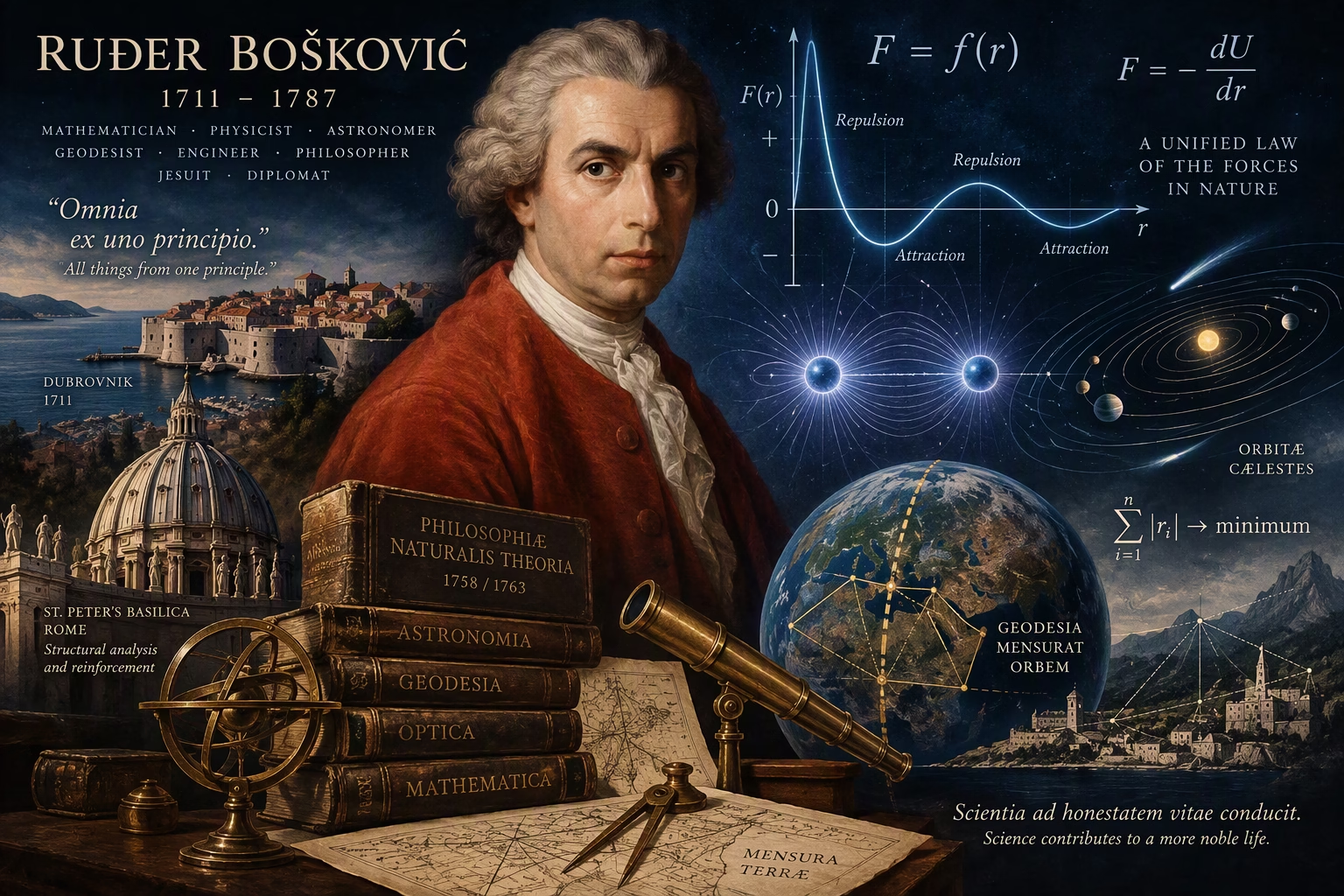
Introduction: A Thinker Between Newton and Modern Physics
Among the major scientific figures of the eighteenth century, few resist simple classification as strongly as Ruđer Josip Bošković, known internationally as Ruggiero Giuseppe Boscovich or Roger Joseph Boscovich. He was a mathematician, astronomer, physicist, geodesist, natural philosopher, engineer, instrument designer, diplomat, poet, and Jesuit priest. Yet merely listing his disciplines does not explain his historical importance.
Bošković’s deepest ambition was intellectual unification. He sought to show that the diversity of observable physical phenomena might arise from a remarkably economical foundation: point-like elements of matter interacting according to a single law of force.
That project reached its mature form in his most important work, Philosophiae naturalis theoria redacta ad unicam legem virium in natura existentium, first published in 1758 and issued in a revised and enlarged Venetian edition in 1763. Its title may be translated as A Theory of Natural Philosophy Reduced to a Single Law of the Forces Existing in Nature.
The importance of Bošković does not rest on the simplistic claim that he “discovered quantum mechanics before quantum mechanics” or “invented relativity before Einstein.” Such statements confuse resemblance with historical identity. His true achievement is subtler and, in many ways, more impressive: working within eighteenth-century natural philosophy, he constructed a radical mathematical conception of matter that departed from the ordinary picture of hard, extended atoms.
His elementary particles possessed no spatial extension. Their physical behavior was determined not by contact between solid surfaces, but by forces varying with distance.
In that respect, Bošković occupies a remarkable position between Newtonian mechanics, Leibnizian metaphysics, later field-based physics, nineteenth-century theories of matter, and the mathematical atomism of the modern age.
Who Was Ruđer Bošković
Ruđer Josip Bošković was born on 18 May 1711 in Dubrovnik, then the Republic of Ragusa, and died on 13 February 1787 in Milan. He began his education in Dubrovnik before continuing at the Jesuit Collegium Romanum in Rome, where he studied rhetoric, philosophy, and theology. He began teaching mathematics there in 1740 and was ordained a priest in 1744.
By the middle of the eighteenth century, he had established himself as a scholar capable of moving between abstract mathematics, observational astronomy, geodesy, optics, structural engineering, and diplomatic service.
His career unfolded across several European intellectual centers, including Rome, Pavia, Milan, Paris, and London. He taught mathematics at the Collegium Romanum and later at the University of Pavia, participated in the development of the Brera Observatory in Milan, and, after the suppression of the Jesuit order, continued his scientific work in France.
The Question of Bošković’s National Identity
Modern attempts to assign Bošković an exclusive national identity must be handled carefully. He was born a citizen of the Republic of Ragusa in an age before the formation of modern South Slavic nation-states. His father, Nikola Bošković, came from the South Slavic hinterland, while his mother, Paola Bettera, belonged to a family of Italian origin established in Dubrovnik. Modern sources differ in their national descriptions of his paternal background.
For an international academic article, the most historically precise formulation is therefore:
Ruđer Bošković was a Ragusan and European scientist of South Slavic and Italian family background, born in Dubrovnik and intellectually formed within the Jesuit and scientific institutions of eighteenth-century Europe.
This formulation does not deny the importance his legacy has acquired in Serbian, Croatian, Dubrovnik, Italian, or broader European intellectual history. It simply avoids projecting modern political categories uncritically onto the world of the eighteenth century.
The Scientific World Bošković Inherited
To understand Bošković’s originality, one must first understand the conceptual situation he inherited.
The success of Isaac Newton had transformed mechanics and astronomy. Newtonian gravitation explained planetary motion through an attractive force varying inversely with the square of the distance:
F(r) = −Gm₁m₂/r²
Here:
- F(r) is the gravitational force
- G is the gravitational constant
- m₁ and m₂ are the interacting masses
- r is the distance between them
- the minus sign represents attraction
Newtonian mechanics was enormously successful at astronomical scales. However, the physical constitution of matter remained philosophically difficult. If matter consisted of hard, impenetrable particles, what produced impenetrability? How did perfectly solid bodies interact during collision? Was contact itself a satisfactory explanation, or did it merely conceal a deeper mechanism?
Bošković’s response was to reject the idea that the elementary constituents of matter must be tiny extended bodies.
Instead, he proposed that the ultimate elements of matter were unextended points separated by finite distances and governed by a distance-dependent force. His system combined the point-like elements associated with the philosophical legacy of Gottfried Wilhelm Leibniz with the dynamic role of force central to Newtonian physics, while departing from both thinkers in essential respects.
Theoria Philosophiae Naturalis
Matter Without Extension
The central ontological claim of Bošković’s theory is striking:
The elementary constituents of matter are indivisible, unextended points endowed with forces.
These points do not possess ordinary size, surface, internal structure, or solid volume. Consequently, they cannot collide in the everyday sense of two rigid bodies touching one another.
Their behavior is determined by their relative positions and by the force acting between them.
In modern symbolic language, the fundamental interaction may be represented abstractly as:
F = f(r)
where r is the distance between two point-like elements.
This notation should not be mistaken for a closed analytical formula provided by Bošković. His theory was represented primarily through a qualitative force-distance curve rather than one universal algebraic expression. The curve captured the changing character of the interaction over different ranges of distance.
That distinction is important. To write F = f(r) is to express the structure of the theory, not to claim that Bošković derived a modern potential function of the kind used in contemporary atomic physics.
Bošković’s Law of Force
Repulsion at Extremely Small Distances
As the distance between two elements approaches zero, Bošković’s force becomes strongly repulsive.
Symbolically:
lim(r→0⁺) F(r) = +∞
provided that positive values are used to represent repulsion.
This divergence prevents two material points from occupying the same position. Matter therefore does not require hard, impenetrable surfaces in order to resist unlimited compression. What appears macroscopically as solidity is explained dynamically through force.
This was a profound conceptual shift.
In a rigid-particle model, impenetrability is treated as an intrinsic geometrical property of matter. In Bošković’s system, resistance to penetration results from the behavior of the force law.
Matter is not fundamentally hard. It behaves as if it were hard under certain conditions.
Alternating Attractive and Repulsive Regions
At greater distances, the force curve passes through a sequence of attractive and repulsive intervals. At certain distances, the force becomes zero:
F(r₁) = F(r₂) = F(r₃) = … = 0
These zero-force distances represent possible equilibrium separations.
However, not every equilibrium is stable. If a small displacement produces a restoring force, the equilibrium is stable. In modern mathematical language, if the interaction is described by a potential energy U(r) such that
F(r) = −dU/dr
then an equilibrium at r = r₀ satisfies
dU/dr│ᵣ₌ᵣ₀ = 0
It is stable when
d²U/dr²│ᵣ₌ᵣ₀ > 0
and unstable when
d²U/dr²│ᵣ₌ᵣ₀ < 0
These differential expressions are a modern reformulation of the equilibrium logic implicit in the force curve. They should not be presented as formulas written by Bošković himself.
Attraction at Large Distances
At sufficiently large distances, the force becomes attractive and approaches the behavior described by Newtonian gravitation.
Thus, the same general law was intended to account for:
- short-range resistance
- cohesion
- elasticity
- stable material configurations
- transitions between attraction and repulsion
- long-range gravitational attraction
Bošković hoped to explain many natural phenomena through variations of one underlying interaction rather than through a collection of unrelated physical causes.
A Unified but Not Modern “Theory of Everything”
Bošković’s project is sometimes described as an early “theory of everything.” The comparison is understandable, but it requires qualification.
He did seek a unified law from which diverse physical properties could be derived. In this methodological sense, his ambition resembles the modern search for unification.
However, his theory was not a modern unified field theory. It did not contain:
- Maxwellian electromagnetism
- relativistic spacetime
- quantum states
- wave functions
- gauge symmetries
- the strong or weak nuclear interactions
- quantum field operators
The term “theory of everything,” if used at all, should therefore be understood as a philosophical analogy rather than a literal scientific classification.
Bošković’s historical achievement was not that he secretly possessed twentieth-century physics. It was that he recognized how a large range of material properties might emerge from mathematically defined interactions among elementary entities.
Was Bošković an Atomist
The answer depends on what is meant by “atom”.
Traditional atomism often imagined atoms as extremely small but extended bodies: solid particles with definite shape and size. Bošković rejected that picture at the fundamental level.
His elements were:
- indivisible
- unextended
- mutually separated
- dynamically active through forces
He was therefore an atomist in the sense that matter had discrete elementary constituents, but not in the classical sense of hard corpuscles resembling microscopic stones.
A macroscopic body, in his system, was an organized configuration of point-like centers. Its apparent continuity and solidity emerged from the relations among those centers.
If the positions of the elements are written as
r₁, r₂, …, rₙ
a modernized expression for the total potential energy of a many-element system might be written as
U = Σᵢ<ⱼ V(rᵢⱼ)
where
rᵢⱼ = |rᵢ − rⱼ|
is the distance between the i-th and j-th elements.
Again, this is not a formula taken directly from Bošković. It is a modern mathematical representation of the relational structure of his model.
Continuity, Collision, and the Problem of Impenetrability
One of the philosophical motives behind Bošković’s system was the problem of collision.
Suppose two perfectly rigid bodies approach one another with finite velocities. If their velocities reverse instantaneously at contact, the change in velocity appears discontinuous. Bošković regarded such discontinuity as physically and philosophically problematic.
His alternative replaced an instantaneous collision with a continuously increasing repulsive force. As the bodies approach, their motion changes progressively rather than through an unexplained instantaneous reversal.
If x(t) denotes position and v(t) = dx/dt velocity, Bošković wanted physical motion to avoid a sudden jump of the form
v(t₀⁻) ≠ v(t₀⁺)
without an intervening dynamical process.
Strong short-range repulsion provided such a process. The particles decelerated, reached a turning point, and moved apart without ever occupying the same position.
The apparent impact between solid bodies was therefore reinterpreted as the visible result of invisible force interactions.
Bošković and Modern Physics: Parallels and Limits
Why His Theory Appears Modern
Several features of Bošković’s natural philosophy sound surprisingly familiar to modern readers:
- elementary constituents are point-like
- physical properties arise from interactions
- forces depend on separation
- short-range and long-range behavior differ
- stable structures correspond to equilibrium configurations
- macroscopic solidity is not fundamental
- mathematics provides the framework connecting microscopic structure with observable phenomena
These similarities explain why later physicists and historians repeatedly returned to his work.
Why He Did Not Invent Quantum Mechanics
Quantum mechanics depends on mathematical structures absent from Bošković’s theory, including state vectors, noncommuting observables, probabilistic amplitudes, quantized energy states, and wave-particle duality.
The Schrödinger equation,
iℏ ∂ψ/∂t = Ĥψ
has no equivalent in Bošković’s natural philosophy.
His elements followed a deterministic system of forces. They were not quantum particles described by a wave function ψ.
It is therefore accurate to say that his point-like elements and variable force law bear a conceptual resemblance to later interaction-based physics. It is inaccurate to claim that he formulated quantum mechanics.
Did He Anticipate Relativity
Claims connecting Bošković directly with relativity are also commonly exaggerated.
He analyzed space, time, motion, and the relational structure of matter in ways that later readers have found suggestive. Nevertheless, he did not derive either the Lorentz transformations of special relativity or the curved spacetime geometry of general relativity.
Special relativity requires relations such as
t′ = γ(t − vx/c²)
and
x′ = γ(x − vt)
where
γ = 1/√(1 − v²/c²)
General relativity is expressed through the Einstein field equations:
Gμν + Λgμν = (8πG/c⁴)Tμν
Nothing equivalent appears in Bošković’s work.
The academically defensible conclusion is that Bošković contributed to the long history of relational thinking about matter, space, and interaction. He should not be transformed retrospectively into an eighteenth-century author of Einsteinian relativity.
Contributions to Astronomy
Bošković made important contributions to both theoretical and observational astronomy.
He developed geometric procedures for determining the equator of a rotating celestial body from three observations of a surface feature and for computing an orbit from three observed positions. These procedures addressed a central problem of mathematical astronomy: how to infer the geometry of celestial motion from limited observational data.
Suppose that a celestial object is observed at three times:
t₁, t₂, t₃
with corresponding directions or positions:
r₁, r₂, r₃
The orbit-determination problem is to identify orbital parameters consistent with those observations and the assumed dynamical law.
In modern notation, a Keplerian trajectory may be described by six orbital elements:
(a, e, i, Ω, ω, M₀)
where:
- a is the semi-major axis
- e is the eccentricity
- i is the inclination
- Ω is the longitude of the ascending node
- ω is the argument of periapsis
- M₀ is the mean anomaly at a reference epoch
Bošković did not use this exact modern notation, but his geometric methods belong to the historical development of solving inverse astronomical problems from sparse observations.
He also worked on comets, planetary observations, astronomical refraction, telescopes, and the practical improvement of observational methods.
The Shape of the Earth and the Science of Geodesy
Bošković was a major eighteenth-century contributor to geodesy, the science of determining the size, shape, orientation, and gravitational properties of Earth.
Between 1750 and 1752, together with the Jesuit astronomer Christopher Maire, he conducted a scientific expedition to measure a meridian arc between Rome and Rimini. The expedition combined astronomical observation, baseline measurement, triangulation, instrument correction, and mathematical analysis. Its results were published in De litteraria expeditione per Pontificiam ditionem, accompanied by a new map of the Papal States.
Meridian-Arc Measurement
If two locations differ in latitude by an angle Δφ, and the measured surface distance along the meridian is s, then a simplified estimate of Earth’s meridional radius is
R ≈ s/Δφ
where Δφ must be expressed in radians.
For a perfectly spherical Earth, equal angular differences in latitude would correspond to equal meridional arc lengths. For an oblate spheroid, however, the length of one degree of latitude varies with geographic latitude.
A modern expression for the meridional radius of curvature is
M(φ) = a(1 − e²)/(1 − e²sin²φ)³ᐟ²
where:
- a is the equatorial semi-major axis
- e is the eccentricity of the reference ellipsoid
- φ is the geographic latitude
Bošković worked before modern reference ellipsoids, satellite geodesy, and global positioning systems, yet he confronted the same fundamental problem: converting imperfect terrestrial and astronomical measurements into a mathematical model of Earth.
A Pioneer in the Mathematical Treatment of Observational Error
One of the most underappreciated parts of Bošković’s legacy concerns the adjustment of inconsistent observations.
Real measurements do not agree perfectly. Suppose a proposed linear relation is
y = a + bx
and the observed data are
(x₁, y₁), (x₂, y₂), …, (xₙ, yₙ)
The residual for the i-th observation is
rᵢ = yᵢ − (a + bxᵢ)
In 1757, Bošković posed a line-fitting problem that can be expressed through two conditions:
Σrᵢ = 0
and
Σ|rᵢ| → minimum
He published a geometrical solution in 1760. Historians of statistics have interpreted this method as an important predecessor of least-absolute-deviations fitting and modern robust regression. Pierre-Simon Laplace later reformulated the approach analytically.
This differs from the later least-squares criterion:
Σrᵢ² → minimum
The distinction is mathematically significant.
Squaring residuals gives large deviations disproportionate influence, whereas minimizing absolute residuals is less sensitive to extreme observations. In contemporary terminology, least-absolute-deviations methods belong to robust statistics and convex optimization.
It would be anachronistic to say that Bošković possessed modern statistical theory. However, he clearly recognized a fundamental scientific problem: when observations disagree, one needs an explicit mathematical principle for combining them.
That insight places him in the early history of data fitting, error analysis, and mathematical statistics.
Structural Engineering and St. Peter’s Basilica
Bošković’s scientific expertise was not confined to theoretical problems.
When cracks in the dome of St. Peter’s Basilica in Rome raised concerns about structural stability, Bošković participated in the investigation and supported the use of iron reinforcement to stabilize the dome. The episode belongs to a broader record of his involvement in structural, hydraulic, and architectural problems.
His engineering work is important because it reveals the unity of his scientific method.
Whether he was studying:
- a planetary orbit
- a meridian arc
- a system of observational errors
- an optical instrument
- or a damaged architectural structure
he repeatedly followed the same general pattern:
- isolate the relevant physical variables
- describe their mathematical relationships
- evaluate the precision of the observations
- distinguish systematic effects from accidental errors
- seek a solution consistent with both theory and evidence
This combination of mathematical reasoning and practical judgment is one of the defining features of his scientific personality.
Optics and Scientific Instruments
Bošković also worked extensively in optics and astronomical instrumentation. He investigated telescopes, the dispersion of light, observational errors, and methods of improving optical measurement. He designed or proposed instruments intended to increase the reliability of astronomical and geodetic observations. His career later included responsibility for optical work connected with the French Navy.
For a prism or transparent medium, dispersion may be represented through the dependence of refractive index n on wavelength λ:
n = n(λ)
Different wavelengths are refracted by different amounts, producing chromatic separation. Although modern dispersion theory developed later, the precise measurement of such optical effects was already essential for telescope design and astronomical observation.
Bošković understood that instrumental science was inseparable from theoretical science. A mathematical theory could be no more reliable than the observations used to test it, and observations could be no more reliable than the instruments through which they were obtained.
Scientist, Diplomat, and Citizen of the Republic of Ragusa
Bošković’s scientific reputation also gave him diplomatic importance. He undertook missions connected with the interests of his native Republic of Ragusa and participated in European networks that crossed political, linguistic, and institutional borders.
This aspect of his life is not secondary to his science. Eighteenth-century scholarship depended on academies, religious orders, courts, patrons, correspondence networks, observatories, universities, and diplomatic protection.
Bošković’s career demonstrates how scientific knowledge circulated before the emergence of modern research institutions. He did not work within one national scientific system. His intellectual world extended across the Republic of Ragusa, the Papal States, the Italian universities, Habsburg territories, France, and Britain.
He was, in the strongest historical sense, a European scholar.
The Philosophical Architecture of Bošković’s Science
Unity Through Law
Bošković’s natural philosophy was guided by the conviction that nature should be explained through a small number of coherent principles.
This did not mean that all observable phenomena looked alike. Rather, it meant that apparently different phenomena might arise from different configurations and scales of the same underlying law.
In modern language, this is an emergent conception of physical properties.
Solidity, elasticity, cohesion, and resistance are not necessarily primitive properties. They may result from:
- the arrangement of elementary constituents
- the distances between them
- the force acting at those distances
- the stability of the resulting configuration
A Relational Conception of Matter
Because Bošković’s elementary points had no extension, their physical significance depended on their relations.
An isolated point without interaction would possess almost none of the properties associated with material bodies. Physical structure arose through distance, position, force, and configuration.
A two-element relation may be symbolized as
Fᵢⱼ = f(rᵢⱼ)
while a many-element system can be described through the collection
{r₁, r₂, …, rₙ}
and the network of pairwise distances
rᵢⱼ = |rᵢ − rⱼ|
This is one reason Bošković’s theory remains philosophically interesting. It treats matter not as passive substance carrying an inventory of fixed qualities, but as a structured system whose observable properties arise dynamically.
Bošković’s Influence and Historical Reception
Bošković’s theory did not become the standard physical theory of the eighteenth or nineteenth centuries. It nonetheless attracted attention from scientists and philosophers interested in the nature of matter, force, continuity, and physical explanation.
His importance lies partly in the alternative path he opened.
Instead of explaining nature through tiny mechanical objects modeled on visible bodies, Bošković proposed that the visible properties of bodies might emerge from invisible mathematical relations.
That transition from substance-centered explanation toward relation-centered explanation became increasingly important in later physics.
However, influence must be distinguished from retrospective similarity. It is historically safer to say that Bošković helped preserve and develop a force-based, mathematical conception of matter than to claim that every later theory of particles or fields descended directly from him.
What Bošković Got Right, and What Remained Speculative
A balanced assessment must recognize both the power and the limitations of his system.
Enduring Insights
Bošković correctly perceived that:
- apparent solidity need not imply fundamentally solid constituents
- microscopic interactions can generate macroscopic properties
- attraction and repulsion may belong to one mathematical framework
- equilibrium and stability are central to material organization
- accurate science requires the mathematical adjustment of observations
- instruments, measurements, and error analysis are integral to theory
- unification is a legitimate and powerful scientific goal
Historical Limitations
His system lacked:
- experimental access to atoms and subatomic particles
- a quantitative microscopic force law verified across physical scales
- electromagnetic theory
- thermodynamic and statistical-mechanical foundations
- quantum mechanics
- relativity
- modern chemistry’s account of electronic structure and bonding
The alternating sections of his force curve were theoretically ingenious, but they were not established by the type of controlled microscopic evidence required by modern physics.
His achievement was therefore primarily conceptual, mathematical, and methodological. It proposed a new way to think about matter, even though the detailed physical theory was not the one ultimately adopted by modern science.
Why Ruđer Bošković Still Matters
Bošković remains important for at least five reasons.
1. He Replaced Hard Matter with Dynamic Interaction
His theory showed that impenetrability and solidity could be explained through forces rather than assumed as irreducible properties.
2. He Sought a Unified Mathematical Physics
He attempted to derive diverse phenomena from a single distance-dependent law.
3. He Connected Theory with Measurement
His astronomy, geodesy, optics, and engineering were grounded in problems of actual observation.
4. He Contributed to the History of Data Fitting
His method of minimizing absolute residuals was an important early step toward robust regression and the mathematical treatment of inconsistent observations.
5. He Demonstrated the Unity of Scientific Practice
For Bošković, natural philosophy was not divided into isolated disciplines. Astronomy, mechanics, geodesy, optics, engineering, and mathematics were different expressions of a common search for lawful order.
Conclusion: Bošković’s Place in the History of Science
Ruđer Bošković should not be celebrated through exaggerated claims that turn him into a premature version of every later scientific genius. Such claims diminish rather than strengthen his real achievement.
He was not Albert Einstein before relativity, nor Max Planck before quantum theory. He was something historically distinct: an eighteenth-century natural philosopher who reconstructed matter as a system of unextended centers of force and pursued the consequences of that idea across physics, astronomy, geodesy, optics, engineering, and the mathematical analysis of observations.
His originality lies in the depth of that reconstruction.
Bošković understood that the world presented to the senses need not resemble the world described by fundamental theory. Solid bodies might be composed of entities without extension. Contact might be an effect of repulsion. Material properties might emerge from equilibrium configurations. Measurement errors might require mathematical optimization rather than arbitrary judgment.
These were not isolated technical suggestions. Together, they formed a coherent scientific vision.
That vision did not contain modern physics in completed form. It did, however, challenge the mechanical imagination of its age and demonstrate that nature could be conceived at a deeper level through points, relations, forces, and mathematical laws.
For that reason, Ruđer Bošković deserves recognition not merely as a versatile scholar from Dubrovnik, nor only as a precursor to later theories, but as one of the most original architects of eighteenth-century mathematical natural philosophy.
Frequently Asked Questions About Ruđer Bošković
Who was Ruđer Bošković
Ruđer Bošković was an eighteenth-century mathematician, astronomer, physicist, geodesist, natural philosopher, engineer, diplomat, and Jesuit priest born in Dubrovnik in the Republic of Ragusa.
What is Ruđer Bošković best known for
He is best known for his theory that matter consists of unextended point-like elements interacting through a force that changes with distance. He also made important contributions to astronomy, geodesy, optics, scientific instrumentation, structural engineering, and the mathematical treatment of observational errors.
What was Bošković’s theory of matter
Bošković proposed that the elementary constituents of matter were indivisible points without spatial extension. These points did not touch one another but interacted through attractive and repulsive forces dependent on distance.
Did Bošković discover atomic theory
He did not discover modern atomic theory. However, he developed one of the most original premodern theories of matter, replacing extended solid atoms with dimensionless centers of force.
Did Bošković anticipate quantum mechanics
Some aspects of his theory resemble modern interaction-based descriptions of matter, particularly his use of point-like constituents and distance-dependent forces. Nevertheless, his theory did not include the mathematical or probabilistic structure of quantum mechanics.
What did Bošković contribute to mathematics and statistics
Among other achievements, Bošković developed a geometric method for fitting a straight line to inconsistent observations under conditions equivalent to making the residuals sum to zero while minimizing the sum of their absolute values. This method is regarded as a precursor to least-absolute-deviations regression.
Why is Bošković important today
He remains important because he developed a relational and dynamic theory of matter, pursued the mathematical unification of natural phenomena, and connected theoretical reasoning with precise observation, instrumentation, and error analysis.