Unlocking The Secrets Of Advanced Integrals: A Deep Dive Into Solving Complex Mathematical Problems
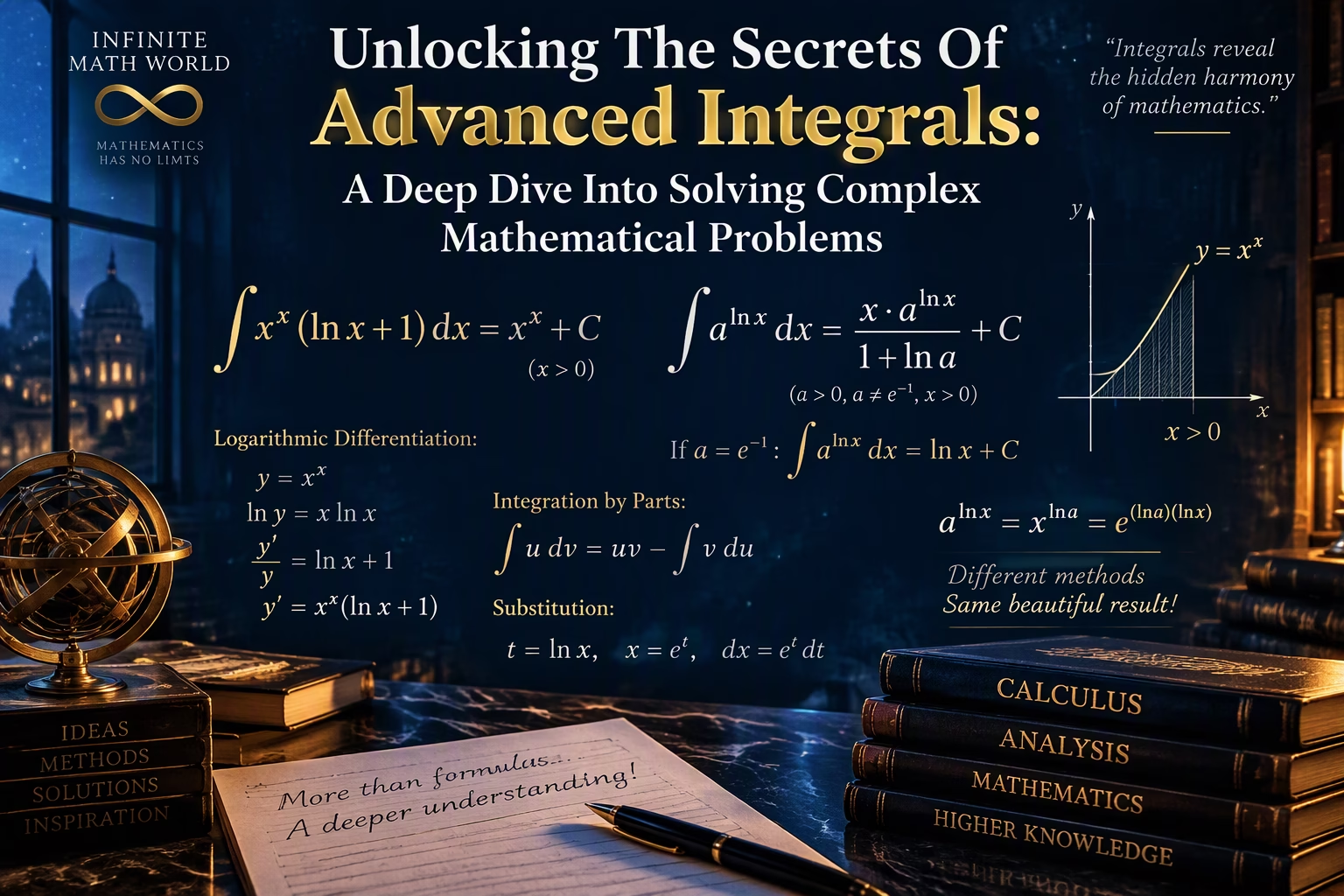
Advanced integral calculus concepts showing logarithmic differentiation, integration by parts, substitution methods, and exponential-logarithmic identities on a premium dark blue mathematical background.

Introduction Advanced integrals often appear intimidating because their solutions are not immediately visible through standard formulas. However, many seemingly difficult integrals become surprisingly elegant once their hidden structure is recognized. In calculus, successful integration frequently depends not on memorizing formulas but on identifying relationships between functions and their derivatives. This article explores two particularly instructive … Read more
Understanding Why The First Derivative Of Arctan(x) Is 1/(1 + X²)

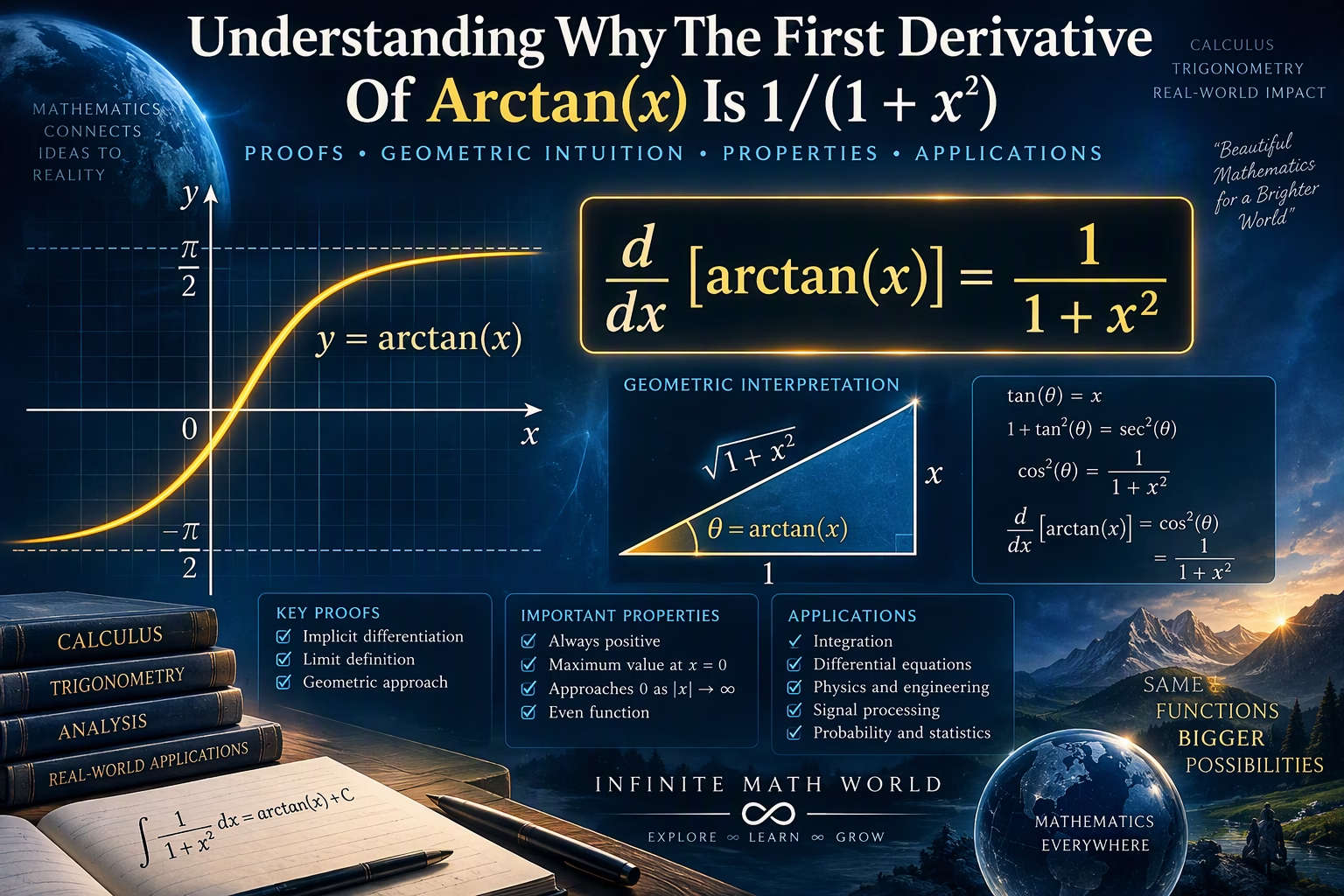
Understanding why the derivative of arctan(x) equals 1/(1 + x²), featuring the arctangent graph, implicit differentiation proof, geometric triangle interpretation, calculus formulas, and real-world applications in mathematics, physics, and engineering.

Introduction Among all inverse trigonometric functions, arctan(x) holds a special place in calculus. Its derivative, d/dx [arctan(x)] = 1/(1 + x²) appears throughout mathematics, physics, engineering, probability theory, and signal processing. Although most students memorize this formula from a table of derivatives, understanding why it is true provides deeper insight into inverse functions, implicit differentiation, … Read more

Ultimate Guide To Power Factor Correction

Illustration of power factor correction with phasor diagram, capacitor bank, and digital power meter showing improved PF for efficient energy use in industrial and renewable systems.

Introduction Power factor correction (PFC) is essential for maximizing electrical system efficiency and reliability. By reducing reactive power and aligning voltage and current waveforms, power factor correction minimizes energy losses, lowers utility charges, and prolongs equipment life. This guide offers a deep dive into power factor fundamentals, detailed mathematical derivations, practical correction methods, and cutting‑edge … Read more

The Number e: Exploring Its Definitions, Properties And Significance

Glowing symbol of Euler’s number e surrounded by formulas and real-world applications like exponential growth, compound interest, probability distributions, and calculus, representing its significance in mathematics and science.

Euler’s number (or Napier’s constant), e ≈ 2.718281828459045, is one of mathematics’ most important constants. Like π, it appears in diverse fields, from finance to physics. This blog post dives into its mathematical definitions, fascinating properties, and real-world relevance. What is Euler’s Number e The number e is the base of natural logarithms and a cornerstone of … Read more

Why Can Cos(i) Be Greater Than 1? Exploring Complex Trigonometry

Complex plane illustration showing cos(i) ≈ 1.543, with Euler’s formula and exponential cosine equation, exploring how cosine exceeds 1 for imaginary inputs in complex trigonometry.

Have you ever wondered if trigonometric functions like cosine can exceed 1? In school, we’re taught that cos(θ) and sin(θ) for real angles θ always lie between -1 and 1. But what happens when we input a complex number like i (the imaginary unit)? Let’s dive into the fascinating world of complex trigonometry and uncover why cos(i) ≈ 1.543, defying traditional rules. Euler’s Formula: The Bridge to Complex Cosine To … Read more

Arithmetic Progression: Unveiling The Patterns In Numbers

Illustration of an arithmetic progression sequence with formulas and real-life applications like finance, physics, architecture, and scheduling. Educational visual showing AP concepts and patterns in numbers.

Arithmetic progressions (AP) are a cornerstone in algebra and have widespread applications in mathematics, finance, physics, and everyday problem-solving. This post explores the fundamental concepts, key formulas, and real-life applications of arithmetic sequences, enabling you to master AP and apply it effectively. Understanding Arithmetic Progression What is an Arithmetic Progression An arithmetic progression (AP) is … Read more

Geometric Progression: A Comprehensive Guide To Understanding And Applying GPs

Visual representation of a geometric progression with mathematical formulas and real-world application symbols like coins, trees, and bouncing balls, illustrates the concept of exponential growth and ratio-based seque.

Geometric progressions (GPs) are fascinating sequences of numbers where each term is obtained by multiplying the previous term by a constant value, called the common ratio. They appear in diverse real-world scenarios, from compound interest and population growth to fractal geometry and the physics of bouncing balls. Understanding geometric progressions is crucial for anyone working … Read more

Mastering Mental Math: How To Quickly Calculate Squares Of Numbers

Illustration of mental math techniques for squaring numbers, featuring mathematical equations, quick squaring formulas, and numbers dynamically appearing on a digital screen.

Introduction Being able to quickly calculate the square of a number is a valuable skill that can save time and improve mental agility. Fortunately, there is a simple mathematical rule that allows for rapid squaring of numbers without the need for a calculator or written calculations. In this article, we will explore this rule, provide … Read more