The Golden Ratio Explained: Mathematics, Fibonacci Numbers, and the Golden Ratio Bridge
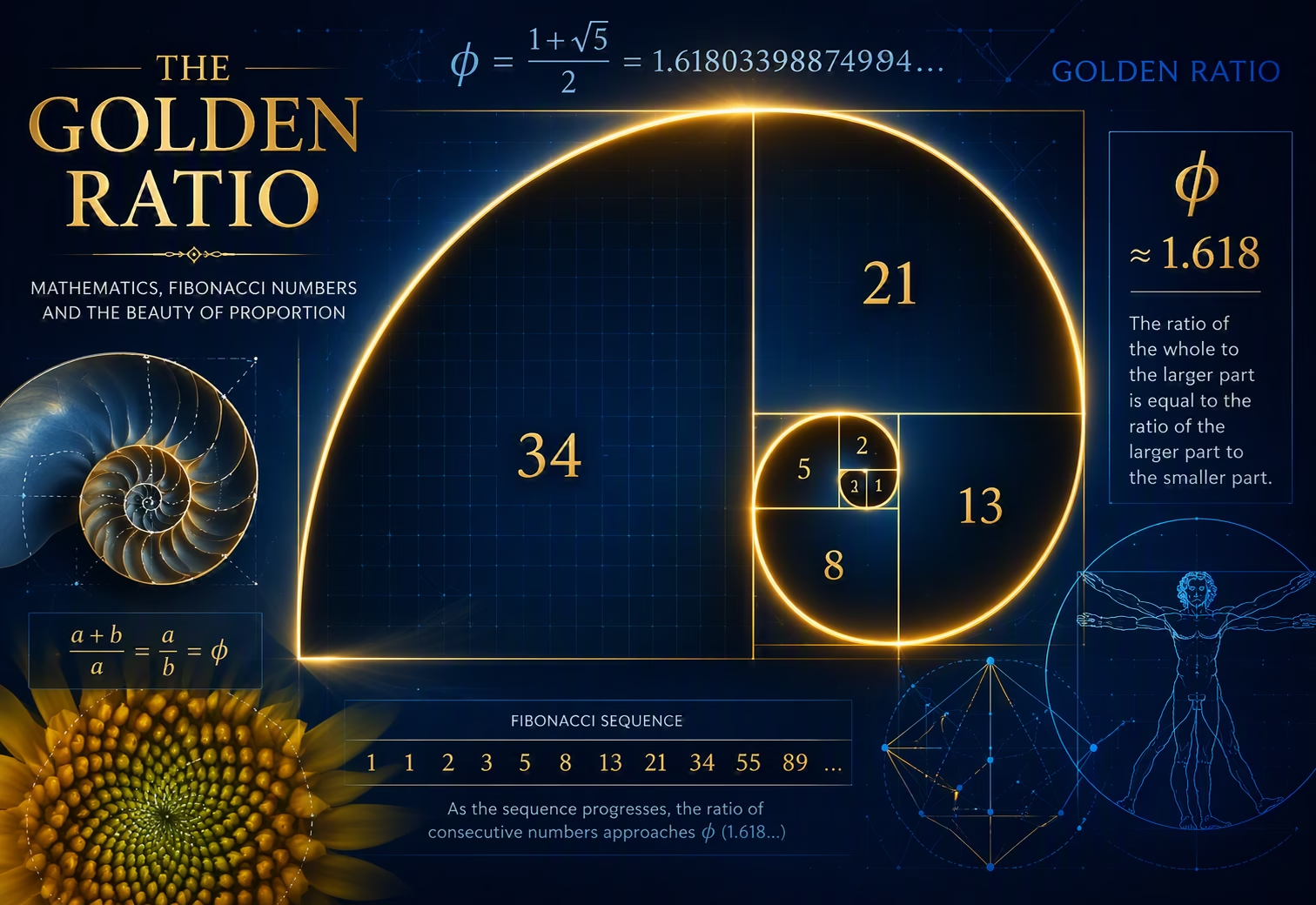
Golden ratio spiral with Fibonacci squares, showing phi 1.618 and its connection to mathematics, geometry, and patterns in nature

The Golden Ratio is one of the most fascinating numbers in all of mathematics. It appears in geometry, number theory, algebra, computer science, architecture, art, biology, and countless natural growth processes. For centuries, mathematicians, philosophers, artists, and scientists have been intrigued by its unique mathematical properties and its surprising appearance in the world around us. … Read more
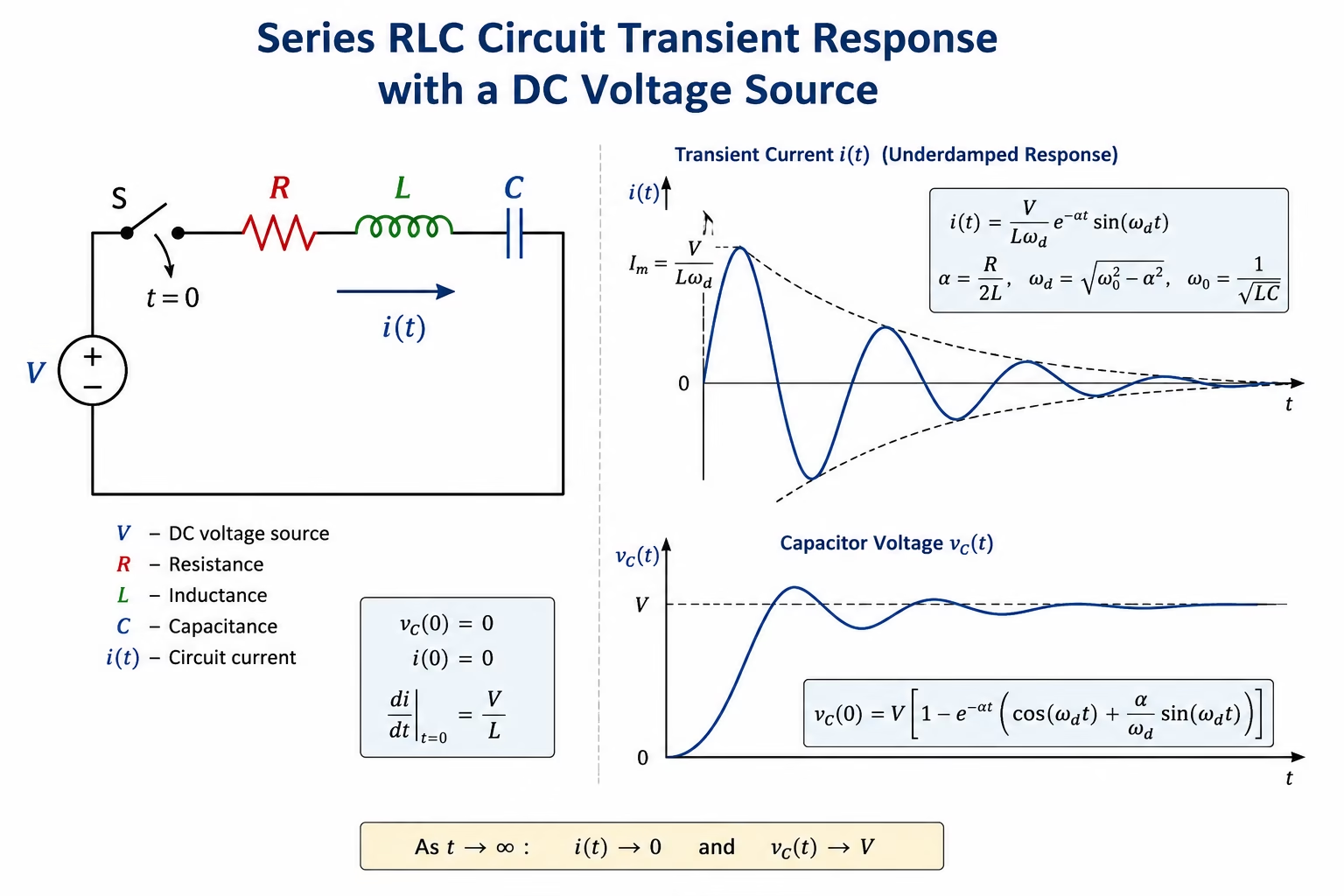
RLC Circuit Transient Response with a DC Source: Complete Mathematical Derivation

Series RLC circuit connected to a DC voltage source showing resistor, inductor, capacitor, transient current i(t), damped oscillations, and capacitor charging during the transient response

Introduction The transient response of electrical circuits is one of the fundamental topics in circuit theory and electrical engineering. While RC and RL circuits are governed by first-order differential equations, an RLC circuit contains both energy-storage elements—a capacitor and an inductor—which leads to a second-order differential equation and considerably richer dynamic behavior. Depending on the … Read more

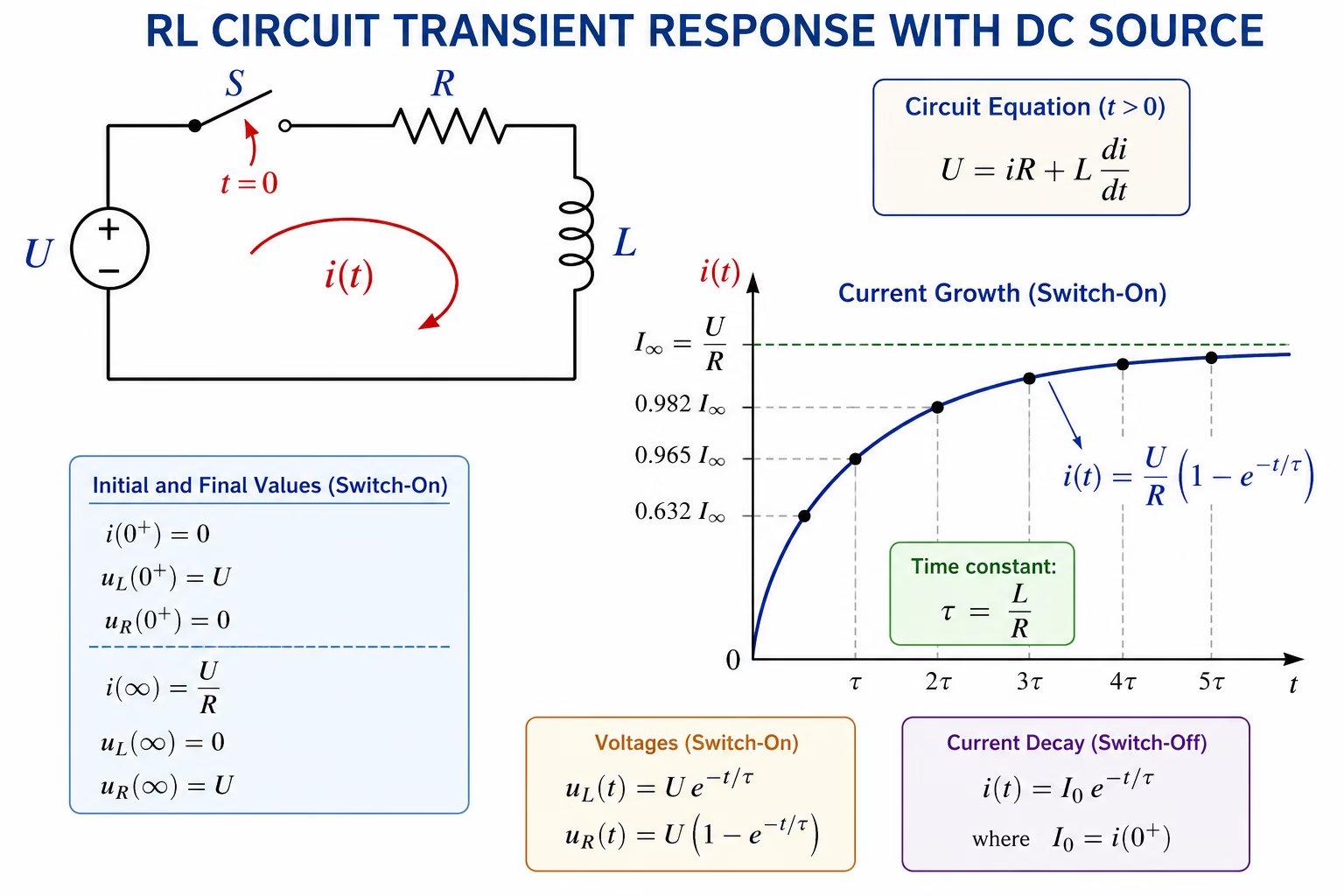
RL Circuit Transient Response with a DC Source: Complete Theoretical Analysis and Formula Derivation

Series RL circuit with DC voltage source U, switch S, resistor R, and inductor L, showing exponential current rise i(t) and the time constant τ during transient response

Introduction The transient behavior of electrical circuits is one of the fundamental topics in electrical engineering. While resistors react instantaneously to changes in voltage and current, inductors possess the unique ability to oppose sudden changes in current due to their magnetic field energy storage. As a consequence, whenever a DC source is connected to or … Read more

Transient Process in RC Circuits with a DC Source: Complete Analytical Derivation of Switching Behavior

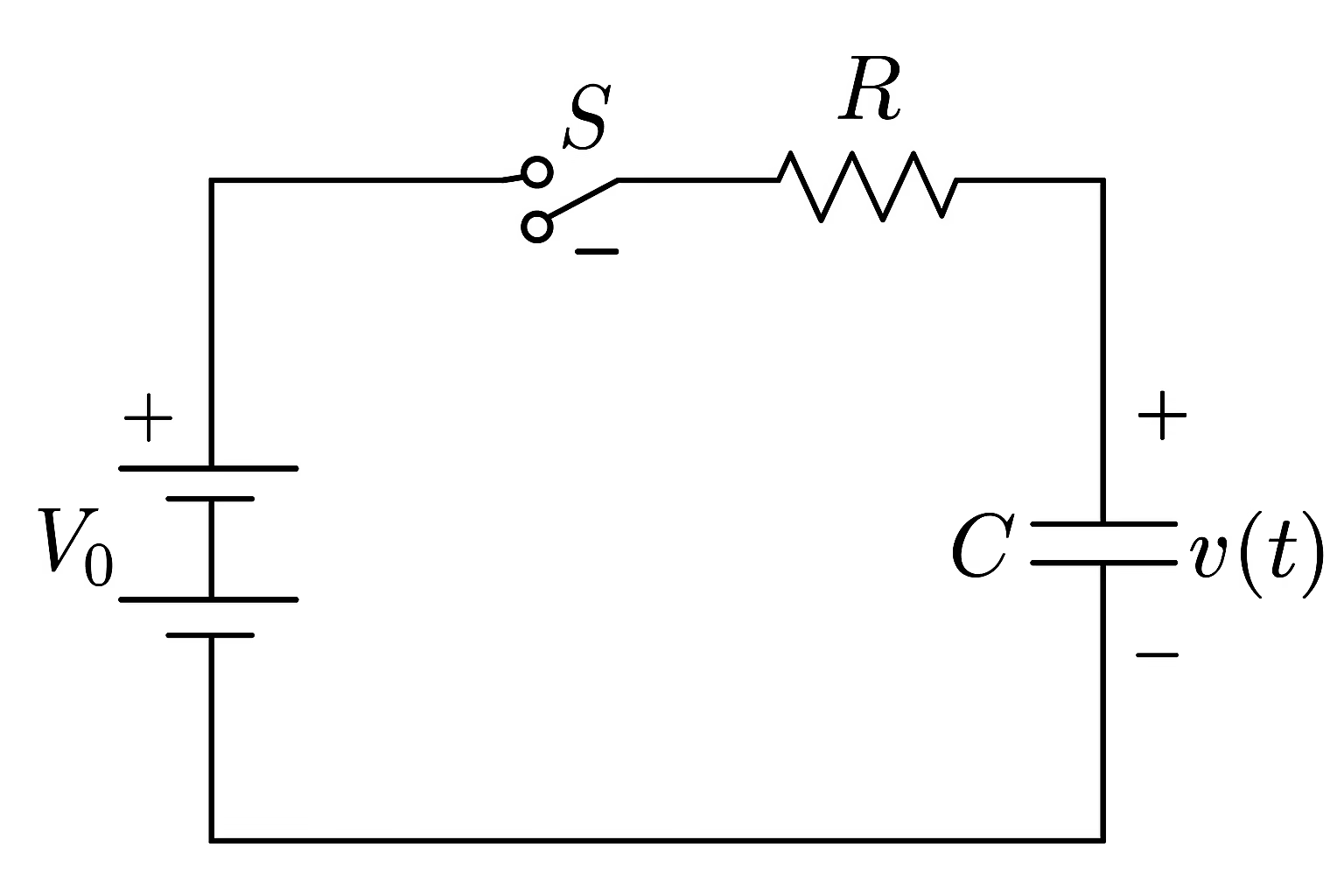
RC circuit diagram showing a DC voltage source, switch, resistor, and capacitor with labeled components, illustrating capacitor charging and discharging transient processes over time

Abstract The transient response of resistor-capacitor (RC) circuits under direct current (DC) excitation represents a fundamental topic in electrical engineering and applied physics. This article provides a rigorous, and fully derived of the charging and discharging processes, emphasizing formulas, physical interpretation, and engineering relevance. Introduction RC circuits are first-order linear dynamic systems whose transient behavior … Read more

Bayes’ Theorem Explained: Why a 99% Accurate Test Can Still Be Wrong

Infographic explaining Bayes’ theorem showing why a 99 percent accurate test can result in only a 50 percent probability

Statistics surround us every day. We encounter percentages, probabilities, survey results, economic indicators, and medical studies in news reports, social media posts, advertisements, and political debates. Because numbers appear objective and scientific, many people accept them without questioning what they actually mean. However, statistics can be surprisingly misleading when presented without context. A single percentage … Read more

Why the Equation 1^x = -1 Has No Real Solution

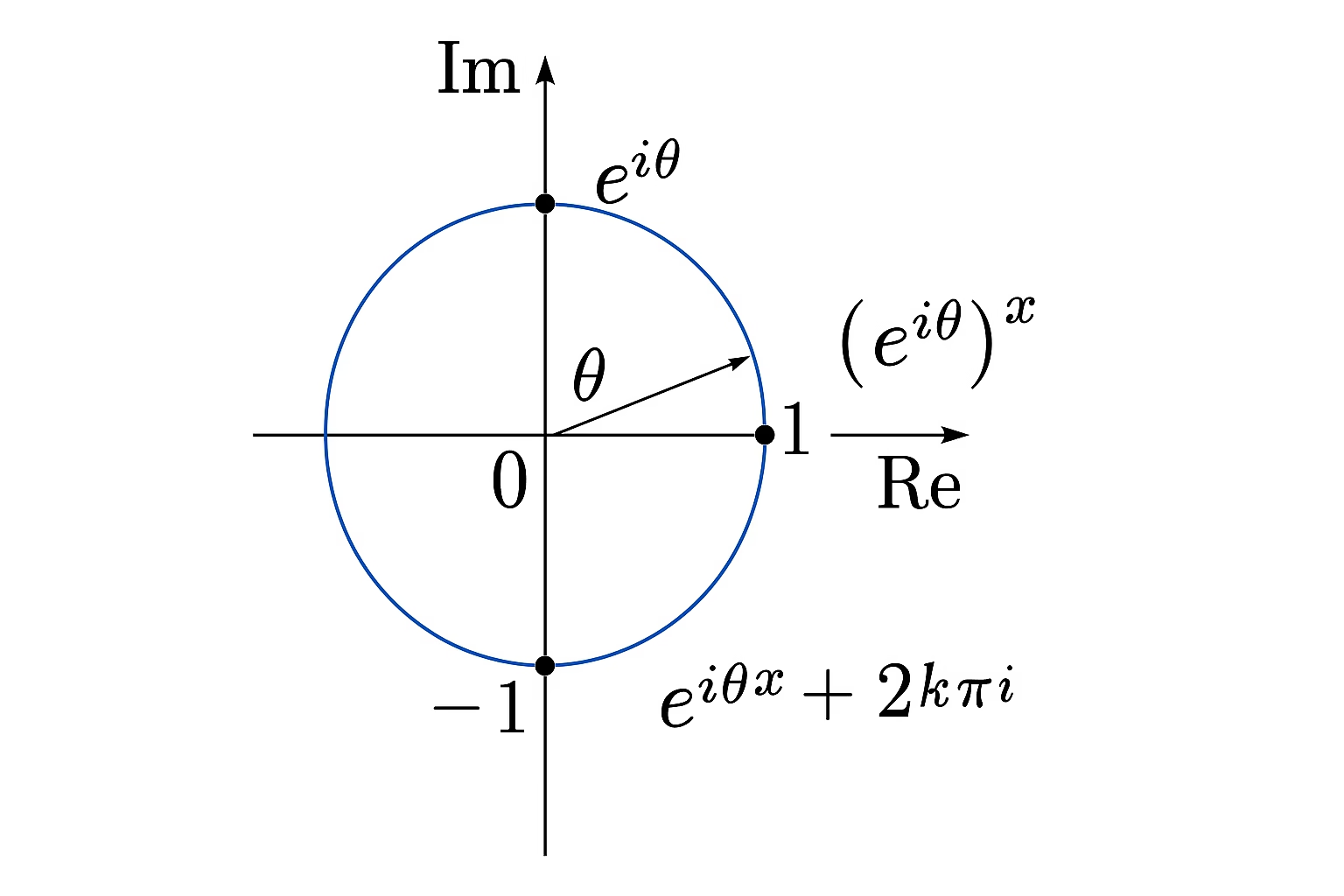
Unit circle in the complex plane illustrating Euler’s formula e^(iθ), complex exponentiation, and multi-valued logarithm leading to the 1^x = -1 paradox

Resolving a Famous Mathematical Paradox In a previous article, we explored a surprising argument suggesting that the equation 1^x = -1 might have infinitely many solutions. But is that really true? 👉 If you haven’t read it, you can find it here:LINK_TO_OLD_ARTICLE In this follow-up, we take a deeper look and uncover what actually went … Read more

Unveiling The Enigma Of „i“: Exploring The Imaginary Unit

A glowing lowercase "i" in a starry blue cosmic background with swirling complex numbers and wave patterns, symbolizing the imaginary unit in math and science.

The Genesis of „i“: When Real Numbers Fall Short Mathematics, in its elegance, often presents us with intriguing puzzles. Sometimes, equations arise that simply don’t have solutions within the familiar realm of real numbers. Consider, for instance, the seemingly simple equation x2 + 1 = 0. If we attempt to solve it, we quickly arrive … Read more

Mastering The Distance: How To Calculate The Distance From A Point To A Line

Diagram showing how to calculate the shortest distance from a point to a line using perpendicular projection on a 2D coordinate grid, featuring labeled point A, line y = kx + n, and the geometric distance formula.

Unveiling the Geometric Powerhouse: Distance from a Point to a Line Formula Explained Understanding how to calculate the distance from a point to a line is a fundamental concept in geometry with wide-ranging applications in mathematics, physics, engineering, and computer graphics. Whether you’re a student grappling with coordinate geometry or a professional looking to refresh … Read more

Unraveling The Catenary: Calculating Distance Between Suspension Poles

Mathematical illustration of a catenary curve formed by a cable suspended between two tall poles, with the curve labeled using a coordinate system and hyperbolic function equation.

Mastering the Math Behind Hanging Cables: A Deep Dive into Catenary Curves Have you ever wondered about the precise distance between two suspension poles, like those holding power lines or bridge cables? It’s not as simple as drawing a straight line! The curve formed by a hanging cable, under its own weight, is a special … Read more